


























Views
Downloads
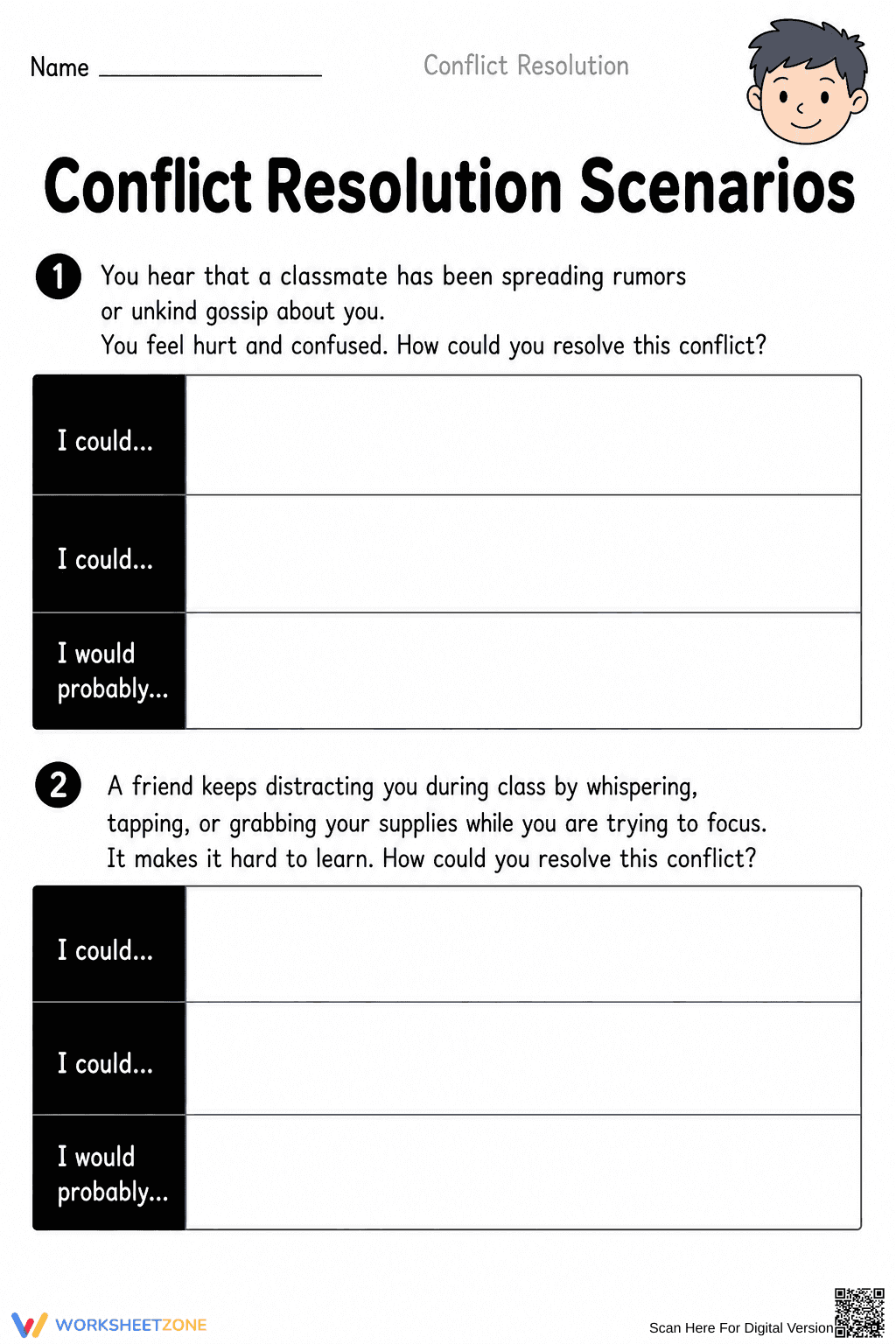

Grade 3-4 Conflict Resolution — Printable No-Prep Worksheet
Paste this activity's link or code into your existing LMS (Google Classroom, Canvas, Teams, Schoology, Moodle, etc.).
Students can open and work on the activity right away, with no student login required.
You'll still be able to track student progress and results from your teacher account.
This Grade 3 and 4 conflict resolution worksheet empowers students to navigate complex social interactions through written reflection. By analyzing realistic peer-to-peer challenges like gossip and distractions, learners develop the critical thinking skills necessary to de-escalate tension and maintain positive relationships. It provides a structured framework for brainstorming multiple prosocial solutions before committing to action.
At a Glance
- Grade: 3-4 · Subject: Social Skills
- Standard:
CCSS.ELA-LITERACY.W.3.1— Write opinion pieces on topics, supporting a point of view with reasons- Skill Focus: Conflict resolution and social problem-solving
- Format: 1 page · 2 scenarios · Open-ended responses · PDF
- Best For: SEL lessons and restorative circles
- Time: 15–20 minutes
The worksheet features two high-interest scenarios: one involving peer gossip and another focusing on classroom distractions. Each scenario is paired with three specific writing prompts—"I could...", "I could...", and "I would probably..."—to encourage divergent thinking. This single-page PDF is designed for immediate use, requiring no additional materials or teacher preparation.
Zero-Prep Workflow
- Print: Generate copies of the single-page PDF for your entire class or small group (30 seconds).
- Distribute: Hand out the worksheet during a morning meeting, SEL block, or as a quiet reflection activity (1 minute).
- Review: Facilitate a brief group share-out to review the various strategies students proposed for each conflict (10 minutes).
Total teacher preparation time is under 2 minutes, making this an ideal choice for substitute plans or unexpected schedule shifts.
Standards Alignment
This resource is primarily aligned with `CCSS.ELA-LITERACY.W.3.1`, which focuses on writing opinion pieces that support a point of view with clear reasons. Students must evaluate a social conflict and justify their proposed resolution. Additionally, it supports CCSS.ELA-LITERACY.SL.4.1 by providing the written foundation for collaborative classroom discussions. Both standard codes can be copied directly into lesson plans, IEP goals, or district curriculum mapping tools.
How to Use It
Use this worksheet during a Tier 1 SEL instruction block to introduce the concept of "Stop, Think, Act." It serves as an excellent formative assessment tool; observe whether students can generate more than one prosocial solution for each conflict. Expect students to complete the writing portion in approximately 15 to 20 minutes, followed by a peer discussion to compare different resolution styles.
Who It's For
This resource is tailored for general education students in grades 3 and 4, but it is also highly effective for small-group counseling or students with IEP goals related to social-emotional regulation. It pairs naturally with a "Conflict vs. Bullying" anchor chart or a direct instruction lesson on "I-statements." The open-ended nature allows for natural differentiation based on student writing ability.
Social-emotional learning (SEL) interventions, particularly those focusing on conflict resolution, are critical for developing prosocial behavior in middle childhood. According to the RAND AIRS 2024 report on school-based interventions, structured reflection on social scenarios significantly improves a student's ability to internalize problem-solving frameworks. This worksheet aligns with CCSS.ELA-LITERACY.W.3.1 by requiring students to provide written reasoning for their chosen social actions. By engaging with two distinct peer-conflict scenarios—gossip and classroom distractions—students practice perspective-taking and consequence-mapping. Research from Fisher & Frey (2014) suggests that providing sentence frames like "I could..." supports cognitive load management during complex social reasoning tasks. This resource provides a practical application of these principles, allowing educators to assess social intelligence through written evidence. The 2-scenario format ensures that students remain focused while producing high-quality, reflective responses that can be used for formative assessment or as a springboard for restorative justice circles within the classroom environment.


