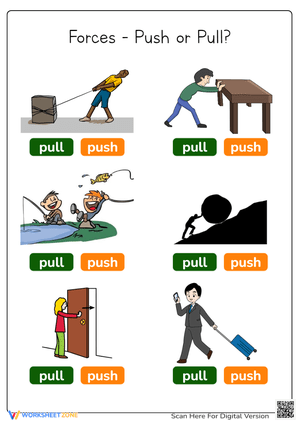
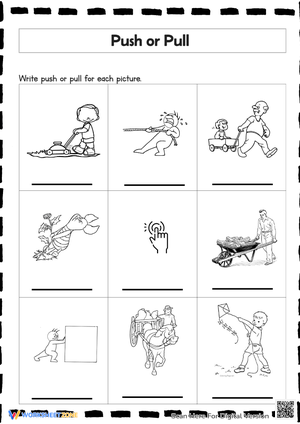
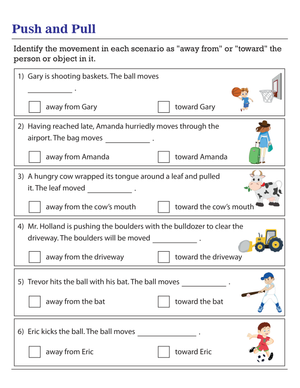
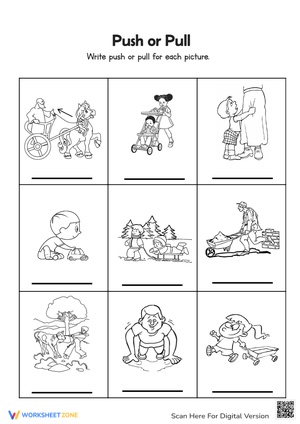
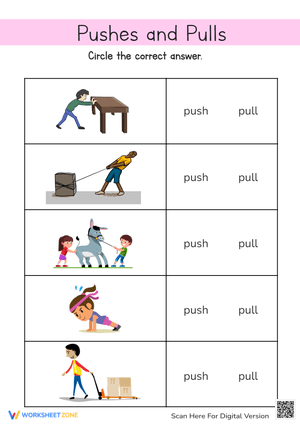
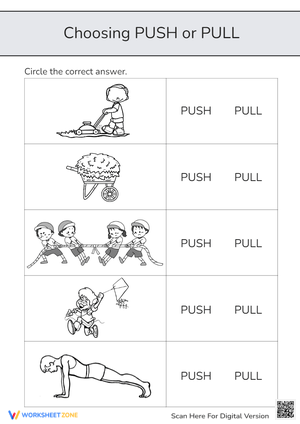
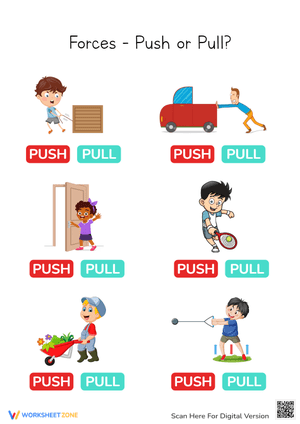
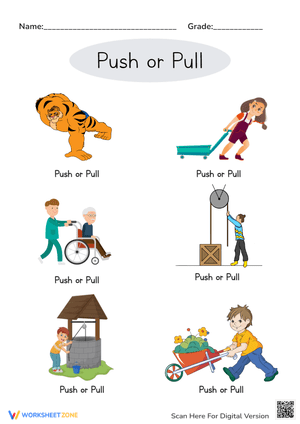
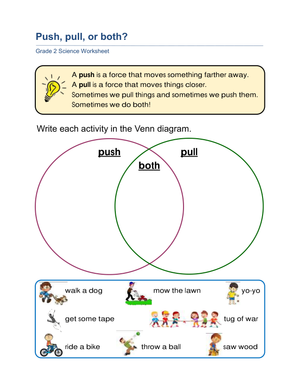
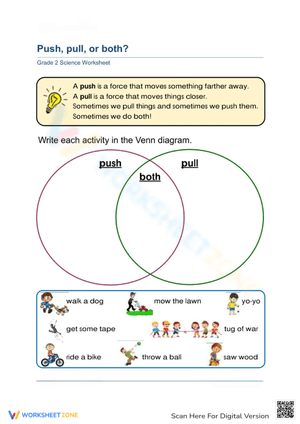
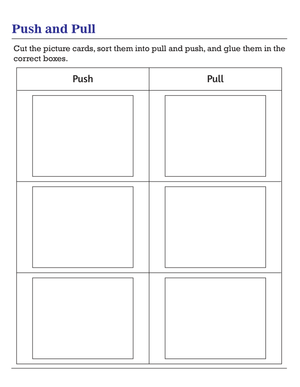
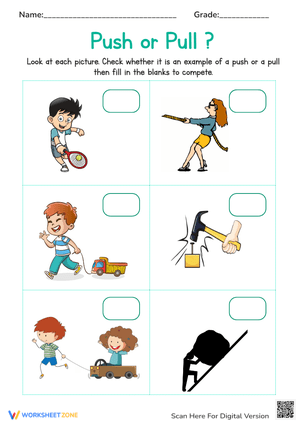
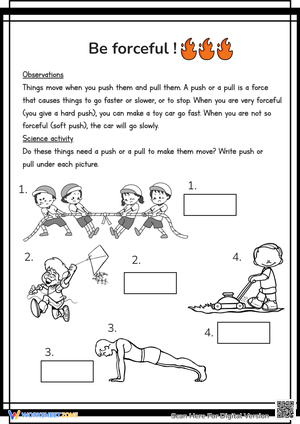
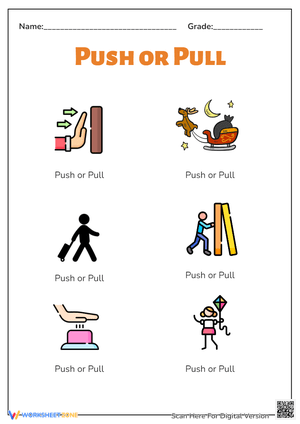
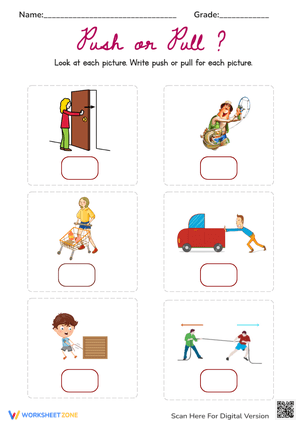
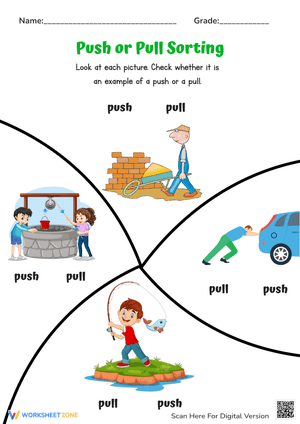
These 2nd grade push and pull printable worksheets give teachers a concrete entry point into early physical science — a unit where students often arrive convinced they already understand the concept, right up until a sorting task with a sliding window or a revolving door makes them reconsider. The set covers core vocabulary, force-comparison reasoning, and real-world identification tasks, moving from simple sorting into more demanding written-response work. Teachers get a range of formats they can deploy across whole-group instruction, science centers, and quick formative checks.
The Skills Each Worksheet Targets
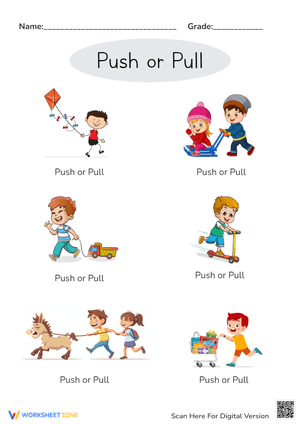
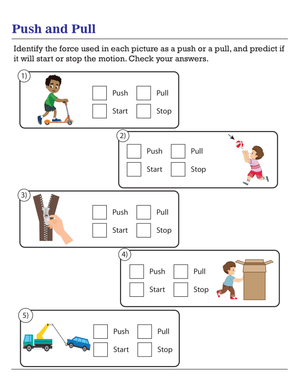
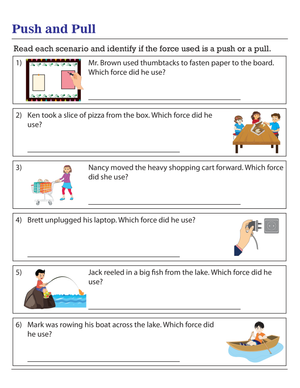
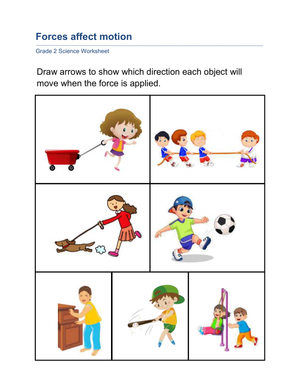
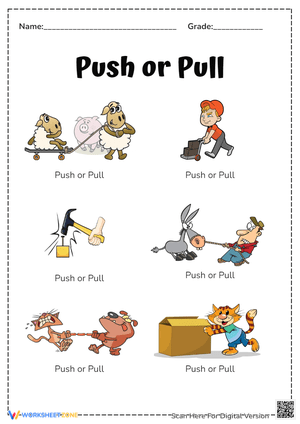
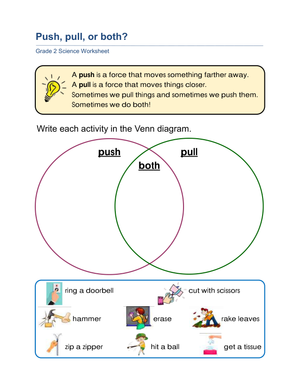
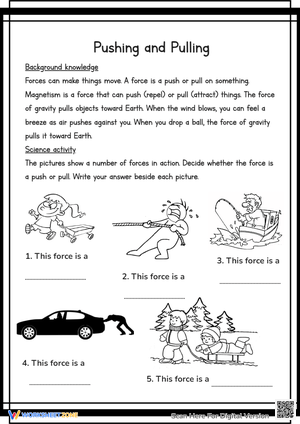
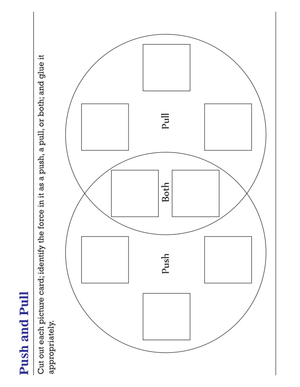
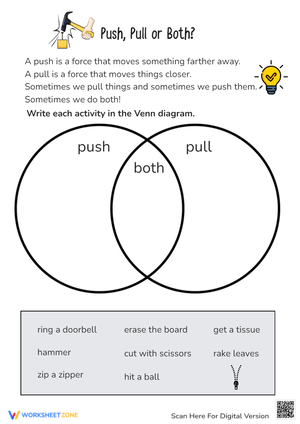
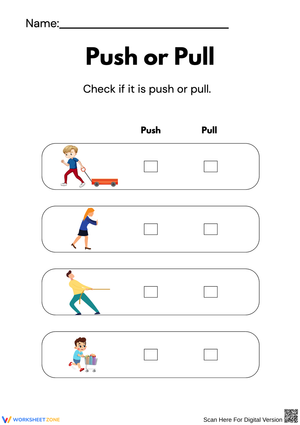
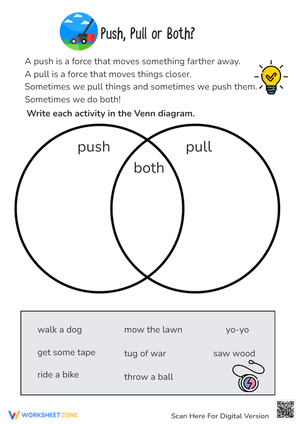
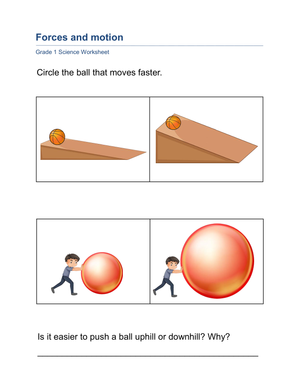
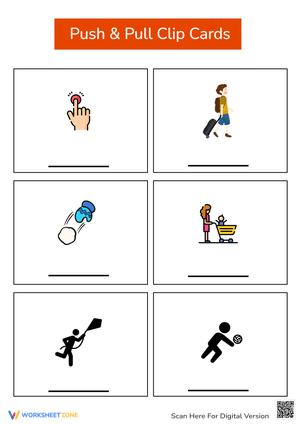
Across the set, students sort illustrated actions into push and pull categories, label forces applied in everyday scenes, and compare scenarios where force strength changes an object's speed or distance traveled. One worksheet focuses specifically on household examples — zipping a bag, sliding open a patio door, pressing a stapler — because students who correctly identify playground actions often struggle when the context shifts indoors. Another asks students to circle the stronger force in paired images, connecting force magnitude to observable outcomes before any formal measurement vocabulary appears.
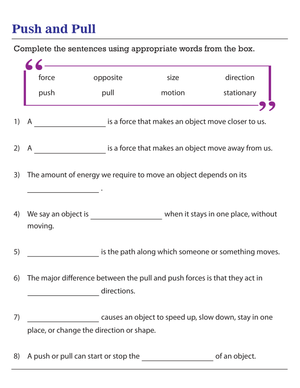
Vocabulary is woven into the exercises rather than isolated on a separate sheet. Students encounter force, direction, motion, and strength in context — labeling actions, completing sentence frames, and writing brief explanations — so the terms land in memory alongside the concept rather than as a standalone memorization task.
Errors Students Make That These Worksheets Help You Catch
The most consistent error at this level is directional confusion when both hands are involved and the object's destination feels obvious. A student correctly identifies pulling open a refrigerator as a pull, but labels "pushing a shopping cart" as a pull because the cart moves toward the store — they are tracking the object's endpoint rather than the direction of force at the point of contact. This is a meaningful developmental pattern: second graders at this stage tie force to outcome, not to action. Sorting worksheets surface it quickly because the error shows up as a systematic pattern across multiple items, not as a random guess.
A second error involves double-action objects. Scissors require a push on one blade surface and a pull on another, and some students mark both or freeze entirely. Treat that as a sign of careful thinking rather than confusion — redirect by asking "What force do your fingers apply when you close the handles?" rather than correcting the response outright. That distinction matters for instruction: a freezing student is not behind; they are reasoning about a genuinely harder case.
Fitting These Worksheets Into Your Weekly Lesson Plans
These work best following a short physical demonstration, not the other way around. Five minutes of having students push and pull actual classroom objects — a desk, a book, a door — before sitting down with a 2nd grade push and pull printable worksheets gives students a physical reference point to draw on when the illustrations feel ambiguous. Monday warm-ups are a natural slot for the simpler sorting sheets: the binary format is familiar enough that students can work independently from the first minute without any additional setup from the teacher.
Science centers are the strongest ongoing context. Laminate the cut-and-sort versions so they stay intact across multiple class groups in the same day. The true/false review sheets work well in the final ten minutes before a transition — short enough to complete in that window and useful for a quick read on where the class stands heading into the next lesson. The real-life connections worksheet travels well as a family activity: students consistently return with household examples more varied than anything the class generates on its own, because parents point to objects the school context never shows — a garage door opener, a pull-chain light, a retractable leash.
Standard Alignment
These worksheets align with NGSS 2-PS2-1 and 2-PS2-2, which ask second graders to investigate cause-and-effect relationships between the direction or strength of a push or pull and the resulting change in an object's motion. The sorting and labeling tasks build the observational groundwork those performance expectations require before students move into structured investigations. The force-comparison exercises directly support 2-PS2-1 by establishing that a larger force produces greater change in speed or direction — a relationship students need to hold clearly before they can design a fair test around it, which is the next cognitive step the standard demands.
Adjusting the Set for a Range of Learners
For students who need more structured support, use the worksheets that pair a large illustration with a binary choice. Reducing the language demand isolates the conceptual task and removes the reading barrier from what is really a science assessment. Students can demonstrate understanding of force direction without getting stuck on vocabulary they haven't fully internalized yet.
A 2nd grade push and pull printable worksheets set also adapts cleanly for small-group intervention. Pull three or four sorting sheets for a reteach session and add one physical step: students mime each action before marking their answer. That addition alone resolves the directional-confusion error for most students within a single session, because the body motion makes the direction of force impossible to misread. For students ready for a greater challenge, the written-response and force-comparison sheets are where the real stretch lives — explaining in writing why a stronger push sends a ball farther requires articulating a causal relationship, not simply categorizing an action.
Frequently Asked Questions
Do these worksheets work for students still building reading fluency?
Yes. The sorting and labeling tasks rely primarily on illustrations, so students with limited reading fluency complete most of each worksheet independently. Written-response prompts are better suited for students reading at or above grade level, or for guided work where the teacher reads the prompt aloud while the student focuses on the science thinking.
How many worksheets should I plan to use across a push and pull unit?
A standard forces unit typically runs five to seven instructional days. Using three to four worksheets across that window — one early sorting activity, one vocabulary-in-context exercise, and one or two comparison or written-response sheets — keeps practice purposeful without making it feel repetitive. Reserve one or two from the set for formative check-ins rather than assigning every one as instruction-day practice; the data from those check-ins shapes the next day's lesson more usefully than another round of guided practice would.
How do completed worksheets inform next steps in instruction?
Reviewing a 2nd grade push and pull printable worksheets for error patterns tells you more than a completion grade. Look specifically for the directional-confusion pattern — where a student consistently codes push-actions as pulls across several items. That pattern signals the student needs a physical demonstration before moving on, and it is far easier to catch on a worksheet than in a whole-class discussion where students often echo one another rather than reveal their own thinking.












 Interactive Worksheet Maker
 Quiz Maker
 Word Search Maker
 Crossword Puzzle Maker
 Word Scramble Generator
 Sentence Scramble Generator
 Handwriting Worksheet Generator
 Name Tracing Generator
 Fill In The Blank Generator