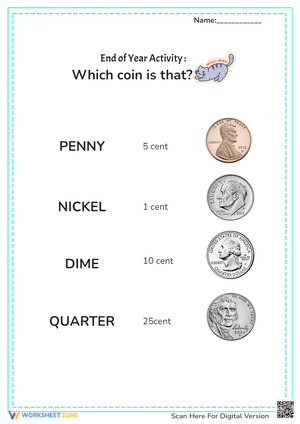
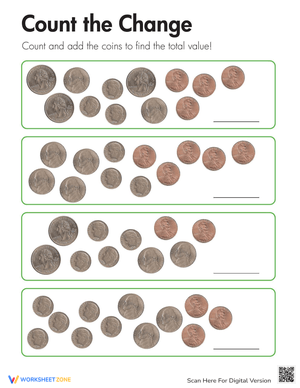
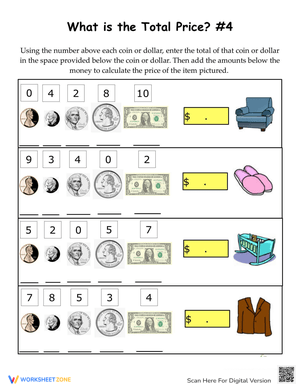
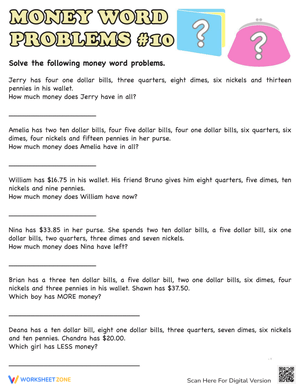
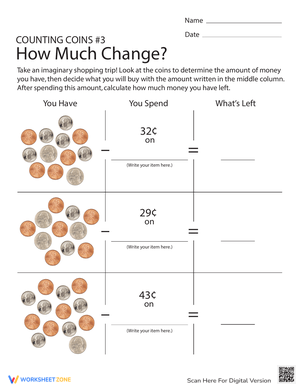
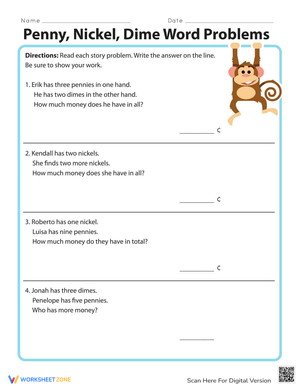
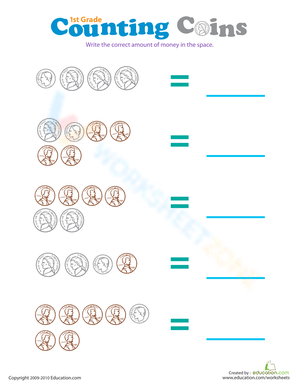
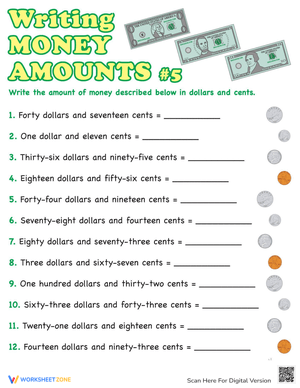
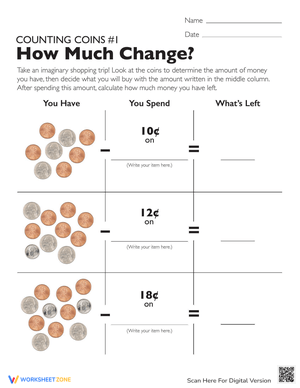
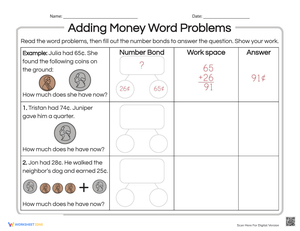
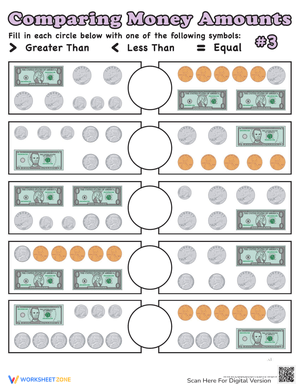
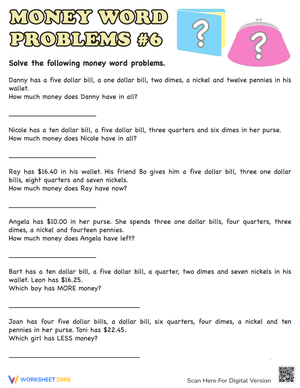
These identifying coins printable worksheets for 2nd grade give teachers a focused set of exercises—coin sorting, front-and-back matching, and attribute labeling—that move students from guessing to deliberate visual analysis. The set covers all four standard coins, with enough varied quarter reverse imagery that students don't freeze the first time a National Park design shows up instead of the classic eagle back.
What the Worksheets Ask Students to Do
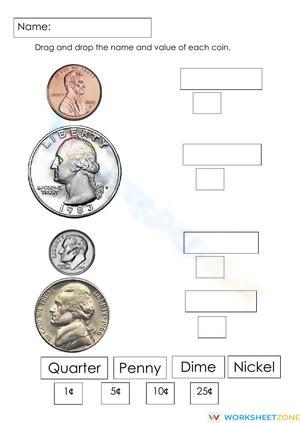
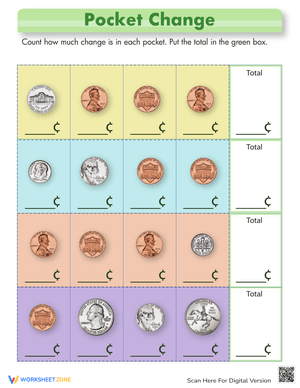
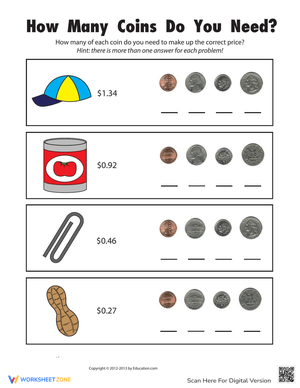
Each worksheet targets a specific layer of coin recognition rather than lumping everything into one task. Early exercises present the heads side of one coin at a time and ask students to name it, write its value, and circle its edge type from two options. Later worksheets mix all four coins—front and back—and ask students to draw lines connecting each obverse portrait to its correct reverse. One worksheet presents a row of mixed coin images and asks students to circle every dime, then separately circle every nickel, forcing them to distinguish between two silver coins rather than relying on a single memorized image.
The attribute work is where recognition becomes durable. Students label edge texture (smooth or reeded), note relative size compared to the penny, and identify the portrait on the front of each coin. Building that multi-feature habit—rather than a single shortcut like "the copper one"—is what holds up when students encounter real money outside of class.
Where Students Consistently Get Stuck
The nickel-quarter swap is the most persistent error in this unit, and it outlasts explicit instruction more than most teachers expect. Both coins are silver, both feel substantial compared to a dime, and second graders who haven't yet connected Jefferson with the nickel or Washington with the quarter are essentially guessing based on color alone. Identifying coins printable worksheets for 2nd grade that place these two coins in direct side-by-side comparison—printed at proportional sizes—make the size difference visible in a way that verbal description cannot replicate. Students who see the quarter drawn noticeably larger than the nickel on the same line start using size as a verification strategy rather than guessing by color.
The dime causes a different kind of trouble. Second graders have been building since kindergarten on the assumption that bigger means more—more blocks, more counters, more of anything. The dime breaks that rule, and students resist the correction quietly. What actually shows up in student work: a child who can correctly name the dime as "the small silver one" will still write its value as five cents on the same exercise, because the association between small size and small value is more deeply embedded than the memorized coin name. Pairing the dime image with the numeral 10 across multiple exercises—not just in a single introductory moment—is what gradually dislodges that assumption.
Quarter reverse designs add a third layer of confusion. A student who has memorized the eagle reverse will hesitate over a quarter from the American Women series. The reliable fix is training students to check the obverse: Washington's profile, the word LIBERTY, and the date are stable across all quarters regardless of what appears on the back. Teaching students to flip their analysis to the front when the back looks unfamiliar turns a confusion point into a transferable identification strategy.
Where These Exercises Fit in a Real School Week
A coin-naming or attribute task placed on desks before students arrive from morning meeting serves two purposes: it occupies the transition productively, and it gives you a fast visual scan of who is still uncertain before the main lesson begins. A student who hesitates for four seconds on a dime tells you something different from one who hesitates on every silver coin, and catching that distinction early shapes where you spend your small-group time that day.
For math centers, laminating two or three copies of the sorting and matching worksheets and supplying dry-erase markers lets the same materials run through multiple rotations without burning through paper. For cut-and-paste exercises, pre-cutting the coin images and storing them in small labeled envelopes by station means students spend center time on the sorting task rather than on scissor work. A center that asks students to sort coin images by edge type—smooth versus reeded—rather than by name alone pushes them to use a feature they cannot determine by color, which is stronger practice.
Before any session where nickel-dime comparison is the focus, passing around one real coin of each and asking students to scratch the edge with a fingernail takes about 90 seconds and changes what students look for on the printed exercise. The smooth nickel and ridged dime edge are immediately distinct to the touch, and students who have felt that difference start actively hunting for the visual representation of those ridges on their worksheet rather than defaulting to "both are silver."
Standard Alignment
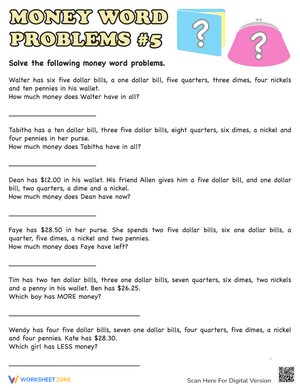
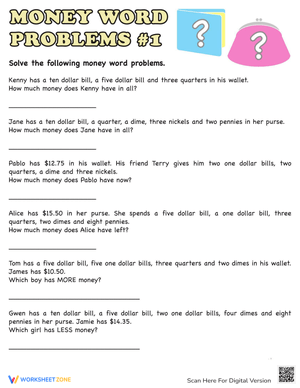
Identifying coins printable worksheets for 2nd grade at this level connect directly to CCSS.MATH.CONTENT.2.MD.C.8, which requires students to solve word problems involving dollar bills, quarters, dimes, nickels, and pennies using dollar and cent symbols appropriately. That standard assumes coin identification is already fluent—students cannot write "$0.10" correctly in a word problem solution if they are still uncertain which coin the problem is naming. Teachers regularly find that students struggle with the MD.C.8 computation tasks not because the addition is difficult, but because coin uncertainty slows down the reading of the problem itself. Working through the identification exercises first removes that obstacle before the counting and combining work begins.
Adjusting the Work for Students at Different Starting Points
Students who need more support benefit from pairing each worksheet with a physical coin or a laminated reference card showing both sides of all four coins at actual size. Some students need to compare directly rather than retrieve from memory, and that is a reasonable support at this stage. It is also worth separating the coins entirely at first for students who struggle with mixed practice—only pennies on one worksheet, only nickels on another—before introducing mixed-coin exercises.
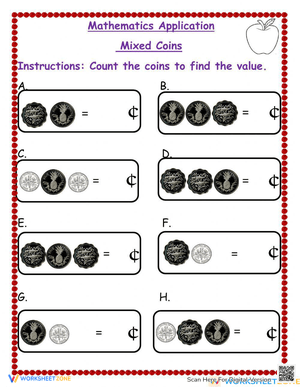
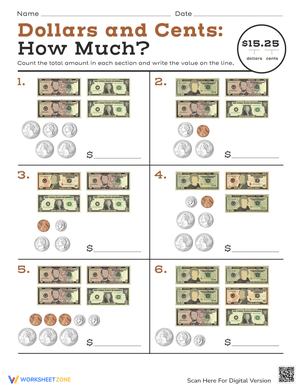
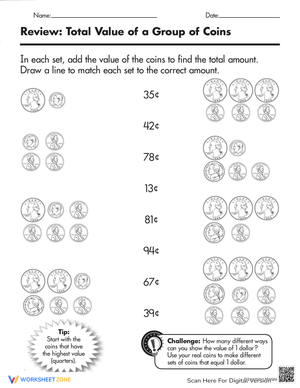
Students who move through basic identification quickly need a different kind of stretch. Give them a mixed set of coin images and ask for the total value rather than just the names, which pushes directly into MD.C.8 territory and uses identification as a tool rather than an endpoint. For the most advanced students in the group, presenting an unfamiliar quarter reverse—something from a recent series they haven't yet encountered—and asking them to argue, in writing or verbally, why it is still a quarter based solely on the front side turns a recognition task into something closer to evidence-based reasoning.
Frequently Asked Questions
How do I help students who keep swapping the nickel and the quarter?
Size comparison works better than verbal explanation alone. On a well-printed worksheet, the quarter's diameter is visibly greater than the nickel's, and directing students toward that gap—rather than toward color—gives them a feature that actually distinguishes the two. Adding edge texture as a second check (the quarter has a reeded edge; the nickel is smooth) gives students two independent attributes to verify, which reduces guessing considerably compared to relying on a single cue.
Should second graders learn to recognize half-dollars and dollar coins from this set?
CCSS.MATH.CONTENT.2.MD.C.8 specifies quarters, dimes, nickels, and pennies—half-dollars and dollar coins are not part of the grade-level standard. Introducing them before students have solidified the core four adds cognitive load without a standards payoff. Once recognition of the standard four is reliable, a half-dollar can work as an enrichment extension for students who are clearly ready for more.
Can these exercises work for students operating below typical second-grade expectations for this skill?
The identifying coins printable worksheets for 2nd grade set opens with single-coin identification in isolation—one coin shown at a time, students name it and write the value—which is accessible to students still building the most foundational recognition. Exercises then progress toward mixed-coin sorting and attribute labeling, so teachers can assign specific worksheets based on where a student currently is rather than moving through the full set in strict order.
How do I keep paper use under control when running these during center rotations?
Laminate the matching and sorting worksheets and supply dry-erase markers. Students complete the task, you check during or at the end of the rotation, and they erase for the next group. For exercises that involve cutting and gluing, prepare the materials ahead of time—coin images pre-cut and stored in labeled envelopes by station—so students can move directly into the sorting work within the 10 to 12 minutes of a typical center block.













 Interactive Worksheet Maker
 Quiz Maker
 Word Search Maker
 Crossword Puzzle Maker
 Word Scramble Generator
 Sentence Scramble Generator
 Handwriting Worksheet Generator
 Name Tracing Generator
 Fill In The Blank Generator