These 2nd grade currency printable worksheets give teachers a focused set of standalone practice materials covering coin identification, mixed-collection counting, making change, and word problems that require students to apply the dollar and cent symbols in their written answers. The set fills a gap that most elementary math series leave — structured, repeatable practice with realistic coin images that students can annotate, mark up, and work through at their own pace.
The Specific Skills Targeted
Each worksheet isolates a distinct skill so teachers can assign targeted practice rather than a mixed bag of tasks. The skills represented across the set include:
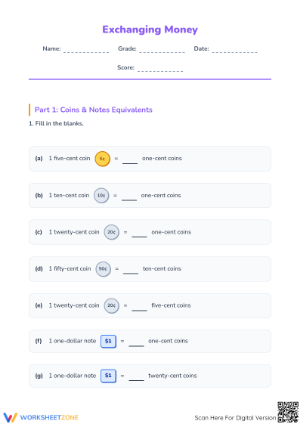
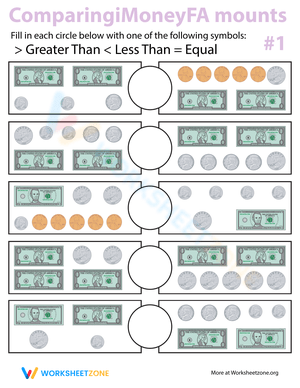
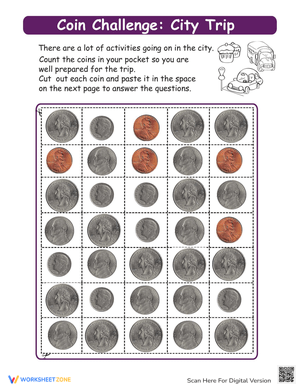
- Coin identification: Students name each US coin and match it to its value, working from images of both the obverse and reverse sides. This matters because second graders often identify a quarter by size rather than image — and the reverse side of a dime trips up a surprising number of students well into spring.
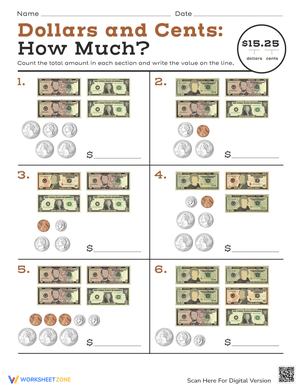
- Mixed-group counting: Students count collections that combine quarters, dimes, nickels, and pennies. The counting sequences shift — sometimes quarters appear last, sometimes first — so students cannot rely on a single memorized strategy.
- Symbol accuracy: Students record totals using both the dollar sign and the cent sign. Several worksheets include answer lines that specify which symbol to use, which forces students to think about whether their total falls below one dollar or reaches one dollar or more.
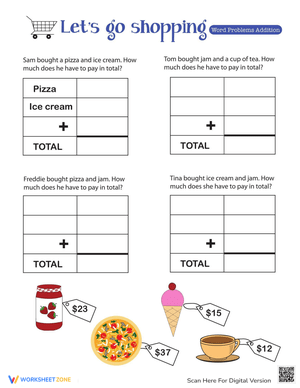
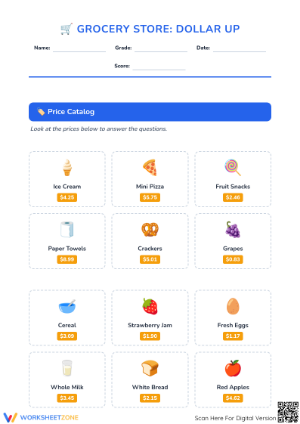
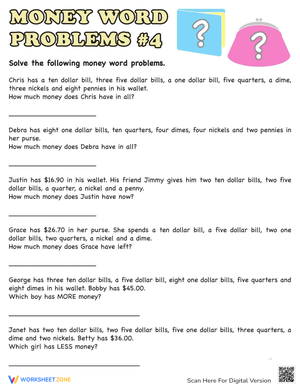
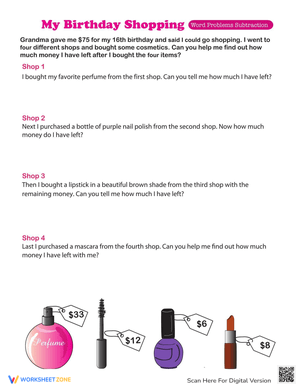
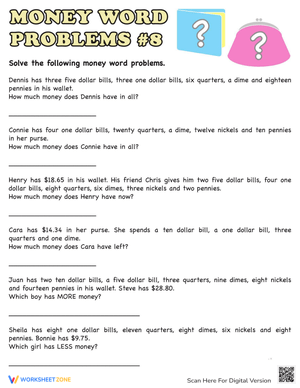
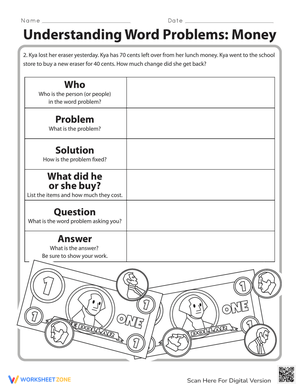
- Word problems: Students read short scenarios — buying items at a pretend store, determining whether a given collection covers a price — and show their work before writing a final answer.
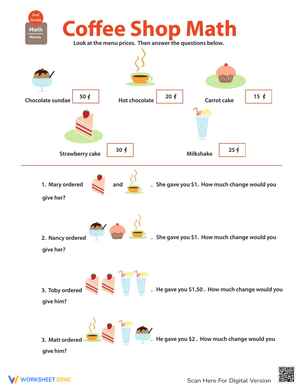
- Making change: The most demanding worksheets ask students to find the difference between a price and the amount paid, then identify which coins make up that change.
Frequent Student Errors Worth Watching For
The single most common mistake is denomination-switching confusion. A student who counts a pile of all dimes without error will often stumble the moment a quarter enters the sequence — they continue skip-counting by tens past the quarter instead of jumping to the next multiple of twenty-five. The error looks like a careless addition mistake on the surface, but it signals something more specific: the student has not automated the shift between skip-counting sequences. Watching for this pattern on completed worksheets tells you whether a student needs more isolated quarter practice before returning to mixed collections.
A separate error involves the dollar and cent symbols. Students frequently write both together — "$0.45¢" appears in actual student work, especially in February when the unit is new. It reads as if the student understands both symbols exist but is uncertain which one governs the answer. A brief class discussion about how the dollar sign already implies a decimal relationship resolves it faster than repeated correction on individual papers. Teaching students to circle the answer line's symbol before they write their total catches the error before it happens.
Standard Alignment
These worksheets address standard 2.MD.C.8 from the Common Core State Standards: solving word problems involving dollar bills, quarters, dimes, nickels, and pennies, and using the $ and ¢ symbols appropriately. This standard sits inside the Measurement and Data domain, and most curriculum maps place it after linear measurement — not by coincidence. Both units require understanding that units come in different sizes and that smaller units combine to make larger ones. Teachers who make that connection explicit ("just like 12 inches make a foot, 100 cents make a dollar") report faster uptake on coin-value relationships than those who introduce money as a standalone unit.
Building These Worksheets Into Your Lesson Plans
The most effective use of a 2nd grade currency printable worksheets during the main unit is as an exit task at the close of a mini-lesson. Students complete one worksheet in the last eight minutes of the block while you circulate. You can see exactly which students are crossing out coins and tracking running totals above each image — and which ones are guessing. That visual read of the room takes about ninety seconds and directly informs small-group work the next day.
Outside the money unit, these worksheets earn their place as spiral review. A single coin-counting worksheet slipped into Monday morning work four weeks after the unit closes shows you whether the skill held. Second graders who seemed solid in March will occasionally arrive in May unable to count a quarter-dime-nickel-penny combination without starting over twice. Catching that regression before the end-of-year assessment gives you time to address it rather than discover it during testing.
For math centers, the word-problem worksheets work well as a paired task — two students work through the same worksheet independently, then compare answers before calling you over. Disagreements tend to be productive. When one student gets 47 cents and another gets 52 cents from the same coin image, they usually self-correct during comparison rather than waiting for a teacher to settle it.
Differentiating the Set Across Ability Levels
For students who still confuse coin values, provide a printed coin reference strip alongside each worksheet — not as a crutch, but as a lookup tool that removes the memorization demand while they build counting fluency. The goal is to let them practice the skip-counting sequence without the added cognitive load of also recalling that a dime is worth ten cents and not five. Once the counting clicks consistently, pull the reference strip.
Students who have already mastered mixed counting benefit from a constraint: cover the coin labels on a worksheet and ask them to find two different combinations of coins that produce the same total shown on the answer line. This reframes the task from computation to flexible thinking about equivalence — a step toward the more open-ended money reasoning they will encounter in third grade.
For students still building one-to-one counting and not yet ready for skip counting, the coin identification worksheets in the set stand alone as appropriate practice. Matching coin names to images and sorting by value are meaningful tasks that do not require multi-denomination counting readiness.
Frequently Asked Questions
What Common Core standard do these worksheets address?
The primary standard is 2.MD.C.8, which requires second graders to solve word problems using dollar bills, quarters, dimes, nickels, and pennies, and to use the $ and ¢ symbols correctly in written answers. Some worksheets also address the standard's implicit expectation that students understand relative coin values — not just names — before they attempt multi-step problems involving mixed collections.
How should I sequence these worksheets across the unit?
Start with coin identification and single-denomination counting before moving to mixed collections. Students who jump to mixed counting before they have automated individual coin values spend most of their effort on recall rather than calculation. A 2nd grade currency printable worksheets that isolates pennies, nickels, dimes, and quarters separately lets you confirm readiness before combining denominations.
Do the worksheets include dollar bills, or only coins?
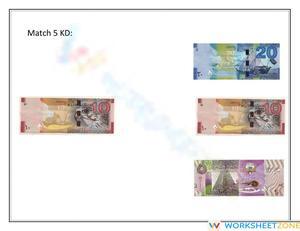
The set covers both coins and bills. Early worksheets focus on coins only, following the typical instructional sequence. Later worksheets introduce the one-dollar bill and ask students to combine coins and bills to reach given totals — which is where 2.MD.C.8 ultimately lands by the end of the year.
Can these worksheets serve as a formal assessment tool?
Yes. The word-problem worksheets work well as end-of-unit checks because the format matches what students have practiced, so results reflect actual understanding rather than test-format confusion. A 2nd grade currency printable worksheets used this way produces a paper record you can include in a portfolio or bring to a parent conference as concrete evidence of where the student stands on 2.MD.C.8.













 Interactive Worksheet Maker
 Quiz Maker
 Word Search Maker
 Crossword Puzzle Maker
 Word Scramble Generator
 Sentence Scramble Generator
 Handwriting Worksheet Generator
 Name Tracing Generator
 Fill In The Blank Generator