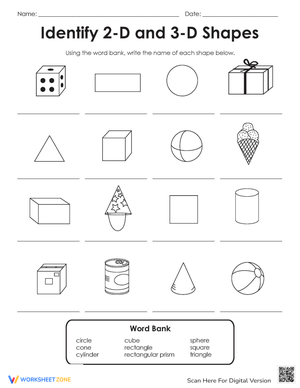
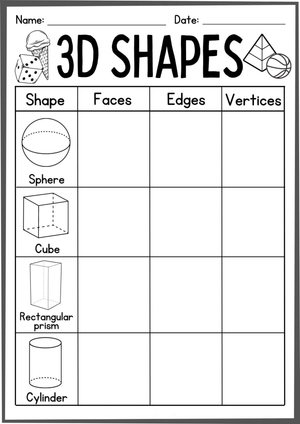
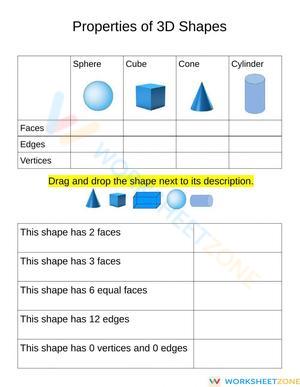
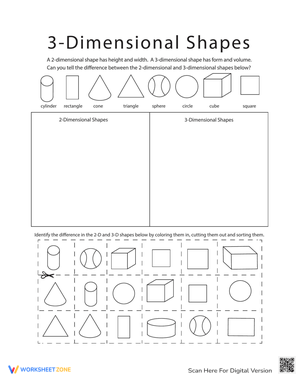
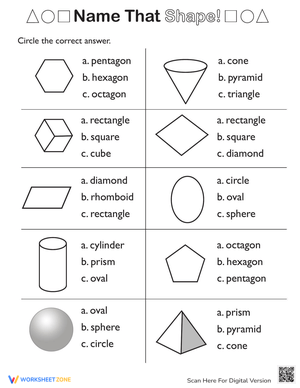
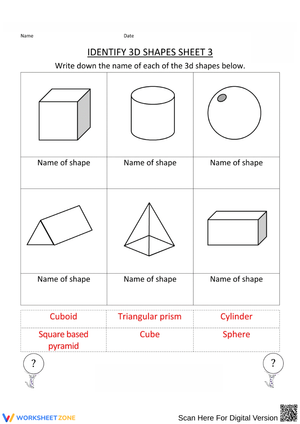
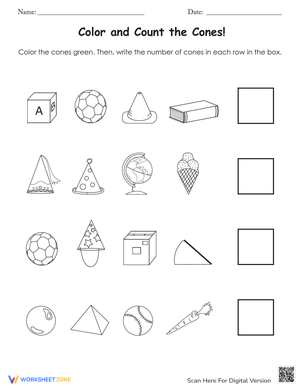
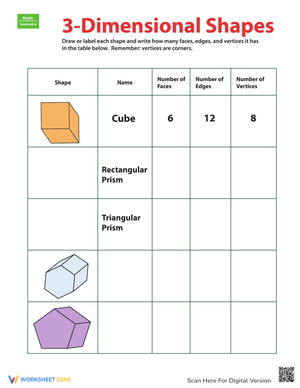
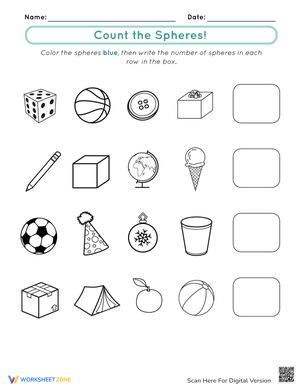
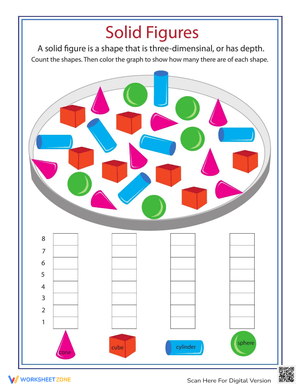
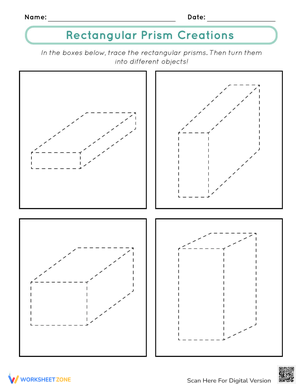
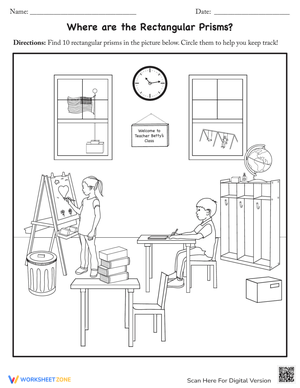
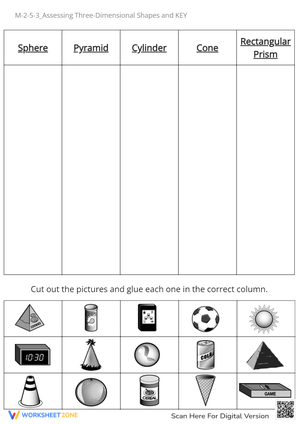
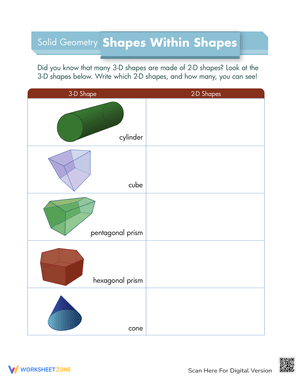
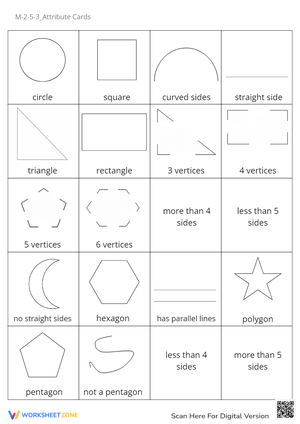
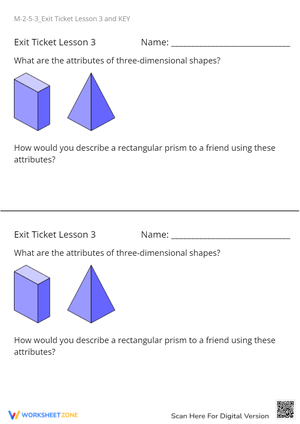
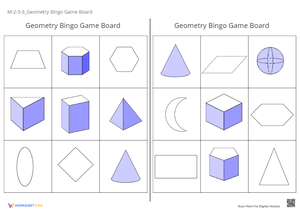
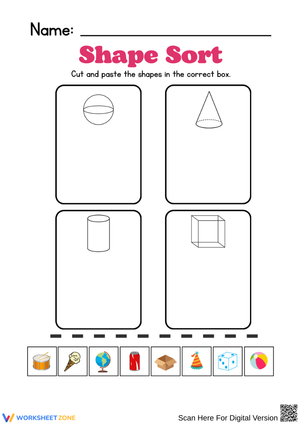
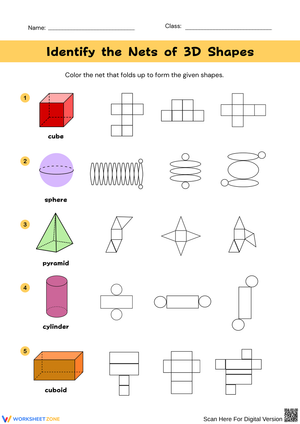
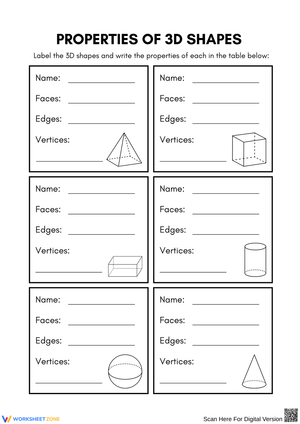
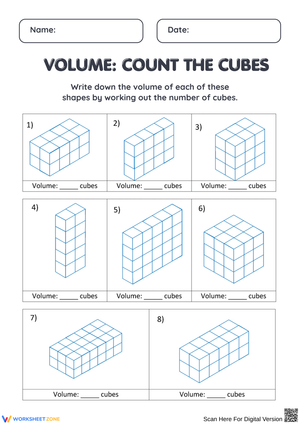
These 2nd grade 3d shapes pdf worksheets give students direct practice with the five solid figures taught in second grade — cube, rectangular prism, cone, cylinder, and sphere — centered on counting and recording faces, edges, and vertices rather than stopping at basic name recognition. The set covers attribute identification, real-world object matching, and 2D-to-3D connections, giving teachers materials usable at multiple points in a geometry unit.
Concepts Each Worksheet Builds
The core task across the set is distinguishing three structural attributes: a face (any flat surface), an edge (the line segment where two faces meet), and a vertex (the corner point where three or more edges converge). Students at this level routinely conflate edge and vertex — the words are unfamiliar and neither one maps onto ordinary language — so the worksheets return to these definitions repeatedly before asking students to compare attribute counts across multiple shapes.
Several worksheets ask students to identify the 2D shapes that make up a given solid's faces. A cube has six square faces; a rectangular prism has rectangular ones; a cylinder's two faces are both circles. That connection keeps prior knowledge in play and prevents the flat-shapes unit and the solid-figures unit from feeling like entirely separate topics taught six weeks apart.
Real-world matching completes the task range. The 2nd grade 3d shapes pdf worksheets that include sorting-by-behavior tasks — roll, stack, or slide — require students to reason from a shape's physical properties rather than simply read a label, which is a meaningfully different cognitive demand than attribute counting alone.
Attribute Errors Worth Anticipating Before the Next Lesson
The most persistent mistake is treating a curved surface as a face. Students will count the curved side of a cylinder and record three faces instead of two, or examine a cone and write two faces rather than one. This happens because the word "face" sounds like it should cover any visible surface — nothing in everyday English signals otherwise to a second grader. Worksheets that ask students to label each surface as flat or curved before counting faces interrupt this error pattern before it consolidates.
Overcounting edges on a rectangular prism is the second common slip. Students who count edge by edge without a method regularly land on ten or fourteen instead of twelve. A brief class discussion about a counting strategy — four top edges, four bottom edges, four vertical connectors — before independent work, paired with a worksheet that visually groups edges into those three sets, significantly reduces this mistake.
Sphere attributes produce the most classroom conversation. Most students record one face, one edge, and one vertex for a sphere. The correct answers are zero, zero, zero — and placing the sphere attribute table next to a cube's creates exactly the productive dissonance that generates real inquiry. Having students hold a sphere and search for an edge by running a fingernail along the surface, then record what they found, makes the worksheet's zeros feel discovered rather than assigned.
Recommended Ways to Build These Worksheets Into Your Lesson Plans
These resources work best when physical manipulatives are in students' hands alongside the paper. A two-dimensional diagram of a rectangular prism is genuinely difficult for seven-year-olds to read without a physical referent. Keeping a bin of geometric solids at each table group during introduction lessons cuts down on counting errors that come from misreading the diagram rather than misunderstanding the concept — those are different problems that need different responses.
During math centers, one worksheet works well as a recording sheet alongside a physical sorting task. Students handle classroom objects, categorize them, and use the worksheet to document and justify their thinking. For a quick formative check, the attribute-recording worksheets serve well as end-of-lesson exit tasks: five minutes before dismissal, students complete the attribute table for two shapes. That fast scan tells a teacher exactly who needs reteaching before the next day begins.
Where 2nd grade 3d shapes pdf worksheets are used in digital or hybrid settings, the PDF format works with tablet annotation tools — students can circle vertices, trace edges in a contrasting color, and type in attribute counts. The roll-stack-slide sorting tasks are the one exception: those are worth pairing with physical objects even in an otherwise digital classroom, because sorting by behavior only makes intuitive sense when students feel a cylinder tip onto its curved surface.
Adjusting the Work for Mixed-Ability Classrooms
For students still developing number sense, reducing the attribute-counting task to three shapes — cube, sphere, cylinder — keeps vocabulary load manageable while the core counting work stays intact. The 2D-face-identification exercises also work well as re-entry tasks for students who need the conceptual bridge from flat to solid made more explicit before they attempt a full attribute table with all five figures.
Students who move through the content quickly can extend the real-world sorting work into a description challenge: they select a household object and describe it using only attribute language — number of faces, whether any surfaces are curved, presence or absence of vertices — then challenge a partner to name the shape. That task requires genuinely flexible understanding, not memorized counts, and it surfaces whether students own the vocabulary or are just pattern-matching answers.
Standard Alignment
CCSS.MATH.CONTENT.2.G.A.1 requires second graders to recognize and draw shapes with specified attributes and to distinguish between defining attributes — such as the number of faces or whether surfaces are flat or curved — and non-defining attributes like color, size, and orientation. These worksheets address the solid-figures dimension of that standard throughout: every attribute-recording and sorting exercise focuses on defining attributes while explicitly setting the others aside. That distinction is built into the task structure of each worksheet, not just noted in a teacher direction line.
Frequently Asked Questions
Are these worksheets suitable for students who have never worked with solid figures before?
The attribute-counting tasks assume students can name basic 2D shapes and understand terms like "flat" and "corner," but no prior solid-geometry instruction is required. The 2D-to-3D face-identification exercises work well as a first lesson. Pairing each worksheet with physical manipulatives during those early sessions matters — students working exclusively from flat diagrams take noticeably longer to build an accurate mental model of what separates an edge from a face, and the misunderstanding that forms is harder to undo than it is to prevent.
How do the sphere attribute exercises work when every correct answer is zero?
The zero-zero-zero result surprises almost every second grader, and that surprise is pedagogically valuable. Before students complete the sphere worksheet, have them hold a real sphere and search for an edge by running a fingernail along the surface. When they cannot locate one, the zero count becomes something they confirmed through physical exploration rather than something imposed from outside. That sequence — handle the object first, record second — applies throughout solid-figures instruction and turns attribute tables into documentation of what students already discovered.
What order works best for using the worksheets across a geometry unit?
Start with naming and attribute-counting exercises during the introduction phase, with physical solids at hand. Move to 2D-face-identification tasks once students can reliably distinguish faces, edges, and vertices. Use real-world matching and roll-stack-slide sorting as application work in the middle of the unit, when students need to transfer vocabulary into context. Save any exercises that ask students to compare attributes across multiple shapes — which solid has the most vertices? which have no vertices at all? — for the end of the unit, when the terminology is consolidated. The 2nd grade 3d shapes pdf worksheets in this set are ordered to follow that progression, though each worksheet also stands alone if a class is entering the content at a different point.













 Interactive Worksheet Maker
 Quiz Maker
 Word Search Maker
 Crossword Puzzle Maker
 Word Scramble Generator
 Sentence Scramble Generator
 Handwriting Worksheet Generator
 Name Tracing Generator
 Fill In The Blank Generator