Why Cone Worksheets Matter for Second Grade Geometry
When your second graders move from flat shapes into the world of solids, cones are one of the trickiest categories to pin down. Students can usually spot a cube or a sphere right away, but cones get confused with pyramids because both come to a point. Worksheets built specifically around cone identification give you a focused way to slow down and let students practice naming attributes before mixing cones into a full 3D shape review. This kind of targeted practice matters because second grade geometry standards ask students to move beyond simply recognizing shapes by sight and start describing them using precise attribute language.
Parts of a Cone: Faces, Edges, and Vertices
A cone has exactly 1 flat circular face, 1 curved surface, and 1 vertex, sometimes called the apex. Unlike a cube or rectangular prism, a cone has no straight edges where two flat faces meet, which is often the detail that trips up second graders who are used to counting edges on boxier shapes. Worksheets that ask students to count and label these three attributes build the vocabulary they need before they can accurately sort or compare solids.
The Common Core State Standards Initiative outlines CCSS.MATH.CONTENT.2.G.A.1, which requires second graders to recognize and draw shapes based on specified attributes, including identifying three-dimensional solids such as cones, cubes, and rectangular prisms, as part of formal geometry instruction for the school year.
Real-World Objects That Anchor Cone Concepts
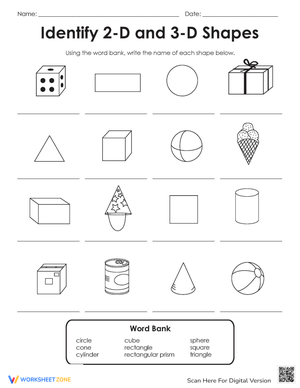
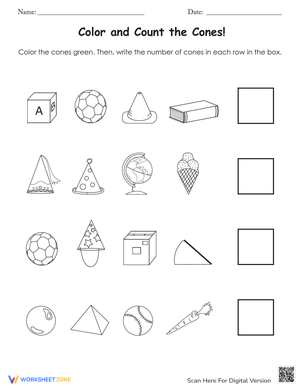
Second graders connect abstract geometry to their own experience much faster when worksheets include familiar objects. Ice cream cones, traffic cones, and party hats are common choices because students have handled or seen all three. Asking students to sort pictures of these objects into cone versus not-cone categories, then explain their reasoning using the words face, curved surface, and vertex, reinforces the academic vocabulary in a low-stakes way. This kind of object sort also works well as a warm-up before a worksheet page that asks for more formal written responses.
Classroom Implementation
Cone worksheets fit naturally into a short whole-group mini-lesson followed by independent or paired practice. Start with a physical cone, such as a rolled paper cone or a real party hat, and have students describe what they notice before introducing the vocabulary. Then move to a worksheet where students trace or color the flat face, mark the vertex, and write a sentence describing the curved surface. For students who finish early, add an extension task that asks them to find a cone shape somewhere in the classroom and sketch it. Keeping the worksheet short and specific to cones, rather than mixing in five other solids, helps you see clearly whether each student has mastered this particular shape before moving on.
Frequently Asked Questions
1. How many faces, edges, and vertices does a cone have?
A cone has 1 flat circular face, 1 curved surface, and 1 vertex. It has no straight edges, which is a key difference from shapes like cubes and pyramids.
2. What CCSS standard covers 3D shape identification like cones in 2nd grade?
CCSS.MATH.CONTENT.2.G.A.1 asks second graders to recognize and draw shapes based on specified attributes and to identify three-dimensional solids such as cones, cubes, and rectangular prisms.
3. How can teachers use cone worksheets in a math center rotation?
Place a cone identification worksheet alongside real objects like party hats or cone-shaped blocks so students can check their written answers against a physical model during independent center time.
4. What real-world objects can teachers use to teach cones to second graders?
Ice cream cones, traffic cones, and party hats are familiar objects that help students connect the abstract vocabulary of faces, curved surfaces, and vertices to things they already recognize.
5. How do cone worksheets fit into a broader 3D shapes unit for grade 2?
Cone worksheets typically come before a mixed-shape review that also covers cubes, rectangular prisms, cylinders, and spheres, giving students a solid reference point for later comparison and sorting tasks.













 Interactive Worksheet Maker
 Quiz Maker
 Word Search Maker
 Crossword Puzzle Maker
 Word Scramble Generator
 Sentence Scramble Generator
 Handwriting Worksheet Generator
 Name Tracing Generator
 Fill In The Blank Generator