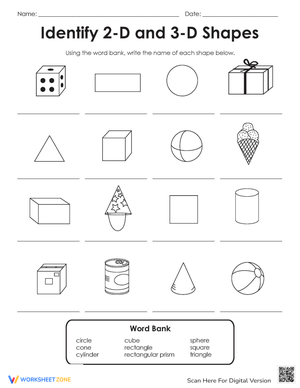
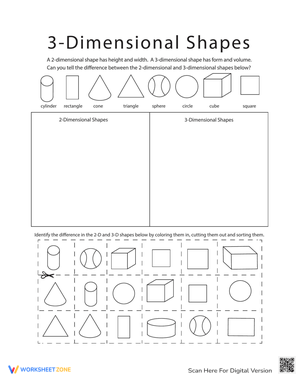
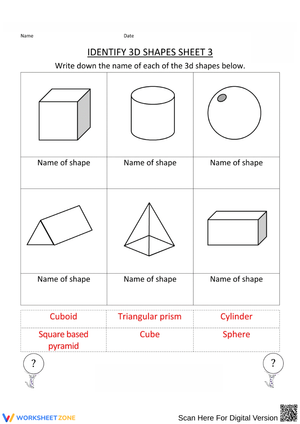
2nd Grade Cylinders worksheets
These 2nd grade cylinders worksheets resources give teachers a focused set of practice tools for one of second grade's more counterintuitive geometry moments: the first time students learn that a shape can have zero corners. The set covers cylinder attribute identification, real-world object recognition, roll-stack-slide sorting, and the geometric vocabulary that CCSS 2.G.A.1 puts at the center of second-grade solid geometry instruction.
What the Worksheets Cover
Each worksheet targets a distinct skill. Students count and label the two flat circular faces and the single curved surface, color-code parts of a cylinder diagram — one color for each flat base, a second for the curved surface — and complete fill-in-the-blank exercises using precise terms: face, base, curved surface, vertex. True-or-false statements, such as A cylinder has three vertices, ask students to mark the statement false and write the correction. That writing task is harder than circling the right answer and gives teachers a clearer window into what students actually understand versus what they have memorized.
One worksheet in this 2nd grade cylinders worksheets set presents a sorting matrix where students check whether each shape can roll, stack, or slide. This is the task that most directly builds the reasoning 2.G.A.1 targets — not just recognizing a cylinder by sight, but justifying what its attributes allow it to do. Separate worksheets pair abstract geometric diagrams with real-world objects: soup cans, AA batteries, glue sticks, cones, spheres. Students circle the items that share a cylinder's defining features, which builds the recognition skill that attribute work on diagrams alone does not fully develop.
Using Real Objects Alongside the Worksheets
The glue stick every student already has on their desk is, geometrically speaking, a clean cylinder — no ridges, flat circular ends, a smooth curved surface that rolls in a straight line when pushed. While students work through a worksheet asking them to count faces or decide whether a shape can stack, they can pick up the glue stick, feel the two flat ends, and roll it across the desk in under ten seconds. That physical check is available without any teacher setup, and it gives hesitant students a way to verify an answer rather than guess. Teaching students to use a real object as a reference while working from 2D diagrams of 3D shapes is a practical workaround for the central difficulty in this unit: a paper diagram cannot show what a cylinder actually does when you push it or set it on its side.
Beyond the glue stick, the worksheets reference soup cans, chalk, paper towel rolls, and batteries as visual anchors. These are objects students have handled, and matching them to a formal geometric description builds a different kind of recognition than tracing lines on a diagram.
Mistakes Students Make That These Worksheets Help You Catch
The most predictable error is counting the curved surface as a third face. Students arrive at "3 faces" through sound logic — a cylinder clearly has three distinct parts, and weeks of prior instruction have taught them that solid shapes have faces. Restating the definition does not fix this. A more effective approach is asking students to trace each face with a finger and draw it flat on paper: a flat circular face produces a circle; the curved surface produces nothing flat. That operational test makes the vocabulary distinction physical rather than terminological, and it resolves the confusion more reliably than re-explaining what "face" means.
A second error runs close to the first: students confuse cylinders and cones because both have at least one circular base. For students still forming 3D mental models, "has a circle" operates as the defining rule for both shapes. Worksheets that place a cylinder and a cone side by side — asking students to mark the number of circular bases on each and locate any pointed vertex — surface this confusion before it hardens. The error typically persists through a first lesson and clears after students have held physical examples of both shapes. The edge-count definition also creates its own moment of classroom uncertainty: some curricula describe a cylinder as having zero edges, others count two curved edges where the flat bases meet the curved surface. Whichever definition the worksheets use should match what was taught explicitly, because a mismatch between worksheet language and classroom instruction generates wrong answers that have nothing to do with student understanding.
Getting the Most From These Worksheets in Your Lesson Plans
These worksheets work best as the second layer of instruction, not the first. Open the unit with physical objects — wooden cylinder blocks, soup cans, batteries — and let students handle them, describe them in their own words, and test whether they roll before any paper comes out. Once students have that grounded experience, moving to diagrams shifts the task from abstract memorization to recording what students are already partially figuring out. Students who see a 2D diagram of a 3D cylinder before they have ever touched one tend to guess at the face-count question rather than reason through it.
Sliding printed copies into clear dry-erase pockets converts any worksheet into a reusable center activity. Students complete the work with a whiteboard marker, erase, and pass the pocket to the next rotation. This works particularly well for the sorting matrix format, which benefits from repeated passes across multiple shape types, not just cylinders. This 2nd grade cylinders worksheets, run through the printer once and sleeved in dry-erase pockets, carries a math center through a full week of rotations without additional prep. For early finishers, a cut-and-paste worksheet where students sort shape images into cylinder and non-cylinder categories provides a kinesthetic extension without requiring a new set of materials.
Standard Alignment
CCSS 2.G.A.1 asks second graders to recognize and draw shapes with specified attributes, such as a given number of faces or a given number of equal sides. A cylinder's attributes — two flat circular faces, one curved surface, zero vertices — are exactly the kind of specified attributes this standard names. The vocabulary exercises across the set (labeling, fill-in-the-blank, true-or-false correction) address the language demand embedded in 2.G.A.1, which expects students to describe geometric attributes in writing and conversation, not just identify shapes by sight. In most second-grade pacing guides, this solid geometry work falls after the 2D shape strand from late first grade or early second grade, making cylinders students' first serious encounter with a shape that has a curved surface that does not count as a face — a distinction this standard presses them to articulate precisely.
Adjusting the Set for a Range of Learners
For students who need more support, begin with worksheets that ask a single question per problem — how many flat faces? can this shape roll? — rather than compound attribute tasks. Keep a physical cylinder nearby during independent work. Holding a real object while answering questions about a drawn one reduces the cognitive gap between reading a 2D diagram and reasoning about a 3D shape, which is where most below-grade-level confusion originates in this unit. The glue stick strategy works here without any additional materials.
Students who move quickly through attribute identification benefit from worksheets that require written justification. Instead of checking a box, they write: A cylinder can stack because both of its circular bases are flat and the same size. That sentence-writing task reveals whether students have internalized the reasoning or just memorized correct answers — students who have memorized without understanding will stall on the explanation. A further extension is a comparison worksheet where students explain why a cylinder can both roll and stack while a sphere can only roll and a cone can do neither cleanly, staying grounded in the same attribute vocabulary the unit introduced.
Frequently Asked Questions
How many faces, edges, and vertices does a cylinder have?
In most second-grade curricula, a cylinder has two flat circular faces, zero vertices, and either zero or two curved edges depending on how the program defines an edge. The two-face count is consistent across materials; the edge count is not. Check which definition your adopted curriculum uses before the unit begins so that instruction and worksheets align on the same language.
When in a geometry unit should these worksheets appear?
After the hands-on introduction with physical objects but before any formal assessment — typically two to four days into a week-long geometry focus. Using a 2nd grade cylinders worksheets before students have handled real cylinders turns the activity into guessing rather than practice. Using it only as a post-unit review is a different instructional purpose and skips the formative value the worksheets provide during the learning sequence, when student errors are still worth catching and correcting.
How do I address the confusion between cylinders and cones?
Focus the correction on the number of circular bases rather than on the overall shape. A cylinder has two flat circular faces — one on each end. A cone has one. Have students count the circular bases by touching each one with a finger before looking at the whole shape. Students who confuse the two are usually matching on "has a circle" rather than the more specific feature of how many circles and what appears at the other end. Once they slow down and count, the distinction becomes manageable for most second graders within one lesson.
Can these worksheets be reused across multiple class periods or groups?
Yes. Placing printed copies inside clear dry-erase pockets lets students complete each worksheet with a whiteboard marker, erase the work, and pass it to the next student in the rotation. The sorting matrix and true-or-false formats work especially well in this setup because students can check their answers against a posted key before moving to the next center station, which builds in a self-monitoring habit without requiring teacher oversight at every table.
Clear All