2nd Grade Cubes printable worksheets: Mastering 3D Geometry
These 2nd grade cubes printable worksheets give students structured, attribute-focused practice at the exact moment in the curriculum when three-dimensional geometry shifts from recognition to description. Rather than asking students to point to the cube in a row of shapes, the exercises here require them to name, count, and compare the attributes that define the figure — the kind of practice that builds vocabulary and spatial reasoning simultaneously.
The Specific Skills These Worksheets Target
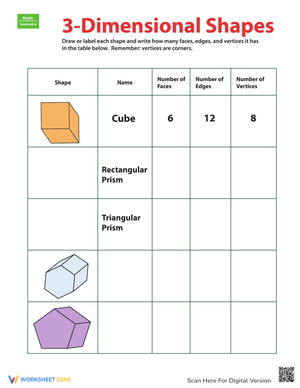
The three attributes students work through are faces, edges, and vertices. These terms arrive together in second grade as a cluster, and the difficulty is that all three sound abstract until students spend real time with them. Each worksheet keeps its focus narrow — one attribute per task — so students count faces without simultaneously tracking edges, then return to edges in a separate exercise. That tight focus matters because young learners lose count when they try to manage too many spatial details at once.
Faces get the most attention across the set, and rightly so. A cube's six square faces are what separate it from a rectangular prism, which may have rectangular faces of unequal size. Students color or label each face on a drawn cube, a task that forces them to account for all six — including the two that feel hidden in a standard diagram. Edge exercises follow: students trace all twelve on a cube skeleton, using the physical tracing to confirm that every edge connects exactly two faces. Vertex work rounds out the attribute exercises; students count all eight corners using a systematic top-four-then-bottom-four approach, which is the most reliable way to prevent the double-counting errors that show up constantly at this grade level.
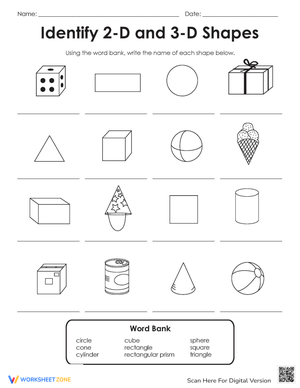
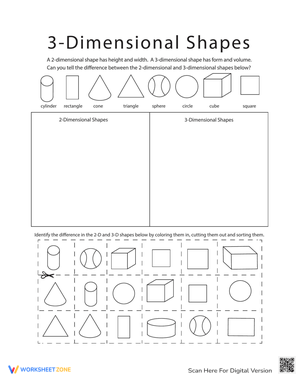
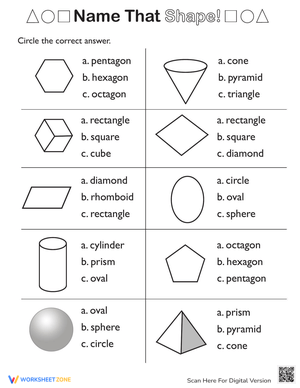
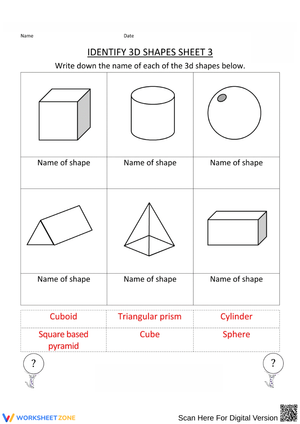
The set also includes real-world identification exercises where students mark which objects from an illustrated scene are cube-shaped. Dice and wooden alphabet blocks appear; tissue boxes and cereal boxes do not — which requires students to apply their attribute knowledge rather than guess by rough visual resemblance. A comparison task between a cube and a rectangular prism closes the skills sequence, asking students to circle which faces are squares and which are not-quite-squares.
Common Misconceptions to Watch For and Address
The most persistent error involves the cube-versus-rectangular-prism distinction. Students who can correctly say "a cube has six square faces" will still mark a tissue box as a cube without hesitation. The problem is visual: if something looks roughly boxy, second graders tend to accept it as a cube. The comparison exercises in the set address this directly, placing a drawn cube next to a drawn rectangular prism so students circle the square faces versus the rectangular ones. Even then, some students will mark the square-looking front face of a rectangular prism and declare the whole shape a cube — which is the deeper misconception to surface through discussion, not just worksheet correction.
Vertex counting produces a different category of error. Students who count without a system land on six or ten rather than eight. The most common version: a student traces around the front face and counts those four corners, then counts the back four, but in the process counts one back corner as a front corner. A reliable fix is to have the student place a finger on each vertex and count aloud, moving deliberately front-top-left, front-top-right, front-bottom-right, front-bottom-left, then the four matching back vertices. Introducing that sequence before students attempt the worksheet saves most of the confusion.
How to Build These Worksheets Into Your Lesson Plans
The set works well in several different lesson moments, and it pays to match each worksheet to the right context before the week begins. For introducing the topic, a labeling exercise — faces, edges, and vertices on one drawn cube — pairs cleanly with time spent handling a physical foam or wooden cube. Students touch each attribute on the physical object and then transfer that experience to the diagram. Without a physical model present, some students count only what is visible in the drawing and miss the attributes implied by the angle.
For math center rotation, the real-world identification exercises run independently once students know the vocabulary. The comparison worksheet between cube and rectangular prism also works as a center task, because students can work through it without teacher facilitation once they understand what a square face looks like versus a rectangular one. The drawing exercises — where students follow a step-by-step guide to sketch a cube by drawing two overlapping squares and connecting the corners — belong closer to whole-group or small-group instruction. The spatial demands of that task are higher than most second graders anticipate, and a few minutes of modeling before students try it independently prevents a lot of frustration.
As formative assessment, 2nd grade cubes printable worksheets answer a clear question at the close of a lesson: has this student internalized all three attributes accurately, or is the cube-versus-rectangular-prism confusion still present? A two-minute exit ticket using one of the attribute-counting exercises gives that information without carving out additional testing time.
Standard Alignment
CCSS.MATH.CONTENT.2.G.A.1 requires students to recognize and draw shapes having specified attributes — a given number of equal faces, defined vertices, and consistent edge lengths. In classroom terms, this standard marks the first time students are held accountable not just for naming a shape but for justifying that identification through attribute evidence. The cube is one of the clearest entry points for this standard because its six equal square faces and twelve equal edges are verifiable by students who have had hands-on time with a physical model. The comparison work between cube and rectangular prism built into the set directly supports the standard's emphasis on specified attributes as the basis for shape recognition, rather than visual resemblance alone.
Adjusting the Set for Different Student Levels
For students still building basic 3D vocabulary, pairing 2nd grade cubes printable worksheets with a physical cube on the desk removes the demand of visualizing a three-dimensional figure from a two-dimensional diagram. These students can touch the physical shape, count real faces with their fingers, and then record on the worksheet — a step-by-step sequence that keeps the conceptual work accessible without lowering the standard. A reference card with the three attribute terms and short definitions, taped to the corner of the desk, also frees working memory for the actual counting tasks rather than vocabulary recall.
For students who move through the attribute work quickly and accurately, the drawing exercises and a net-prediction task serve as natural extensions. Before revealing a cube net, ask these students to sketch where they think each of the six faces will land when the shape is unfolded flat. Mental rotation of that kind is considerably harder than counting, and students who find the basic attribute work easy will meet real challenge there without needing a separate worksheet set entirely.
Frequently Asked Questions
How many faces, edges, and vertices does a cube have?
A cube has 6 faces, 12 edges, and 8 vertices. All six faces are equal squares and all twelve edges are the same length — both properties that distinguish a cube from other rectangular prisms, which may have rectangular faces of unequal dimensions.
What is the difference between a square and a cube?
A square is a two-dimensional figure with four equal sides and four right angles. A cube is a three-dimensional solid whose six faces are all squares. One way students hold onto the distinction: you can draw a square on paper, but a cube takes up space you can hold in your hand.
Is a cube a type of rectangular prism?
Yes. A cube is a rectangular prism where every face is a square rather than a general rectangle. Because a square is a specific kind of rectangle, a cube satisfies the definition of a rectangular prism. This relationship is one of the key conceptual points in second-grade geometry and comes up directly in the comparison exercises included in this set.
Can second graders learn to draw a cube?
Most second graders can draw a recognizable cube with step-by-step guidance. The standard method — two overlapping squares connected at the corners — challenges fine motor control and spatial thinking at the same time. The 2nd grade cubes printable worksheets in this set include a guided drawing sequence, and the exercise is worth attempting even with students who find it difficult, because deciding which edges are visible and which are hidden deepens spatial reasoning in a way that identification tasks alone do not produce.
Clear All