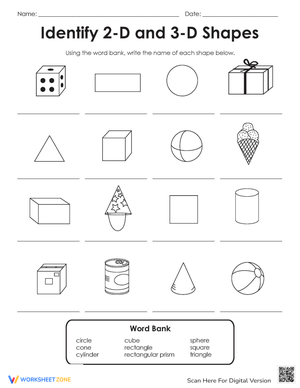
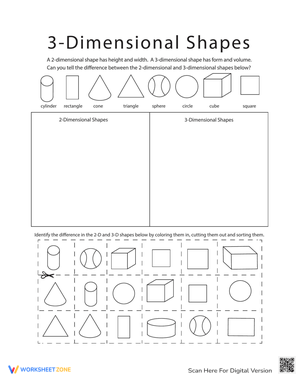
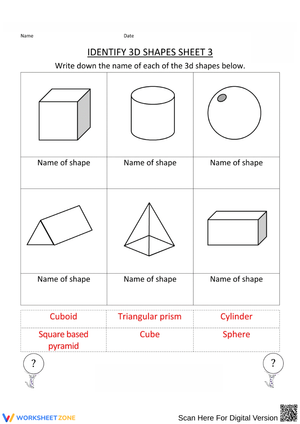
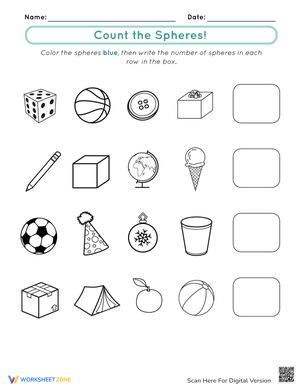
Spheres worksheets for grade 2 gives students a clean contrast case. It has no flat surface at all, which forces them to sharpen their definitions of the other shapes instead of relying on a vague sense of roundness versus pointiness. Many teachers introduce spheres during the first week of a 3D-shapes unit, before moving into faces, edges, and vertices vocabulary. Worksheets that ask students to circle every sphere in a mixed set, or to sort shapes into curved-surface and flat-surface groups, build the visual discrimination skills that later support more precise attribute counting.
What CCSS 2.G.A.1 Requires for Grade 2 Geometry and Relationship To Sphere
CCSS 2.G.A.1 asks second graders to recognize and draw shapes with specified attributes, and it names triangles, quadrilaterals, pentagons, hexagons, and cubes explicitly. Spheres are not listed by name in the standard text.
That gap matters for lesson planning. Because CCSS 2.G.A.1 lists cubes but not spheres, cones, or cylinders, many grade 2 scope-and-sequence documents treat those three shapes as supporting vocabulary that builds toward the standard rather than as separately assessed content, which means a sphere worksheet works best as reinforcement practice alongside cube-focused attribute tasks rather than as a stand-alone graded assignment.
According to the Common Core State Standards Initiative, grade 2 geometry content centers on reasoning about shapes and their attributes as a bridge toward area and fraction concepts in later units; the Utah State Board of Education's Grade 2 Geometry Core Guide frames sphere, cone, and cylinder identification as prerequisite vocabulary that supports the standard's cube-and-polygon attribute work rather than a separately tested requirement.
From Concrete Objects to Abstract Worksheet Practice
Second graders benefit from handling real spheres before they work on paper. Balls, globes, oranges, and marbles let students feel the absence of flat surfaces and edges directly, which makes the worksheet vocabulary meaningful rather than memorized.
A short object hunt works well as a warm-up: students walk the room or look through a photo set and record every sphere they find, along with one non-example they considered and rejected. That rejected example is valuable because it surfaces early misconceptions before they show up on independent work.
Once students have handled and sorted real objects, move to worksheets that mix photographs of real spheres with line drawings of 3D shapes. This step bridges the concrete and abstract representations that grade 2 geometry standards are designed to connect.
Common Misconceptions: Spheres vs. Circles
The most frequent error in grade 2 classrooms is confusing a sphere with a circle. A circle is a flat, two-dimensional shape, while a sphere is a solid, three-dimensional shape. Students who have spent a full year working with 2D shapes often default to calling any round outline a circle.
Address this directly by placing a paper circle next to a ball during instruction and asking students to identify which one they could stack, roll across a table, and hold with both hands versus which one lies flat. Worksheets that include a circle as one of the answer choices in a sphere-sorting task, rather than only including other 3D shapes, help you catch and correct this misconception before it becomes a lasting habit.
Frequently Asked Questions
1. Do grade 2 CCSS standards require teaching spheres specifically?
No. CCSS 2.G.A.1 names triangles, quadrilaterals, pentagons, hexagons, and cubes, but it does not list spheres by name. Most classrooms teach spheres as supporting vocabulary within the same 3D-shapes unit that addresses cubes.
2. What attributes distinguish a sphere from other 3D shapes for second graders?
A sphere has 1 curved surface, 0 flat faces, 0 edges, and 0 vertices. This all-curved profile is what separates it from cones and cylinders, which each have at least one flat surface.
3. How can teachers use spheres worksheets in a broader geometry unit?
Use them early in the unit as a contrast shape before introducing detailed faces-edges-vertices counting on cubes and prisms, then revisit sphere identification during sorting and review activities later in the unit.
4. What common misconceptions do second graders have between spheres and circles?
Students frequently call a sphere a circle because both are round. Comparing a flat paper circle with a solid ball side by side, and asking whether each can be stacked or rolled, helps students separate 2D and 3D reasoning.













 Interactive Worksheet Maker
 Quiz Maker
 Word Search Maker
 Crossword Puzzle Maker
 Word Scramble Generator
 Sentence Scramble Generator
 Handwriting Worksheet Generator
 Name Tracing Generator
 Fill In The Blank Generator