


























Views
Downloads


Grade 2-4 Telling Time — Printable No-Prep Worksheet
Paste this activity's link or code into your existing LMS (Google Classroom, Canvas, Teams, Schoology, Moodle, etc.).
Students can open and work on the activity right away, with no student login required.
You'll still be able to track student progress and results from your teacher account.
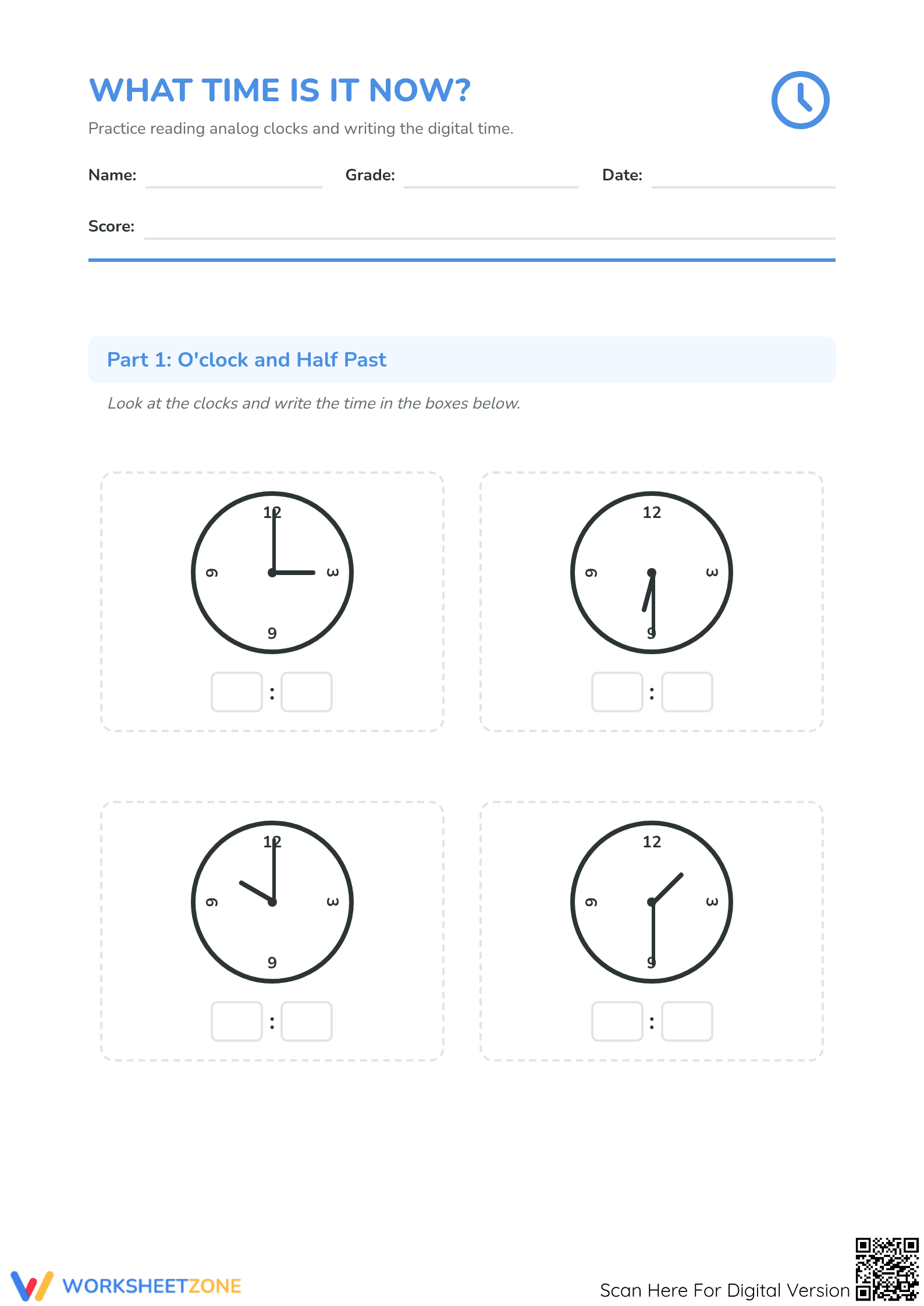
This comprehensive telling time worksheet packet provides students with focused practice in translating analog clock faces into digital time formats. By mastering o'clock, half-past, and quarter-hour increments, learners build the essential fluency needed for real-world time management. It offers a structured progression from basic intervals to mixed practice, ensuring a solid mathematical foundation.
At a Glance
- Grade: 2–4 · Subject: Math
- Standard:
CCSS.MATH.CONTENT.2.MD.C.7— Tell and write time from analog and digital clocks to the nearest five minutes- Skill Focus: Analog Clock Reading
- Format: 5 pages · 24 problems · Answer key included · PDF
- Best For: Independent practice and formative assessment
- Time: 20–30 minutes
This five-page PDF includes 24 distinct analog clock faces distributed across three logical parts. Part 1 focuses on o'clock and half-past positions, Part 2 introduces quarter-to and quarter-past intervals, and Part 3 offers mixed practice to challenge student recall. Each page features clear, high-contrast clock illustrations with dedicated digital entry boxes, accompanied by a full answer key for rapid grading.
The zero-prep workflow for this resource follows three efficient steps: Print the entire packet in under 30 seconds, distribute it to the class for 20 minutes of engagement, and review the results in less than 2 minutes using the provided key. This zero-setup approach ensures a total teacher prep time of under two minutes, making it an ideal candidate for emergency sub plans or quick skill reinforcement.
This resource is strictly aligned to CCSS.MATH.CONTENT.2.MD.C.7, which requires students to tell and write time from analog and digital clocks using a.m. and p.m. notation. The worksheet specifically targets the identification of hour and minute hand placement at 15-minute intervals. This standard code can be copied directly into lesson plans, IEP goals, or district curriculum mapping tools.
Use this worksheet as a summative exit ticket after a unit on measurement and data to gauge student mastery of analog intervals. Alternatively, assign Part 3 as a timed warm-up activity to reinforce mental math skills. During instruction, observe if students struggle with the "quarter to" concept, as this often indicates a need for more direct instruction on temporal proximity.
This material is designed for second through fourth-grade students who are developing or refining their temporal awareness. It is particularly effective for learners requiring visual scaffolds, such as the clear digital box prompts. Pair this worksheet with a physical geared classroom clock to provide a tactile anchor during initial guided practice sessions.
According to the RAND AIRS 2024 report, structured practice in measurement skills like telling time significantly correlates with improved numerical reasoning in early elementary students. This worksheet targets the CCSS.MATH.CONTENT.2.MD.C.7 standard by requiring students to decode analog clock hands into digital text, a process that reinforces spatial visualization and base-60 counting logic. Research from EdReports 2024 emphasizes that high-quality, aligned mathematical tasks provide the necessary low-floor, high-ceiling opportunities for diverse learners to achieve fluency. By providing 24 scaffolded tasks, this resource ensures that students encounter enough repetition to move from guided recognition to independent mastery of quarter-hour intervals. The inclusion of a comprehensive answer key further supports the instructional cycle by allowing for immediate feedback, which is a critical component of successful formative assessment as identified in recent ScienceDirect analysis of pedagogical efficacy in primary education.


