


























Views
Downloads



Calculate Elapsed Time Worksheet | Essential Grade 2 Math
Paste this activity's link or code into your existing LMS (Google Classroom, Canvas, Teams, Schoology, Moodle, etc.).
Students can open and work on the activity right away, with no student login required.
You'll still be able to track student progress and results from your teacher account.
This essential Grade 2 math resource helps students master the concept of elapsed time through a structured, three-part approach. By moving from visual clock face comparisons to digital time calculations and real-world word problems, learners develop a concrete understanding of how much time passes between two events in their daily lives.
At a Glance
- Grade: 2 · Subject: Math
- Standard:
2.MD.C.7— Tell and write time from analog and digital clocks to the nearest five minutes- Skill Focus: Elapsed Time Calculation
- Format: 3 pages · 8 problems · Answer key included · PDF
- Best For: Independent math centers or morning work
- Time: 20–30 minutes
What's Inside
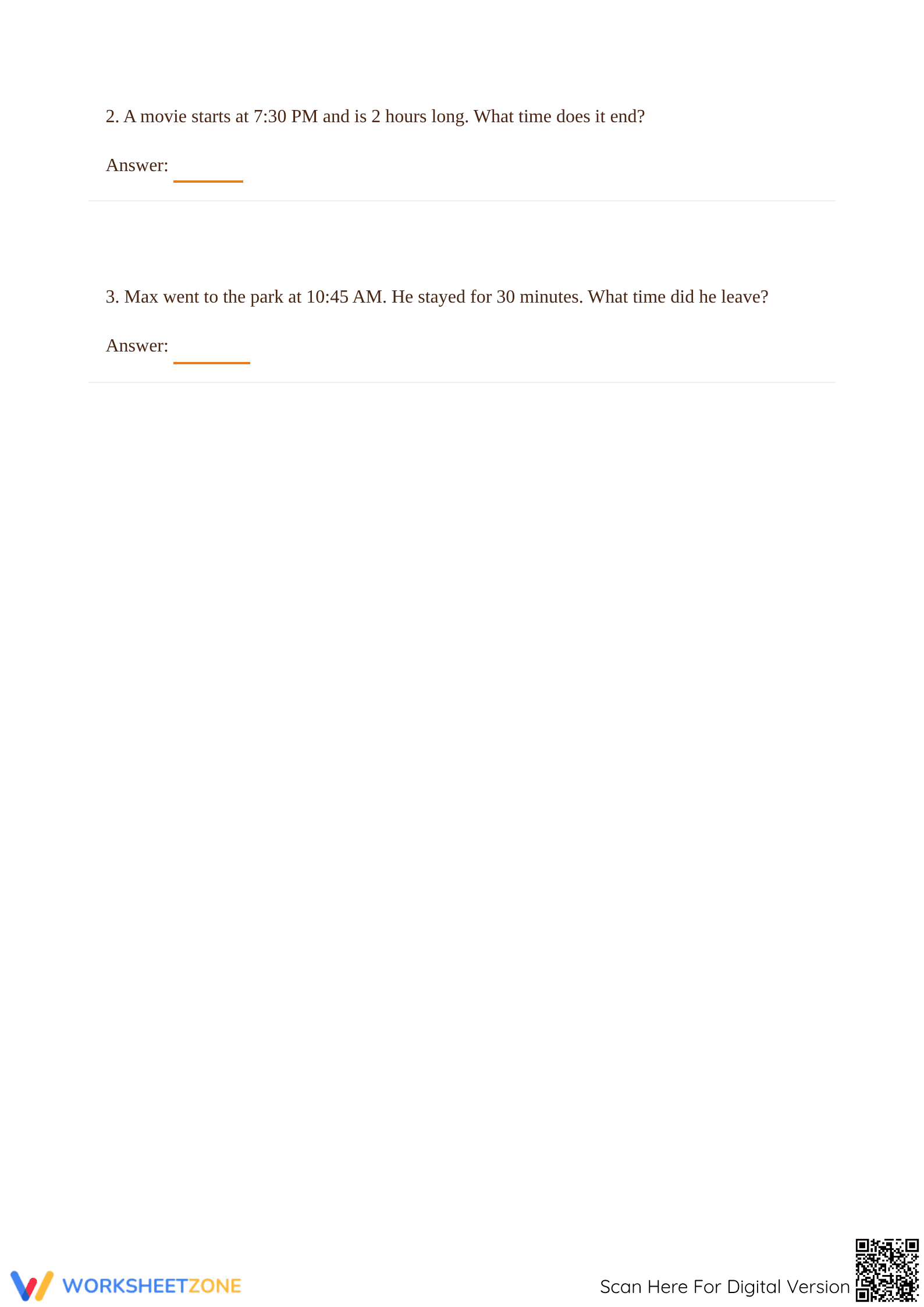
This 3-page PDF is divided into clear sections for progressive learning. Part 1 features analog clocks where students determine the time difference by looking at the start and end positions of the hands. Part 2 shifts to digital format, requiring mental addition or subtraction of minutes and hours. Part 3 provides three daily routine word problems that apply these skills to realistic scenarios like homework time or movie durations. A full answer key is provided for quick grading.
Zero-Prep Workflow
- Print (30 seconds): Select the three pages and the answer key for a complete classroom set.
- Distribute (1 minute): Hand out the "Time Detectives" packet as a standalone activity or sub plan.
- Review (1 minute): Use the provided answer key to check student work or project it for a whole-class self-correction session. Total preparation time is under three minutes, making it ideal for busy educators.
Standards Alignment
The primary standard addressed is 2.MD.C.7, which requires students to "Tell and write time from analog and digital clocks to the nearest five minutes, using a.m. and p.m." This worksheet extends that skill by requiring students to calculate the interval between two such times. This standard code can be copied directly into lesson plans, IEP goals, or district curriculum mapping tools.
How to Use It
Use this worksheet as a follow-up to a direct instruction lesson on reading clock faces. It works exceptionally well as a formative assessment tool; observe students during Part 1 to see if they are counting minutes around the dial or using the hour hand to track progress. Expect students to complete the entire packet in approximately 25 minutes during a math rotation or as a quiet morning task.
Who It's For
This resource is designed for Grade 2 students but serves as an excellent remediation tool for Grade 3 learners who need additional support with time intervals. It pairs naturally with a classroom anchor chart showing "skip counting by fives" and can be used immediately after a hands-on lesson using plastic manipulative clocks to reinforce the abstract concept of duration.
According to the NAEP (National Assessment of Educational Progress), proficiency in measurement and data, specifically telling and calculating time, is a critical milestone for early elementary students. Research indicates that students often struggle with the transition from reading a static clock face to understanding the fluid nature of elapsed time. This worksheet addresses that gap by providing a scaffolded sequence of tasks. By starting with analog visual cues and ending with narrative word problems, the material aligns with the "gradual release of responsibility" model supported by Fisher & Frey (2014). This approach ensures that learners are not just memorizing clock positions but are developing a functional mathematical sense of time. The inclusion of real-life scenarios, such as "Lily started her homework at 4:00 PM," helps bridge the gap between abstract numbers and daily lived experience, which is a key predictor of long-term retention in early mathematics.


