




























Views
Downloads
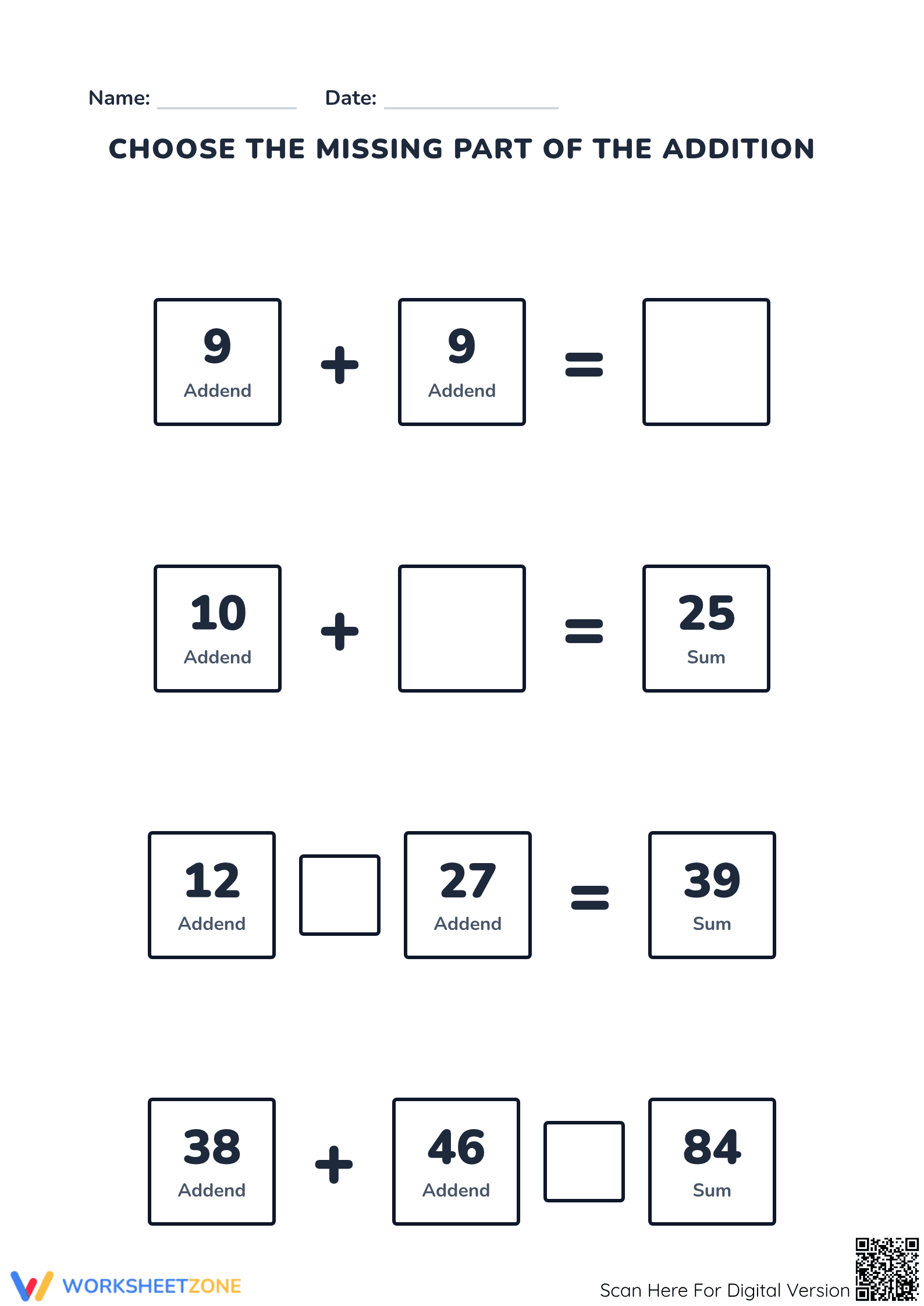

Parts of Addition Worksheet | Essential Grade 3 Math

Paste this activity's link or code into your existing LMS (Google Classroom, Canvas, Teams, Schoology, Moodle, etc.).
Students can open and work on the activity right away, with no student login required.
You'll still be able to track student progress and results from your teacher account.
This Grade 3 addition worksheet helps students master the fundamental components of mathematical equations by identifying missing addends, sums, and operators. By focusing on the vocabulary of addend and sum, students build the conceptual foundation necessary for algebraic thinking and multi-digit computation. It is designed for quick reinforcement of core math facts.
At a Glance
- Grade: 3 · Subject: Math
- Standard:
CCSS.MATH.CONTENT.3.NBT.A.2— Fluently add and subtract within 1000 using strategies and algorithms- Skill Focus: Parts of addition (Addends and Sums)
- Format: 1 page · 4 problems · Answer key included · PDF
- Best For: Quick formative assessment or warm-up
- Time: 5–10 minutes
This single-page PDF features 4 distinct problems that challenge students to fill in different parts of an addition sentence. The worksheet uses clear labels for Addend and Sum, reinforcing mathematical vocabulary. It includes a variety of missing elements, from the final sum to the internal addend and even the operational symbols, ensuring a comprehensive check of student understanding. A full answer key is provided for rapid grading and immediate feedback.
Zero-Prep Workflow
- Print: Generate the single-page PDF in under 30 seconds for your entire class.
- Distribute: Hand out the worksheet as a bell-ringer or exit ticket to gauge student readiness.
- Review: Use the included answer key for a collective class review or individual grading in about 60 seconds.
This streamlined workflow makes it an ideal choice for substitute folders or unexpected schedule changes where teacher prep time is limited.
Standards Alignment
The primary standard addressed is CCSS.MATH.CONTENT.3.NBT.A.2, which requires students to fluently add and subtract within 1000. By identifying missing parts of equations, students also engage with foundational algebraic concepts, focusing on unknowns in all positions. Both standard codes can be copied directly into lesson plans, IEP goals, or district curriculum mapping tools.
How to Use It
Use this worksheet as a formative assessment immediately following a lesson on addition vocabulary. Observe whether students can distinguish between the addends and the total sum when the unknown is placed in the middle of the equation. It is also effective as a 10-minute center activity to reinforce mental math strategies for sums up to 100. Expected completion time ranges from 5 to 10 minutes depending on student fluency.
Who It's For
This resource is designed for Grade 3 students but is highly applicable for Grade 2 enrichment or Grade 4-5 intervention. It supports English Language Learners by providing visual labels for mathematical terms. Pair this with a physical number line or base-ten blocks for students who require concrete modeling to solve for the missing parts.
According to the RAND AIRS 2024 report, high-quality supplemental materials that focus on mathematical vocabulary and equation structure significantly improve student performance on standardized assessments. This worksheet targets CCSS.MATH.CONTENT.3.NBT.A.2 by requiring students to identify addends and sums in various positions, a skill that Fisher & Frey (2014) identify as critical for the gradual release of responsibility in mathematics. By isolating the parts of addition, the resource ensures that students are not just performing rote calculation but are understanding the underlying logic of the operation. Research from EdReports 2024 suggests that such targeted practice helps bridge the gap between basic arithmetic and early algebraic reasoning. This 4-problem set provides the precise, focused repetition needed to solidify these concepts in a classroom setting without overwhelming the learner with excessive text.


