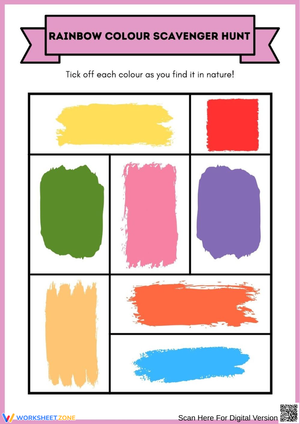
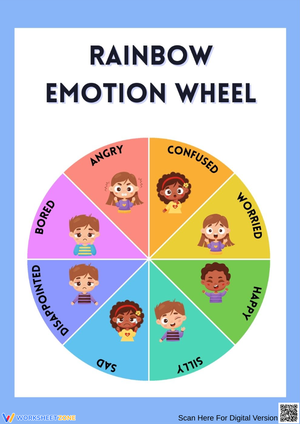
These 2nd grade rainbow printable worksheets resources give teachers a ready set of skill-focused activities for one of the most naturally engaging science topics at this grade level — a topic where student curiosity is already high before instruction even begins. The set covers color sequencing, light science diagrams, and reading for information, with enough variety to fit across multiple lesson formats without repetition.
What's Inside the Set
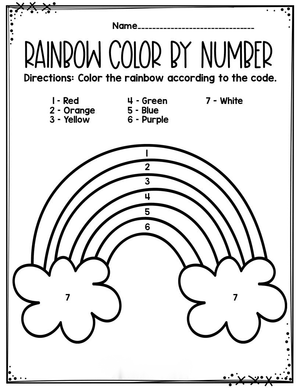
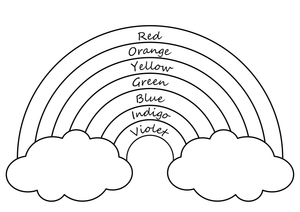
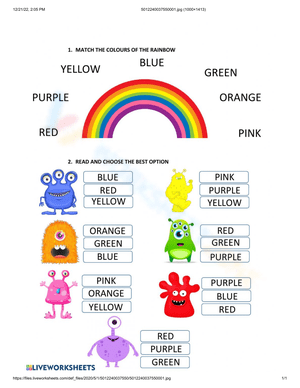
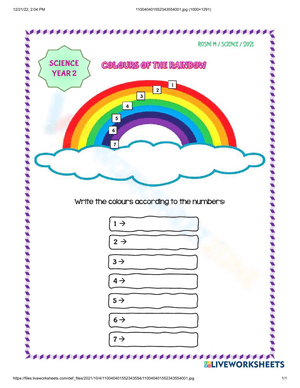
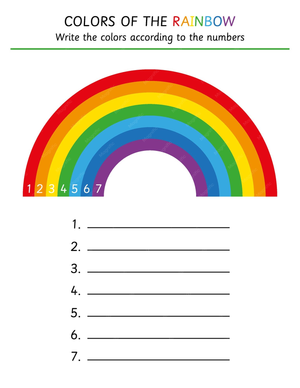
The resources target three distinct skill areas. Color order: students sequence the visible spectrum using ROY G. BIV as an anchor, filling in labeled arcs, sorting color chips into the correct position, or correcting a rainbow that has been intentionally scrambled. Light science diagrams: each worksheet walks students through a labeled cross-section of a raindrop, with arrows showing how sunlight enters, bends, reflects off the back surface, and exits as separate color bands. Reading for information: short passages explain refraction and reflection at an accessible second-grade level, followed by comprehension questions that ask students to identify cause and effect — a core RI.2 standard that the rainbow topic illustrates unusually well.
One worksheet focuses specifically on vocabulary, asking students to match terms like refraction, reflection, and spectrum to definitions and then use each word in a sentence drawn from the passage they have just read. That low-stakes writing task reveals how much students actually understand versus how much they have simply memorized the sound of a word.
Mistakes Students Make That the Worksheets Help You Catch
The most predictable error isn't with the science — it's with the color sequence. Students confidently place violet before indigo because, in their visual logic, "purple comes before dark purple." Indigo is genuinely hard for 7-year-olds to distinguish from the blue on its left and the violet on its right, and many adults share the same difficulty. A worksheet that asks students to color each arc from a labeled key — rather than from memory — makes this distinction visible in their work and opens a quick whole-class discussion about why scientists named a color most people can barely see as distinct.
The second consistent error shows up on diagram worksheets: students draw the exiting light beam going upward rather than downward toward the observer. They understand that the raindrop "bends" light, but they haven't grasped that bending changes direction, not just color. Walking through the diagram one arrow at a time — having students narrate each step before drawing it — surfaces this misconception faster than re-explaining refraction verbally.
How to Build These Worksheets Into a Weather or Light Unit
These resources work best when they're sequenced deliberately rather than dropped in as one-off activities. The vocabulary-matching worksheet runs well as a pre-teaching activity two days before students encounter a diagram, giving terms like spectrum and refraction time to settle before students have to apply them under the cognitive pressure of following arrows on a cross-section. The diagram worksheet itself works best in small groups where you can ask students to narrate each arrow as they draw it — narration surfaces the directional misconception early, and it's far easier to correct at that stage than after the whole class has drawn the same wrong ray.
The color-sequencing worksheet is a natural Monday warm-up during the rainbow unit. It takes about 8 minutes, gives students something concrete to do while attendance is handled, and provides a quick formative read on who still needs the mnemonic anchored. For teachers using science journals, the reading comprehension worksheet works well after the experiment stage — students annotate as they read, answer questions, and return to their notes when preparing for end-of-unit discussion. That return visit is a form of spaced retrieval that research consistently supports for vocabulary retention at this age.
The 2nd grade rainbow printable worksheets set also fits cleanly into a station rotation. A science station pairs a diagram worksheet with a glass of water near a sunny window — students sketch what they observe in real light and compare it to what the labeled cross-section shows. The comparison between their own sketch and the diagram usually generates genuine questions rather than passive copying.
Standard Alignment
These resources connect directly to NGSS 1-PS4-3, which asks students to plan and investigate the effect of placing objects in the path of a beam of light — a standard many second-grade classrooms revisit when the curriculum reaches weather and the visible spectrum. The strongest classroom placement is after an introductory hands-on experience with a prism or a water glass on a sunny windowsill, so students arrive at the diagram worksheet with a physical referent already in memory. The reading comprehension worksheets support CCSS.ELA-LITERACY.RI.2.3, which targets identifying connections between events in an informational text — here, the link between sunlight entering a water droplet and a specific color band emerging on the far side.
Adjusting the Set for a Range of Second-Grade Learners
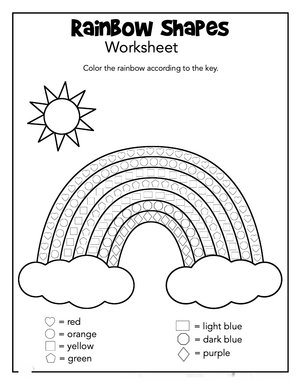
Students who are still solidifying color recognition work well with coloring worksheets that include a labeled key alongside each arc. They don't have to hold ROY G. BIV in working memory while also managing a crayon and staying inside arc lines — removing one cognitive demand at a time makes the sequencing itself accessible without reducing the science content.
For students who move quickly through color-order work, the diagram worksheets extend the challenge considerably. Ask them to add a second raindrop showing a double rainbow, note that the outer arc reflects at an angle greater than 42 degrees, and write a caption explaining why the colors appear in reverse order in the secondary bow. That task requires spatial reasoning the standard worksheet doesn't demand. Students reading below grade level benefit from using the 2nd grade rainbow printable worksheets vocabulary-matching activity before the reading passage rather than after — it functions as a word preview that lowers the barrier when those terms appear embedded in paragraph context.
Frequently Asked Questions
Do these worksheets require any materials beyond printing?
Most need only crayons or colored pencils. The diagram worksheets work with a pencil alone. If you run the station rotation described above, a glass of water and a sunny window are the only additional materials involved — nothing that requires advance ordering or a supply budget.
Can the reading passages be used independently from the diagram and coloring worksheets?
Yes. Each worksheet stands alone. The reading passages work as a standalone literacy activity within a weather unit even if you're not running the full light-science sequence. Comprehension questions are self-contained, so there's no dependency on other worksheets being completed first.
When in a unit do the diagram worksheets land best?
After students have seen refraction demonstrated physically — a prism, a water glass on a sunny windowsill, or a short video clip of light splitting through a raindrop. Showing students the 2nd grade rainbow printable worksheets diagram before any physical experience tends to produce shallow engagement; most students will copy the arrows without reasoning about direction. A concrete referent turns the diagram into an explanation of something they have already seen rather than a transcription task.












 Interactive Worksheet Maker
 Quiz Maker
 Word Search Maker
 Crossword Puzzle Maker
 Word Scramble Generator
 Sentence Scramble Generator
 Handwriting Worksheet Generator
 Name Tracing Generator
 Fill In The Blank Generator