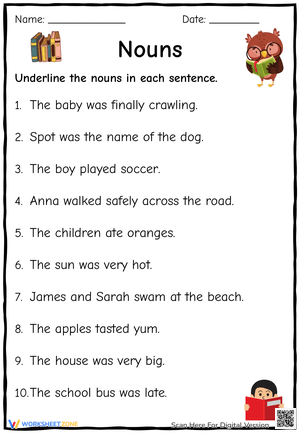
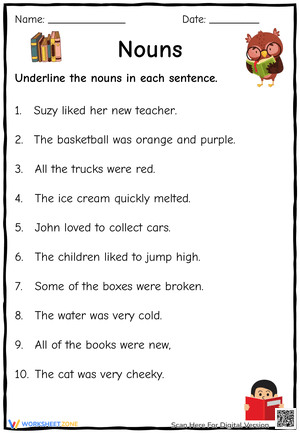
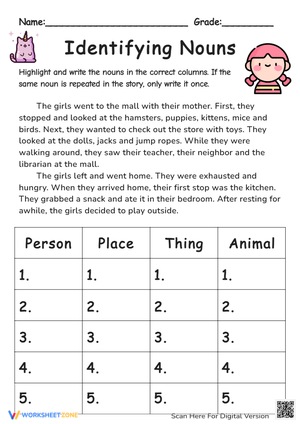
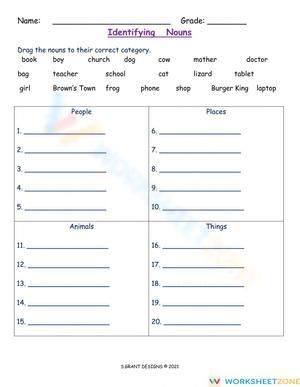
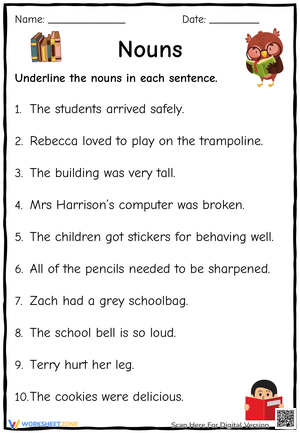
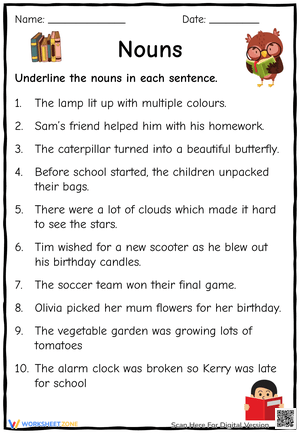
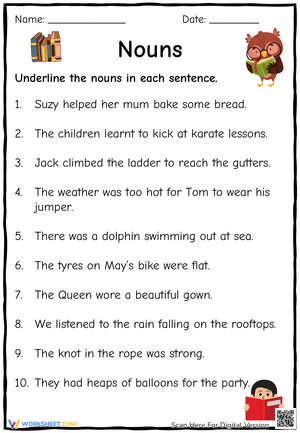
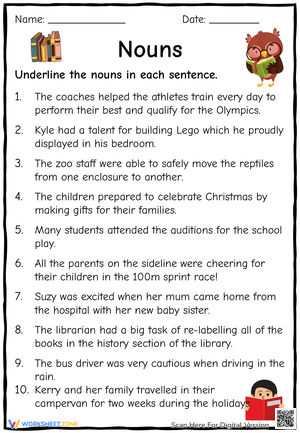
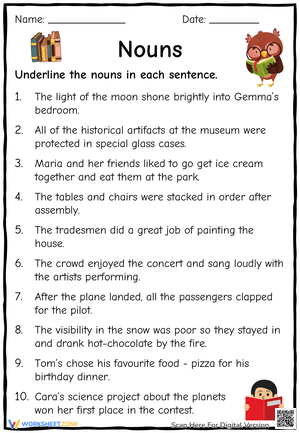
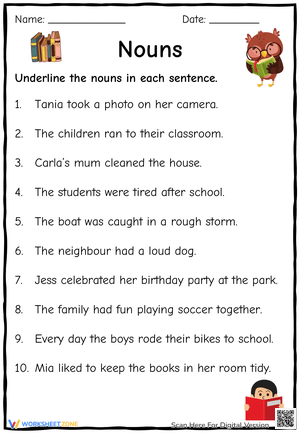
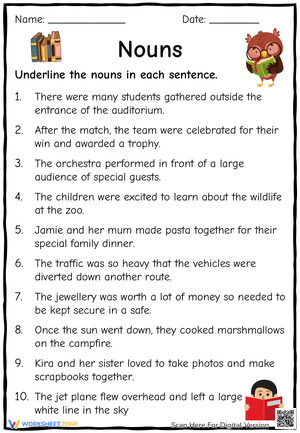
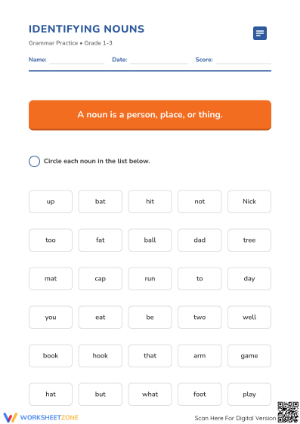
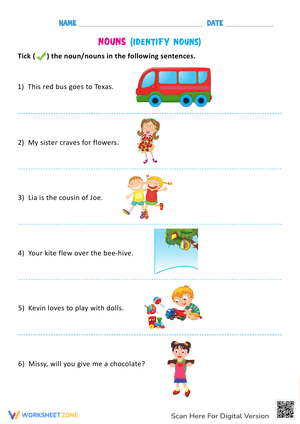
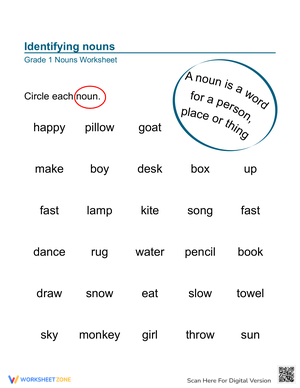
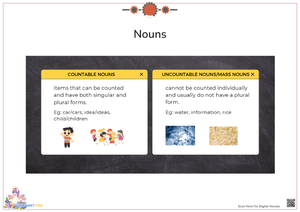
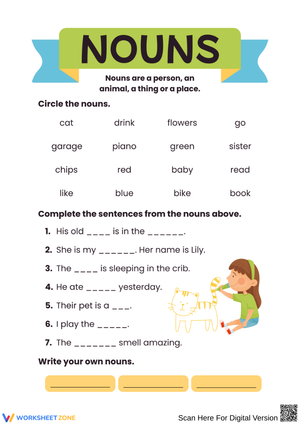
These 2nd grade identifying nouns worksheets move students past the "person, place, or thing" shorthand they picked up in first grade and into the more demanding work of sorting common from proper nouns, naming collective noun groups, and spotting abstract nouns in a sentence. Each worksheet focuses on a distinct noun category, so teachers can pair it directly with that day's instruction instead of pulling out a generic grammar packet and hoping the timing lines up.
The Noun Categories Each Worksheet Covers
The set addresses three main areas of noun study, each representing a real cognitive step forward for seven- and eight-year-olds.
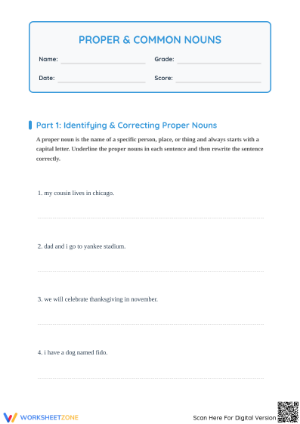
Common and proper nouns anchor most of the early worksheets. Students sort words into labeled columns, underline proper nouns in short paragraphs, and rewrite sentences with correct capitalization. The sorting format forces a decision — a student cannot passively scan a word list and feel done. Fix-the-sentence exercises are especially effective here because students encounter the error in context, not in isolation, which is where capitalization actually matters.
Collective nouns — introduced under CCSS L.2.1.A — get their own focused practice. Matching tasks pair animal groups with the correct collective term: a pride of lions, a school of fish, a murder of crows. These exercises double as vocabulary work, which matters because most second graders have never encountered "flock" or "herd" as grammar-specific terms before seeing them on a worksheet.
Abstract nouns appear in the later worksheets, woven into read-and-circle tasks alongside concrete nouns. That mix is deliberate — students have to read carefully before deciding whether a word names something they can hold or something they can only feel. That act of pausing and rereading is the real skill being built.
Mistakes Students Make That These Worksheets Help You Catch
The most persistent problem is not what teachers usually expect. Most second graders handle "dog" and "teacher" without trouble. The confusion comes when a proper noun spans multiple words. Students who correctly capitalize Monday will write new york city in a fix-the-sentence task because they treat capitalization as a single-word rule, not a category concept. Watching for that specific error in completed worksheets tells a teacher far more than a class discussion would about whether the rule has truly been internalized.
Abstract nouns produce a different kind of gap. When students circle nouns in a paragraph, they skip past courage or freedom and land on the nearest action word instead — they are searching for something that feels graspable, and abstract terms don't trigger that recognition yet. A brief conversation before the worksheet, connecting the abstract noun to something the class actually experienced ("Remember when Marcus gave his speech even though he was nervous? That took courage — and courage is a noun"), makes the subsequent circling task noticeably more accurate.
Fitting These Worksheets Into a Real Teaching Week
The most reliable use of 2nd grade identifying nouns worksheets in actual classrooms is as a five-minute entry task on the days when grammar is not the main lesson. Students settle in, work independently, and teachers circulate — picking up an informal read on who still confuses "library" (common) with "Lincoln Elementary" (proper) before the whole class has moved on. That's a faster diagnostic than any exit slip because it happens before instruction, not after.
For teachers running literacy stations, placing one worksheet at an independent work station gives students meaningful practice that connects naturally to nearby reading material. A student circling nouns in a sentence about a flock of geese, sitting next to a book about bird migration, finds the grammar far less arbitrary. For the eight minutes before afternoon specials when a full lesson isn't possible, a collective-noun matching worksheet gives those minutes real instructional weight without requiring any setup or teacher direction.
Exit tickets work well with the proper noun capitalization worksheets specifically. A two-sentence rewriting task at the close of a grammar lesson gives clear data on who is ready to move toward verb and adjective work — and who needs a small-group pull the following morning before the class moves on.
Adapting These Worksheets for Different Student Levels
For students still building confidence with basic noun recognition, pair the concrete-noun worksheets with a labeled picture reference card — a simple visual anchor listing common objects under each noun category. The goal is to keep the cognitive demand on noun identification, not vocabulary retrieval. Reducing that vocabulary barrier lets the grammar practice actually happen.
Students who move through sorting and circling tasks quickly benefit from a writing extension: take five nouns from a completed worksheet and use each one in an original sentence. That task surfaces whether a student understands noun function, not just noun labels. Abstract nouns make the strongest extension prompts — writing a sentence that gives bravery a specific, concrete meaning in a story context is genuinely difficult at this age, and the attempts show exactly where a student's understanding sits.
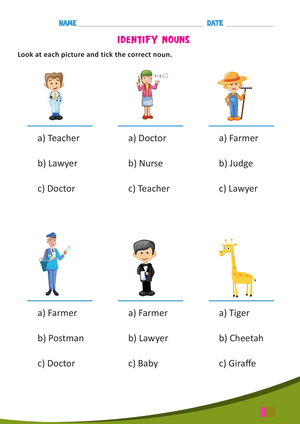
English Language Learners generally do better starting with picture-matching and sorting worksheets before moving to read-and-circle formats. Visual cues support comprehension in a way that raw sentence text doesn't, and success on an earlier worksheet builds the confidence to tackle an abstract-noun task later in the set without shutting down.
Standard Alignment
The worksheets align to CCSS L.2.1, which addresses conventions of standard English grammar and usage at the second-grade level, and specifically to CCSS L.2.1.A, which requires students to use collective nouns. Capitalization work connects to CCSS L.2.2.A, which covers the capitalization of holidays, product names, and geographic names — the category of proper nouns most likely to trip students up in their own writing. In practical classroom terms, L.2.1 and L.2.1.A tend to anchor the first half of the school year, when teachers are building grammar foundations before the focus shifts to longer writing projects. The 2nd grade identifying nouns worksheets in this set follow that same instructional arc — common and proper nouns appear in the earlier materials, collective and abstract nouns after students have the basic sorting concept under control.
Frequently Asked Questions
Why do students keep missing abstract nouns even after instruction?
Second graders build noun recognition around the concrete — they learn nouns by pointing at things. Abstract nouns don't trigger that same pointing reflex, so when students circle nouns in a paragraph, they tend to skip past freedom or sadness because those words don't match their internal model of what a noun looks like. Explicit instruction that frames abstract nouns as "words that name feelings or ideas — not objects, but still nouns" helps, and so does practicing on sentences where the abstract noun holds the subject position, making its grammatical role impossible to overlook.
Can these worksheets work as homework?
Yes, with one caveat: the collective noun matching worksheets assume students have already encountered the vocabulary in class. Sending one home before any instruction on terms like pod or gaggle produces frustration rather than practice. The common and proper noun sorting worksheets travel home cleanly — students are applying a rule to words they already know, not learning new vocabulary in isolation while a parent watches helplessly.
How do I use these worksheets with students who finish early?
The most productive extension is to flip the task: instead of identifying nouns in a given sentence, students write their own sentence using a noun from the worksheet, then underline the noun and label its type. For collective noun worksheets, ask early finishers to invent a plausible collective noun for a group not on the list — the reasoning required to construct one shows deeper understanding than matching one correctly. These 2nd grade identifying nouns worksheets also convert easily into a peer review task: one student circles the nouns, a partner checks and challenges any disagreements, and the two talk through the ones they don't agree on.












 Interactive Worksheet Maker
 Quiz Maker
 Word Search Maker
 Crossword Puzzle Maker
 Word Scramble Generator
 Sentence Scramble Generator
 Handwriting Worksheet Generator
 Name Tracing Generator
 Fill In The Blank Generator