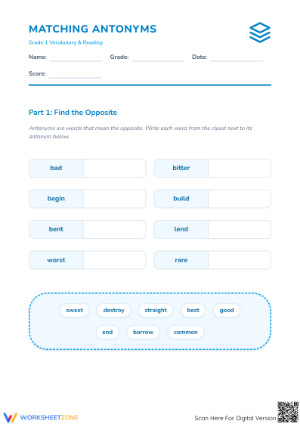
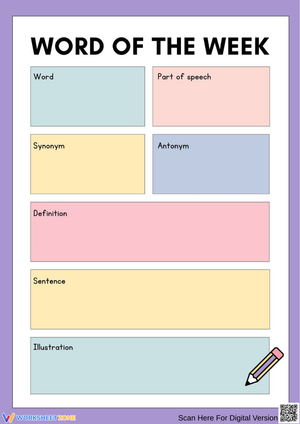
These antonyms worksheets for 2nd grade give teachers a set of standalone practice resources built around the relational vocabulary work that defines second-grade ELA — the shift where students stop treating words as isolated labels and start seeing them as parts of a meaning system. Word pairs move from spatial opposites to more descriptive adjective pairs, following the progression teachers actually use across the school year. Each worksheet targets a distinct task, so it can slot into independent work, small groups, or literacy centers without rearranging the lesson plan.
What Students Do Across the Set
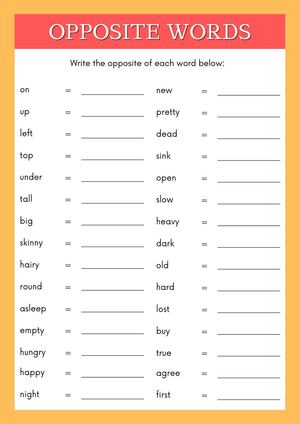
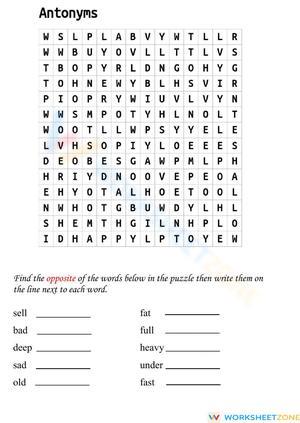
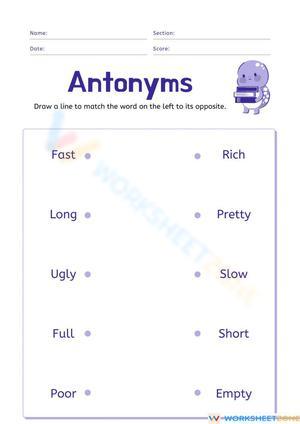
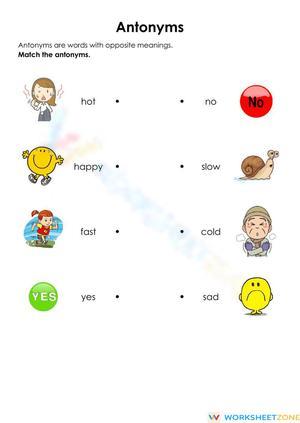
The tasks vary by worksheet and by the type of antonym relationship being practiced. Some worksheets ask students to match word pairs by drawing lines or sorting columns — a format that works well for complementary pairs like awake/asleep or alive/dead, where no middle ground exists. Others ask students to identify an antonym within a sentence context, which is harder and more useful: a student who correctly writes short as the antonym of tall on a matching task may still write warm instead of cold when asked to change the meaning of "the soup was very hot." Sentence-level tasks make that gap visible before it gets embedded as a habit.
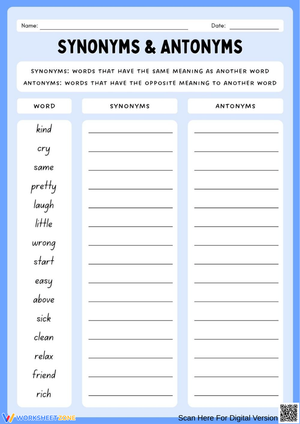
A third group of worksheets presents a word and asks students to generate the antonym independently, then use it in a sentence. This moves vocabulary practice toward productive use — actual writing — rather than recognition alone. The word pairs across the set include:
- Spatial and directional opposites: above/below, in/out, over/under, forward/backward
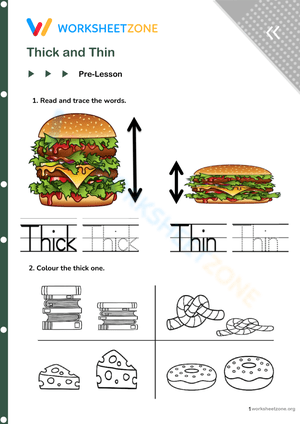
- Physical quality pairs: rough/smooth, heavy/light, deep/shallow, thick/thin
- Emotional and descriptive pairs: happy/sad, loud/quiet, brave/afraid, tidy/messy
- Action opposites: push/pull, give/take, win/lose, buy/sell
Mistakes Students Make That Are Worth Catching Before They Stick
The most predictable error is the context-free opposite swap. Students who are strong at antonym matching often hit a wall on sentence-revision tasks because they know a word's antonym in isolation but not across contexts. The clearest example is hard: paired with soft on a texture task, most students get it right. But in the sentence "the hike was very hard," a significant number will still write soft rather than easy. That tells you they memorized the pair, not the meaning relationship. These worksheets surface exactly this pattern because they include both matching tasks and sentence tasks within the same skill area.
A second issue is antonym/synonym confusion. At this age, students understand that the two categories are different, but when asked to produce a word on the spot, they will occasionally offer a synonym — especially under time pressure. Seeing large and writing big is the classic instance. It is not random; it happens because both relationship types involve "words that go together," and the distinction between same-ish and opposite is genuinely subtle until students have sorted enough pairs to internalize it. A quick class sort of five or six word cards at the start of a lesson resets that distinction before students move into independent work.
Building These Worksheets Into Your Instructional Week
The worksheets that work best as warm-ups are the matching and circling formats — low-stakes entry tasks students can start without waiting for instructions. The Monday morning antonyms worksheets for 2nd grade routine of five pairs on the board as students settle in is genuinely useful: the task is clear, the cognitive demand is right for re-engagement after a weekend, and it takes four to six minutes. Save the sentence-rewrite and word-generation worksheets for the middle of a lesson block, after brief whole-group instruction, when students have the working memory available for more demanding work.
In literacy centers, one worksheet per rotation works well. Pair a word-generation worksheet with a vocabulary notebook so students record the new pairs for later reference. During small-group instruction, the sentence-level worksheets are worth doing aloud first — read the sentence together, discuss what it means, then ask students to change the underlined word to its antonym. That oral step before writing reduces the number of students who complete the task correctly without actually understanding the shift in meaning.
Standard Alignment
These worksheets align to CCSS.ELA-LITERACY.L.2.5.b, which asks second graders to distinguish shades of meaning among closely related words. Antonym work is central to this standard because understanding that enormous and tiny are opposites requires knowing where each word sits on a scale of size — that is shades-of-meaning thinking, not just opposite-pair recall. The standard sits in the Language strand under Vocabulary Acquisition and Use and builds toward the third-grade expectation that students identify and distinguish synonyms and antonyms for words encountered in context.
Adjusting the Set for a Range of Learners
For students still at the word-level reading stage, pair the worksheet with a printed word bank. This removes the retrieval burden and lets the student focus on the relationship between words rather than on spelling from memory. Visual supports — a small illustration next to each word — extend this further and are especially useful for English language learners who may understand the concept of an opposite in their home language but are still building English vocabulary. The matching-format worksheets suit this group well because the answer is present on the page; students are making a conceptual decision, not a recall one.
Students who move through basic pairs quickly benefit from tasks that ask them to find antonyms in context: given a short paragraph, mark every adjective and write its antonym in the margin. That task is harder than it sounds because adjectives like hard, light, and sharp each have more than one antonym depending on usage, and deciding which fits requires re-reading for meaning. The antonyms worksheets for 2nd grade in this set include items that touch this territory — enough to extend strong readers without requiring a separate advanced version of every resource.
Frequently Asked Questions
When in the school year should antonym instruction begin?
Most second-grade teachers introduce antonyms formally in the first quarter, after students have settled into word study routines. Simple spatial and physical pairs — up/down, hot/cold — work well as entry points because the concepts are easy to demonstrate with classroom objects. By the second quarter, students are typically ready for the sentence-revision tasks, where knowing a word's antonym is only part of the job; they also have to understand the sentence well enough to rewrite it coherently.
What is the difference between antonyms and synonyms, and how do I explain it to 7-year-olds?
Antonyms are words with opposite meanings; synonyms are words with the same or very similar meanings. The classroom explanation that tends to land at this age is: antonyms pull words to opposite ends, synonyms keep words close together. A brief physical demonstration — students step apart when you say an antonym pair, step together for a synonym pair — anchors the concept without relying on abstract definitions, and it takes less than two minutes to set up.
Can these worksheets be used for homework, or are they better kept in class?
The matching and circling worksheets travel well as homework because they require little context-setting and most families can support them without preparation. The sentence-rewrite worksheets are better kept in class, at least until students have practiced the format several times with teacher guidance. Students who have not worked through the process orally first will often change the wrong word in a sentence, or change it to a related word that is not actually an opposite. The antonyms worksheets for 2nd grade that work best as independent homework are the ones where the answer is constrained: match the pair, circle the opposite, fill in the blank from a word bank.












 Interactive Worksheet Maker
 Quiz Maker
 Word Search Maker
 Crossword Puzzle Maker
 Word Scramble Generator
 Sentence Scramble Generator
 Handwriting Worksheet Generator
 Name Tracing Generator
 Fill In The Blank Generator