2nd grade present tense verbs printable worksheets give teachers a direct way into one of early grammar's harder moments: the point where a student's natural speech patterns start to conflict with written English conventions. The set covers subject-verb agreement with singular and plural subjects, third-person singular -s and -es endings, and the irregular "to be" forms — am, is, are — that students encounter daily but rarely think about analytically. Each worksheet isolates a specific verb pattern so students practice one rule at a time rather than absorbing a cluster of exceptions at once.
The Verb Skills Built Across the Set
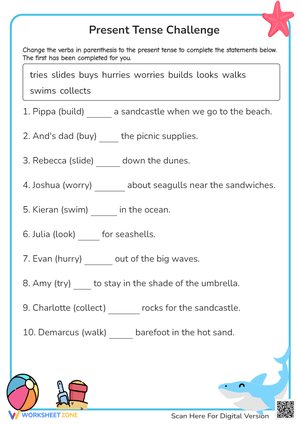
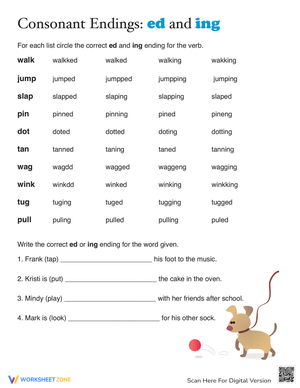
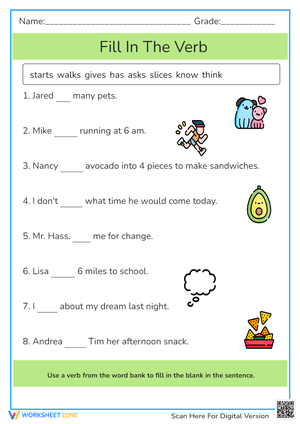
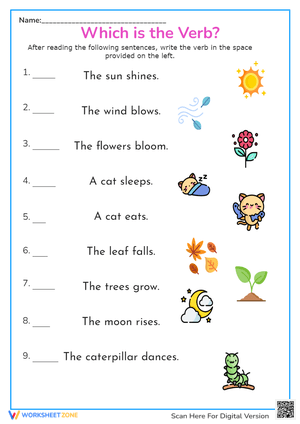
Students work with present tense verbs in several distinct ways across these worksheets:
- Choosing the correct verb form from two options: The dog run / runs to the door.
- Rewriting sentences with a changed subject so the verb form must shift — turning "They play outside" into a sentence with "She" as the subject
- Sorting verb forms into singular-subject and plural-subject columns
- Correcting agreement errors planted in short passages
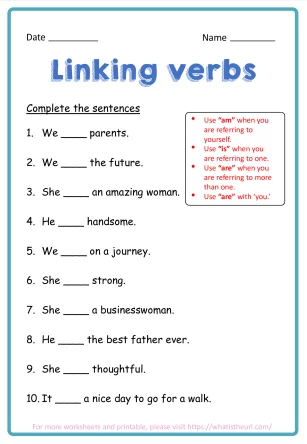
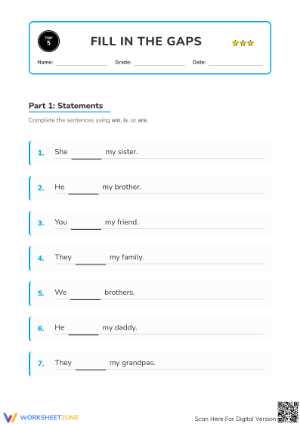
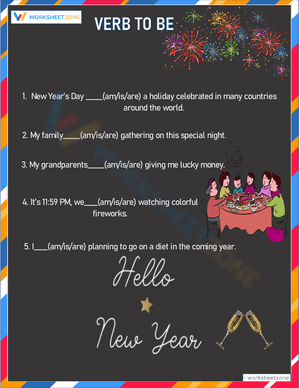
- Filling in the correct form of "to be" for a range of given subjects
Each task type asks students to make a slightly different cognitive move. The rewrite task is particularly diagnostic. If a student fills in a blank correctly but produces errors when rewriting a full sentence from scratch, the rule isn't automatic yet — it's still a conscious lookup rather than a reliable habit. That distinction matters when you're deciding who needs more practice and who's ready to move on.
Verb Mistakes That Surface in Second-Grade Writing
The most consistent error is omission of the third-person singular -s. Students write "She walk to school" or "He like pizza" and register nothing wrong because the sentence sounds complete to them. For many seven-year-olds, this -s is genuinely absent in conversational speech — sometimes because of a home dialect, sometimes just because spoken English is faster and less rule-governed than written English. The gap between what sounds right and what the written convention requires is real and wide.
A second error pattern is more conceptually interesting: students who already know that nouns add -s to become plural sometimes apply that logic in reverse to verbs. If adding -s signals plurality, why does the singular subject "she" get the extra letter while the plural "they" does not? Students making this error aren't confused — they're overapplying a pattern they've already internalized. Placing "the dogs run" and "the dog runs" side by side in the same exercise puts the asymmetry directly on the page, which is far more effective than explaining it verbally.
Irregular "to be" forms generate a third pattern: students writing "they is" or "me and my friend is going" long after they've demonstrated accuracy on isolated verb drills. Getting the form right in a controlled exercise does not automatically transfer. Pairing worksheet practice with a short editing step — students locate and check every "to be" verb in a piece of their own recent writing — closes that gap more reliably than additional drills alone.
Fitting These Worksheets Into Your Grammar Block
The most productive use of these resources is as a five-to-eight-minute warm-up at the start of a writing block, not as homework. When students retrieve and apply a verb rule just before drafting, the errors you would otherwise see distributed across their independent writing drop noticeably. That's spaced retrieval operating in a practical classroom setting — low stakes, fast, and directly connected to what comes next in the period.
For whole-class instruction, the error-correction worksheet works particularly well on the document camera. Work through the first two items aloud with a think-aloud, then have students complete the rest and compare answers before you reveal corrections. The discussion that follows — "I wrote watches but she wrote watchs" — carries more instructional value than silent independent completion. Students who disagree have to articulate the rule, which is a different and more demanding cognitive act than simply applying it.
2nd grade present tense verbs printable worksheets also serve well as formative checks at the end of a unit. Collect an error-correction worksheet at the start of instruction, then administer a parallel one two weeks later. The side-by-side comparison gives you a concrete record of growth, which is useful in parent conferences and in planning small-group sessions. If five students are still producing the same error on item four, you have the evidence you need to pull that group the following morning.
Standard Alignment
These worksheets address CCSS L.1.1e, which requires students to use verbs to convey a sense of past, present, and future — explicitly naming tense formation as a first-grade standard that continues to be practiced and consolidated in second grade — and CCSS L.2.1, the second-grade mandate for command of standard English grammar conventions in writing and speaking. Present tense verb agreement sits at the intersection of both: it's where the tense awareness introduced in first grade gets sharpened into the consistent, rule-governed production that second-grade writing demands.
In instructional sequence, present tense agreement work typically belongs early in the school year — September and October — because it underlies nearly every sentence students write. Before students can work on sentence combining, descriptive detail, or paragraph structure, they need reliable verb form production. Teachers who use these worksheets in the first units of the year are establishing that reliability before the writing expectations scale up in the second and third quarters.
Adjusting These Worksheets for a Range of Learners
Students who are still uncertain about locating the subject benefit from one added step before they choose a verb form: circle the subject, then write "S" for singular or "P" for plural above it. That slows the process down enough that the agreement rule has time to engage. It also reveals exactly where the breakdown occurs — if a student circles the wrong word, the verb error downstream makes complete sense, and you know what to address.
For students working above grade level, the rewrite tasks in the set can be extended into production practice. Instead of only changing a subject in a provided sentence, these students write three original sentences for each rule — one with a singular noun subject, one with a plural, one with I or you. No fill-in-the-blank exercise replicates the demands of generating your own sentence from scratch. The 2nd grade present tense verbs printable worksheets provide the entry point and the rule reference; the open-ended extension is where stronger writers build real fluency.
For English language learners, it helps to be explicit that the third-person -s is a written academic convention, not a feature of all spoken English varieties. Framing it as a "school writing rule" — one register among several — removes some of the implicit suggestion that a student's home language is incorrect. Students who understand what they're learning and why tend to engage with the practice more readily.
Frequently Asked Questions
My students get these worksheets right but still write "he run" in their drafts. What's going on?
Worksheet accuracy and transfer to independent writing are two different skills. A controlled exercise activates the rule in a supported context; applying it during free writing requires that same rule to be automatic enough to operate alongside all the other demands of composition — generating ideas, spelling, punctuation, and organization all at once. The fix is not more worksheet work alone. Add a focused self-editing step to your writing routine: after drafting, students underline every present tense verb and check each one against its subject before moving to revision. A few weeks of that routine produces more transfer than additional exercises.
How should I approach these worksheets with students who use a dialect in which the third-person -s is not standard?
Teach code-switching directly rather than framing the worksheet practice as a correction of speech. Explain that spoken English varies by community and setting, but academic writing follows a single set of conventions that applies regardless of where a student is from. Students who understand they are learning to write in a specific register — not being told their speech is wrong — engage more readily and experience less conflict between their home language and school expectations. The 2nd grade present tense verbs printable worksheets focus specifically on written academic English, and naming that frame out loud makes the purpose of the practice legible to students.
Should I grade these worksheets or treat them as ungraded practice?
Ungraded practice produces more honest data. When students know a worksheet affects their grade, they slow down, second-guess, and occasionally copy — none of which tells you what they actually know. Use completed worksheets as a quick formative read instead: scan for patterns across the class before filing them. If six students made the same error on a particular item, that's your next mini-lesson topic. Formal assessment of verb agreement belongs in a piece of independent writing where the student is generating sentences without external support — not in a constrained exercise where the correct forms are visible in the answer choices.












 Interactive Worksheet Maker
 Quiz Maker
 Word Search Maker
 Crossword Puzzle Maker
 Word Scramble Generator
 Sentence Scramble Generator
 Handwriting Worksheet Generator
 Name Tracing Generator
 Fill In The Blank Generator