Mastering 2nd Grade Irregular Verbs with Targeted Classroom Worksheets
2nd grade irregular verbs worksheets give students the focused, repeated exposure they need to move past over-generalization — the stage where a child understands that past tense exists but writes goed and runned because the -ed rule is the only tool they have. This set targets the exact verb pairs that second graders encounter most in their reading and writing, organized so teachers can use each worksheet flexibly across a unit or drop one in wherever a student needs it.
Verb Patterns Covered in the Set
The worksheets are sorted around the informal groupings that actually help 7- and 8-year-olds organize new information rather than memorize a random list. Five main pattern types appear across the resources:
- Internal vowel shifts — verbs like run/ran, swim/swam, and sit/sat, where the middle vowel changes in a way students can start to hear if you drill them aloud before they write.
- The -ow to -ew shift — know/knew, grow/grew, throw/threw — a cluster that trips up many second graders who have just learned flew and try to apply it indiscriminately.
- Complete replacements — high-frequency words like go/went, do/did, and have/had that have no logical connection between present and past forms and need straight memorization.
- No-change verbs — hit, put, cut — the ones where students invent a past tense (hitted, putted) because the word feels like it should change.
- State-of-being pairs — am/is → was and are → were, which require students to track not just tense but subject agreement at the same time.
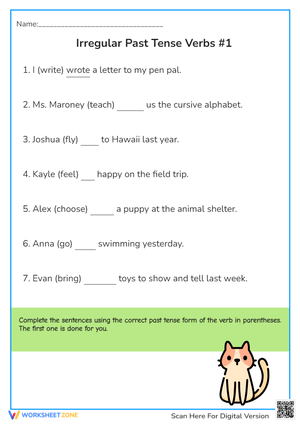
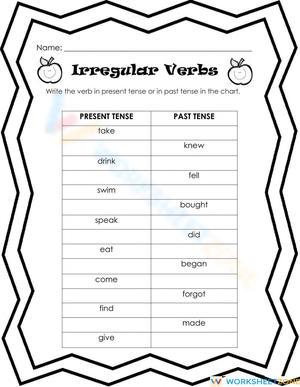
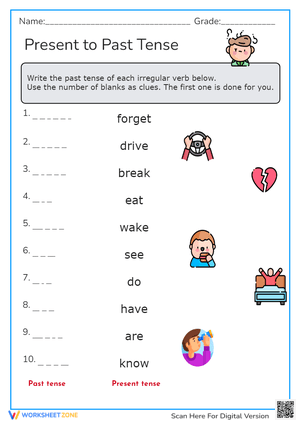
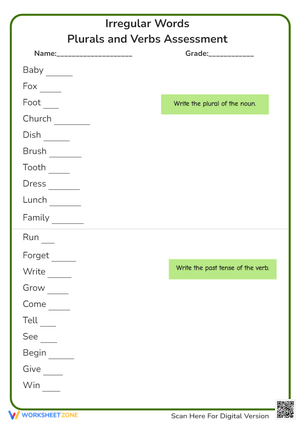
Each worksheet focuses on one cluster so students can notice the pattern before the next one introduces a different type. Task formats include fill-in-the-blank sentences, verb sorting, sentence rewriting in past tense, and short paragraph editing where students locate and correct irregular verb errors in context.
The Verb Errors That Surface Most in Student Writing
Over-generalization is the most persistent problem, and it's worth understanding what it actually looks like before trying to address it. A student who writes I swimmed across the pool is not confused about past tense — they understand tense perfectly. What they haven't internalized yet is that swam is the correct form. That distinction matters for instruction: these students don't need a review of what past tense means. They need pattern-focused practice with the specific verb, not a reteach of the concept.
The no-change verbs create a different kind of confusion. Students hear I hit the ball yesterday and sometimes assume the teacher or the text made an error, because the word looks identical to its present-tense form. Some will write hitted with complete confidence. Others will write hit but circle it in their own drafts, unsure whether they got it right. A brief class discussion about why some words carry their own tense signal — followed by a focused worksheet on hit, cut, put, and let together — does more than any general review lesson at this point.
State-of-being verb errors tend to appear later in the year, once students are writing longer narratives. The switch from is/am to was is manageable on its own, but second graders frequently write they was because they've locked in the singular pattern. Watching for this in completed 2nd grade irregular verbs worksheets lets you plan a small-group session before the error solidifies in independent writing.
Building These Worksheets Into Your Instructional Week
The most reliable placement is the five-minute warm-up before the main writing block. Put one verb pair on the board, ask students to write three sentences using the past tense form, then review together. It takes less time than a full grammar lesson and keeps the forms fresh through spaced retrieval rather than a single teach-and-move-on approach. Monday morning, after a weekend away from academic writing, is particularly well-suited for this: students who knew wrote on Friday will sometimes produce writed on Monday without the quick review.
During a grammar unit, drop in 2nd grade irregular verbs worksheets after direct instruction as the bridge to independent practice. Circulating while students work on a fill-in-the-blank task gives you real-time information about which students are guessing versus which have genuinely internalized the form — information that shapes the next day's small-group work more efficiently than an exit ticket at this level.
For editing practice, the paragraph-correction worksheets fit cleanly into the revision step of a writing cycle. Students who are currently drafting their own narratives are noticeably more attuned to verb choices when they've just spent ten minutes finding errors in someone else's paragraph.
Adjusting Each Worksheet Across Ability Levels
The fill-in-the-blank worksheets with a word bank at the top are the right entry point for students new to a pattern or for anyone who freezes when they can't confirm a guess. The word bank reduces cognitive load enough that students can focus on selecting the correct form rather than retrieving it from memory under pressure. Once they complete those accurately and consistently, remove the bank. Same sentence, same verb, no visible answer — that single change is a meaningful increase in demand without requiring a different resource.
For students ready to go further, the sentence-rewriting tasks carry the most challenge. Asking a student to take a present-tense sentence and rewrite it accurately in past tense requires both retrieval and sentence construction at the same time. A student who finishes early can extend any worksheet by composing two or three original sentences using the target verbs — a low-prep move that doesn't require printing anything extra.
Students still building English language fluency benefit from hearing the verb pairs used in full sentences before they work independently. Reading two or three example sentences aloud — where the past tense form appears in natural context — gives those students the auditory input they need alongside the written task. The structure of 2nd grade irregular verbs worksheets that embed verbs inside full sentences, rather than listing them in isolation, is especially useful here because the sentence's meaning carries part of the tense signal.
Standard Alignment
These worksheets address CCSS.ELA-LITERACY.L.2.1.D, which requires students to form and use the past tense of frequently occurring irregular verbs. That standard is the grammatical anchor of the second-grade language strand and sits directly upstream of the L.3.1 expectation that students produce sentences with accurate verb tense throughout their writing. Teachers who track this standard in writing samples alongside worksheet performance get a fuller picture of where each student actually stands — some students master isolated fill-in tasks but revert to over-generalized forms the moment they're composing original text, which is a meaningful and actionable distinction.
Frequently Asked Questions
Do I need to introduce irregular verbs in a specific order?
Not strictly, but starting with pattern-based clusters makes the early instruction more efficient. Opening with a set like run/ran, swim/swam, sit/sat gives students a model they can apply when they encounter new verbs in the same family. Introducing complete-replacement pairs like go/went lands better once students already understand that irregular verbs are a category — otherwise each replacement feels like an isolated exception rather than part of a broader class of words with their own internal logic.
How do these worksheets work alongside a published grammar program?
They work as targeted supplementary practice. Most second-grade programs move through irregular verbs briefly within a larger tense unit, which often isn't enough repetition for students to carry the forms into writing. These resources give teachers the flexibility to revisit a specific pattern — the -ow to -ew cluster, for example — when it breaks down in student writing, without reteaching the full unit from the beginning.
Can I use these for assessment as well as practice?
Yes. The fill-in-without-support and paragraph-correction formats double as strong formative assessment tools. Collecting a completed worksheet after independent work takes less than two minutes to scan and immediately shows which students have made the go/went transition and which are still writing goed. That information directly informs small-group groupings for the following day. Using the same worksheet format first as guided practice and then again independently — separated by several days — also gives you a clean before-and-after picture of retention without designing a separate assessment task.
Clear All