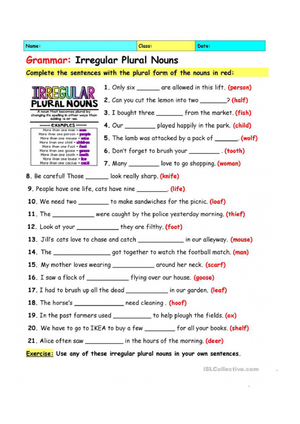
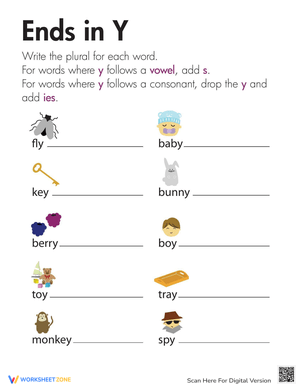
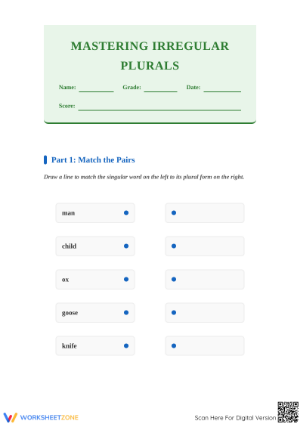
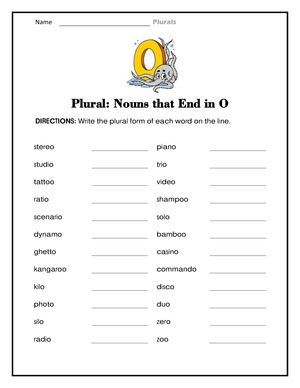
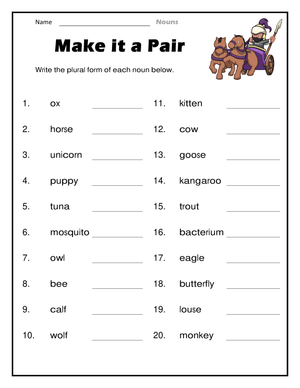
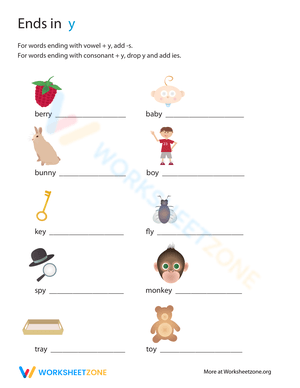
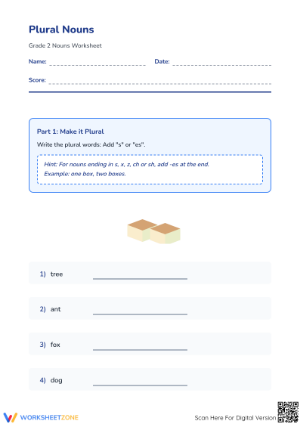
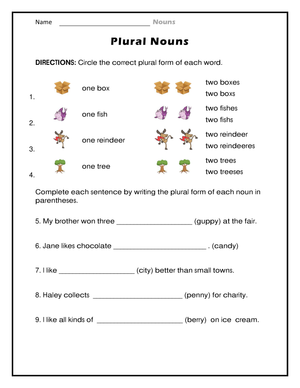
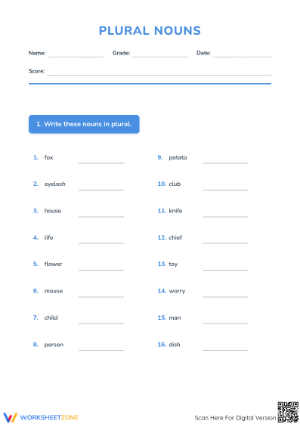
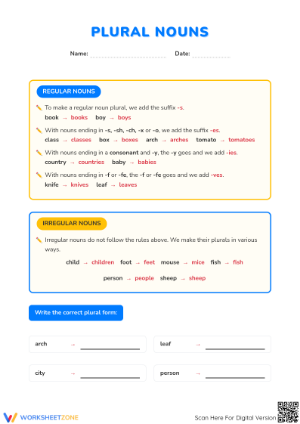
These 2nd grade plural nouns printable worksheets resources address all three categories of plural formation that second graders are expected to control: regular -s endings, -es endings for words closing in a sibilant or affricate sound, and irregular forms that require direct memorization. Each worksheet targets one pattern rather than mixing them, so teachers can assign exactly what a student or small group needs without handing over a review exercise that retreads ground they already hold.
Skills Across the Set
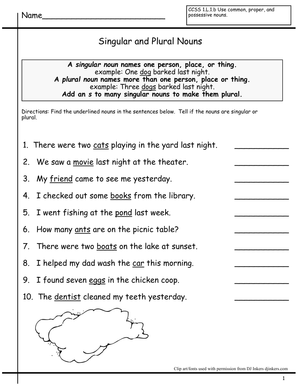
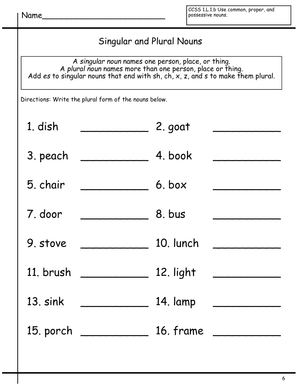
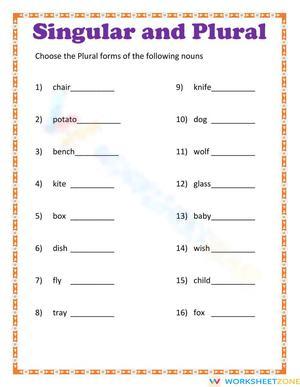
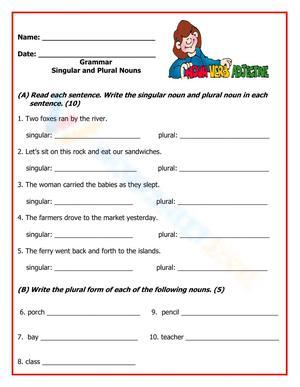
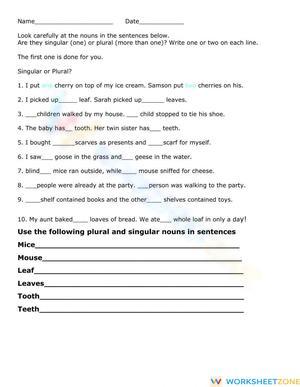
The worksheets move through three tiers of difficulty, though the progression isn't rigid — teachers select the worksheets that match where a student currently is. Across the set, students work in several formats: writing plural forms from singular prompts, underlining plural nouns inside sentences, sorting words by ending rule, and completing sentence frames with the correct plural form. The variety matters because some students internalize a pattern through repeated production while others need a categorization task to see the structural logic.
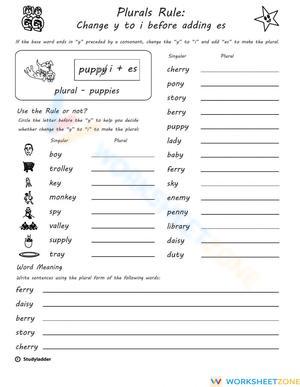
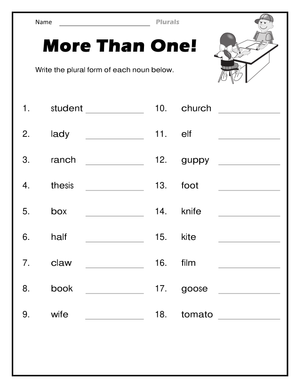
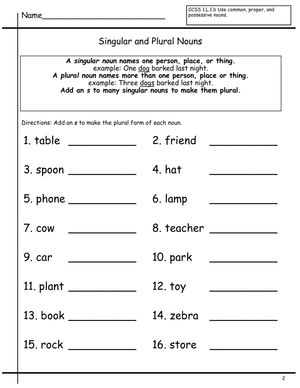
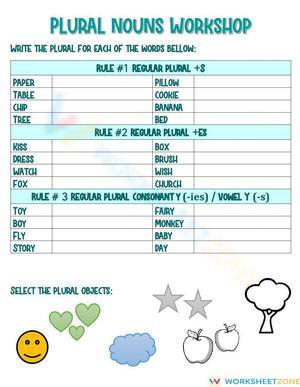
- Regular -s plurals: Students produce plural forms for standard nouns — "lamp," "cloud," "frog" — and locate and mark plural nouns in printed sentences. This builds both production and recognition before the more complex patterns are introduced.
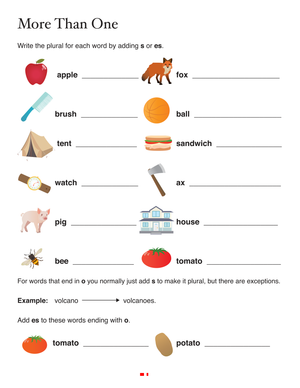
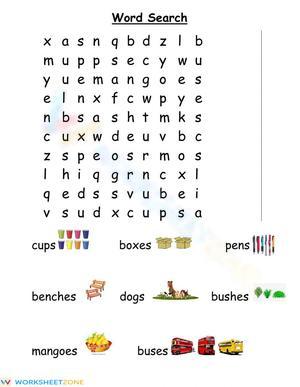
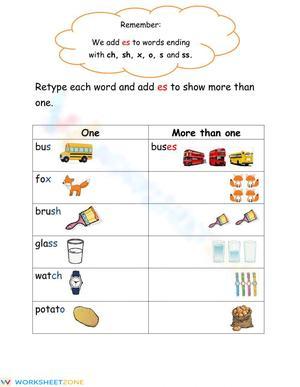
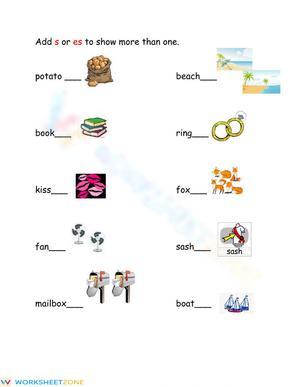
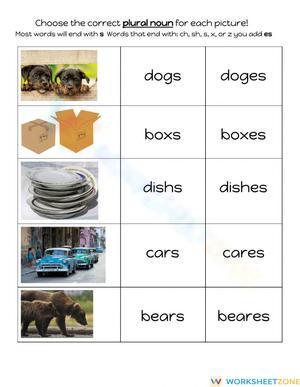
- -es plurals: Words ending in -s, -x, -z, -ch, and -sh. Each worksheet in this group includes an example anchor at the top ("bench → benches," "fox → foxes") so students have a reference without needing to interrupt the teacher. Sorting tasks ask students to group words by final sound pattern before writing the plural.
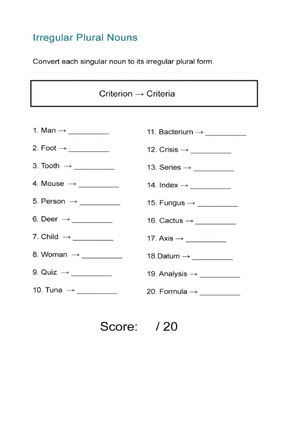
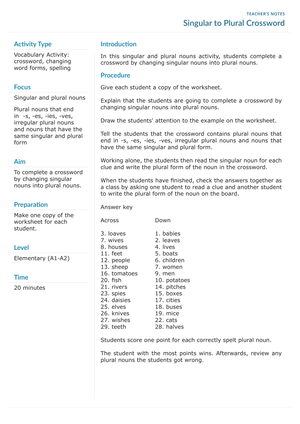
- Irregular plural nouns: The high-frequency forms in the grade 2 standards — child/children, man/men, woman/women, mouse/mice, tooth/teeth, foot/feet — plus the zero-change words (fish, deer, sheep) that many programs underemphasize. Students match, sort by category, and use these forms in sentence context.
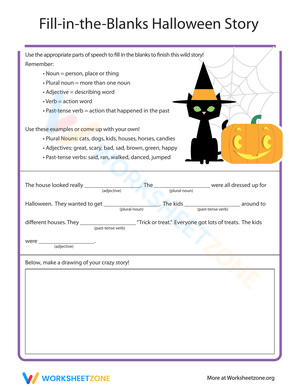
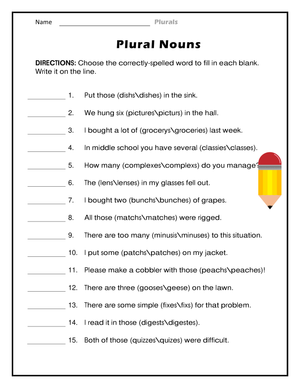
The sentence-level tasks appear on most worksheets as a closing section. Students rewrite or complete two or three sentences using the plural form of an underlined noun. In practice, this is where the gap between knowing a rule and using it under writing pressure becomes visible.
Errors That Show Up in Writing, Not Just Drills
The most persistent -es error isn't that students don't know the rule — it's that they know it when asked directly but drop it under writing pressure. A student who correctly says "boxes" during a class lesson will write "boxs" in a journal entry ten minutes later because her attention is split between spelling the base word and remembering the correct ending. That's a cognitive load problem, not a rule-knowledge problem, and more isolated drills on the rule alone won't close it. The sentence-completion tasks on the 2nd grade plural nouns printable worksheets set exist specifically to surface this gap and address it directly.
Irregular nouns follow a different error pattern. Students who write "mice" correctly on a matching activity will often revert to "mouses" inside a story sentence — the irregular form hasn't transferred from recognition to spontaneous production. The reliable signal that a student has genuinely absorbed an irregular plural is consistent use in unprompted writing, not accuracy on a fill-in task. A few worksheets in the set ask students to write their own sentences using assigned irregular plurals, which is a sharper diagnostic than any multiple-choice format.
Zero-change plurals ("fish," "deer," "sheep") produce more incorrect -s additions than any other pattern at this grade level. Students see a word that looks singular and apply the default rule out of habit. Even brief, direct attention to this category — listing these words on a classroom anchor chart or marking them in a sort — measurably reduces that error rate.
Where These Worksheets Fit in a Real Lesson Plan
The most efficient entry point is the morning warm-up. Project one worksheet at the start of your language arts block, work through the first two or three items together, then let students finish independently. That shared opening gives you a quick read on the class before you split into small groups — and five minutes of modeled thinking shows students how to approach an item without turning it into a full lesson.
For literacy centers, the sorting worksheets run as station tasks without requiring teacher support once students know the format. Students cut and paste singular nouns under the correct rule heading and move through the station at their own pace. The irregular noun matching tasks are better suited for a teacher-led small group, where you can watch for students who are guessing rather than retrieving and prompt them to connect the written form to a word they already say: "You say 'teeth' when you talk — what does it look like when you write it?" The sentence-completion items hold up as exit tickets because a student who gets those right has shown transfer, not just rule recall.
For year-long review, the 2nd grade plural nouns printable worksheets resources work as low-stakes reactivation tools. After plural nouns instruction wraps up in the fall, one worksheet pulled in January — before a new noun unit begins — brings the pattern back without requiring a full re-teach.
Standard Alignment
CCSS.ELA-LITERACY.L.2.1.B requires students to "form and use frequently occurring irregular plural nouns (e.g., feet, children, teeth, mice, fish)," which is the standard most directly served by the irregular-noun worksheets in this set. The regular -s and -es work falls under the broader L.2.1 standard covering noun and verb conventions at grade 2, and it also reinforces the phonics and spelling patterns addressed in L.2.3 — particularly the spelling-sound correspondences students are building at the same time.
In most classroom sequences, -s plurals are reviewed briefly at the start of second grade, since most students carry this pattern from first grade L.1.1.C instruction. A quick diagnostic task shows who retained it and who needs re-teaching. The -es patterns typically receive direct instruction in the fall, and irregular plurals follow from mid-year through spring. The worksheets sequence accordingly: the -s exercises function as review and diagnostic tools, while the -es and irregular materials carry the weight of new instruction.
Adapting Each Worksheet Across Readiness Levels
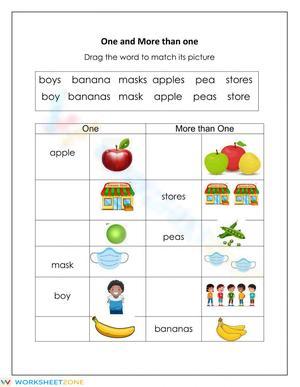
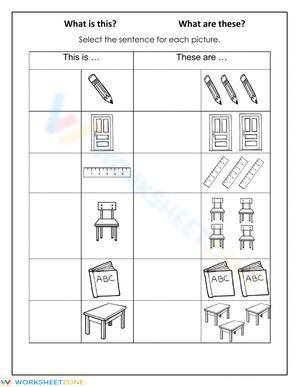
Students working below grade level need the -s rule fully isolated before anything else is layered in. A worksheet that pairs the written word with a small illustration reduces the naming demand so the student can focus on the plural ending itself. Mixing -s and -es items for these students before -s is automatic adds unnecessary load at the wrong time. Hold the combined work until the simpler pattern is reliable under independent conditions.
On-grade students generally handle -s and -es together in sorting formats. Placing both categories side by side helps students notice the structural difference, and sorting tasks that require them to examine a word's final letters before assigning it to a column sharpen that attention in a way sequential instruction sometimes doesn't.
For students who have moved through the regular endings, the 2nd grade plural nouns printable worksheets resources for irregular nouns carry real extension value. Introduce zero-change plurals alongside the standard irregulars, and push these students toward sentence-generation tasks rather than fill-in-the-blank items. A student generating her own sentences with "children" and "teeth" — and catching her own errors during revision — is working at a level that prepares her for possessive nouns and more complex noun phrase structures later in the year.
Frequently Asked Questions
What sequence works best when introducing the three plural types?
Start by checking whether students have retained the -s rule from first grade — a short sort or word-level task reveals this quickly and saves you from re-teaching something most students already know. Introduce -es patterns next, since they connect directly to ending sounds students are working on in phonics at the same time. Save irregular plurals for after -es is stable, because these forms require memorization and benefit from being framed as their own distinct category rather than a harder version of the regular rules.
Can I use these as formative assessments rather than just practice?
Yes, and the sentence-level items are the most informative for that purpose. A student who completes the word-level items correctly but misses the sentence frames is flagging a transfer problem — one that additional word-level drills won't address. The sorting tasks work better as practice than as assessments; students can complete them correctly through process of elimination without having internalized the underlying pattern.
Are these appropriate for first grade or third grade students?
The -s rule worksheets align with first grade L.1.1.C expectations and work for first graders extending their noun knowledge in the second half of the year. The -es and irregular noun worksheets span second and third grade — a third grader still writing "childs" or "tooths" in writing journals benefits from the irregular noun practice without the format feeling below-grade. The sentence contexts use upper-primary vocabulary rather than strictly second grade language.
How do I support students who can state the rule correctly but still make errors in their writing?
More isolated rule practice will not close that gap. These students need application under load — plural noun tasks embedded in sentence writing rather than word-level drills. Assign the sentence-completion and sentence-generation worksheets more heavily for this group, and track plural noun accuracy in their daily writing as the real measure of progress. When a student starts catching her own plural errors during editing without a prompt, the rule has transferred.












 Interactive Worksheet Maker
 Quiz Maker
 Word Search Maker
 Crossword Puzzle Maker
 Word Scramble Generator
 Sentence Scramble Generator
 Handwriting Worksheet Generator
 Name Tracing Generator
 Fill In The Blank Generator