


























Views
Downloads

Essential Plural Nouns Worksheet | Grade 2-3 Grammar
Paste this activity's link or code into your existing LMS (Google Classroom, Canvas, Teams, Schoology, Moodle, etc.).
Students can open and work on the activity right away, with no student login required.
You'll still be able to track student progress and results from your teacher account.
This Grade 2-3 plural nouns worksheet provides a comprehensive framework for mastering noun inflection. Students first review explicit rules for regular suffixes and irregular transformations before applying that knowledge to 20 targeted practice problems. By bridging the gap between grammatical theory and written application, this resource ensures students can confidently pluralize complex words.
At a Glance
At a Glance
- Grade: 3 · Subject: English Language Arts
- Standard:
L.3.1.B— Form and use regular and irregular plural nouns correctly in writing- Skill Focus: Regular and Irregular Pluralization
- Format: 2 pages · 20 problems · Answer key included · PDF
- Best For: Independent practice and grammar reinforcement
- Time: 15–20 minutes
What's Inside
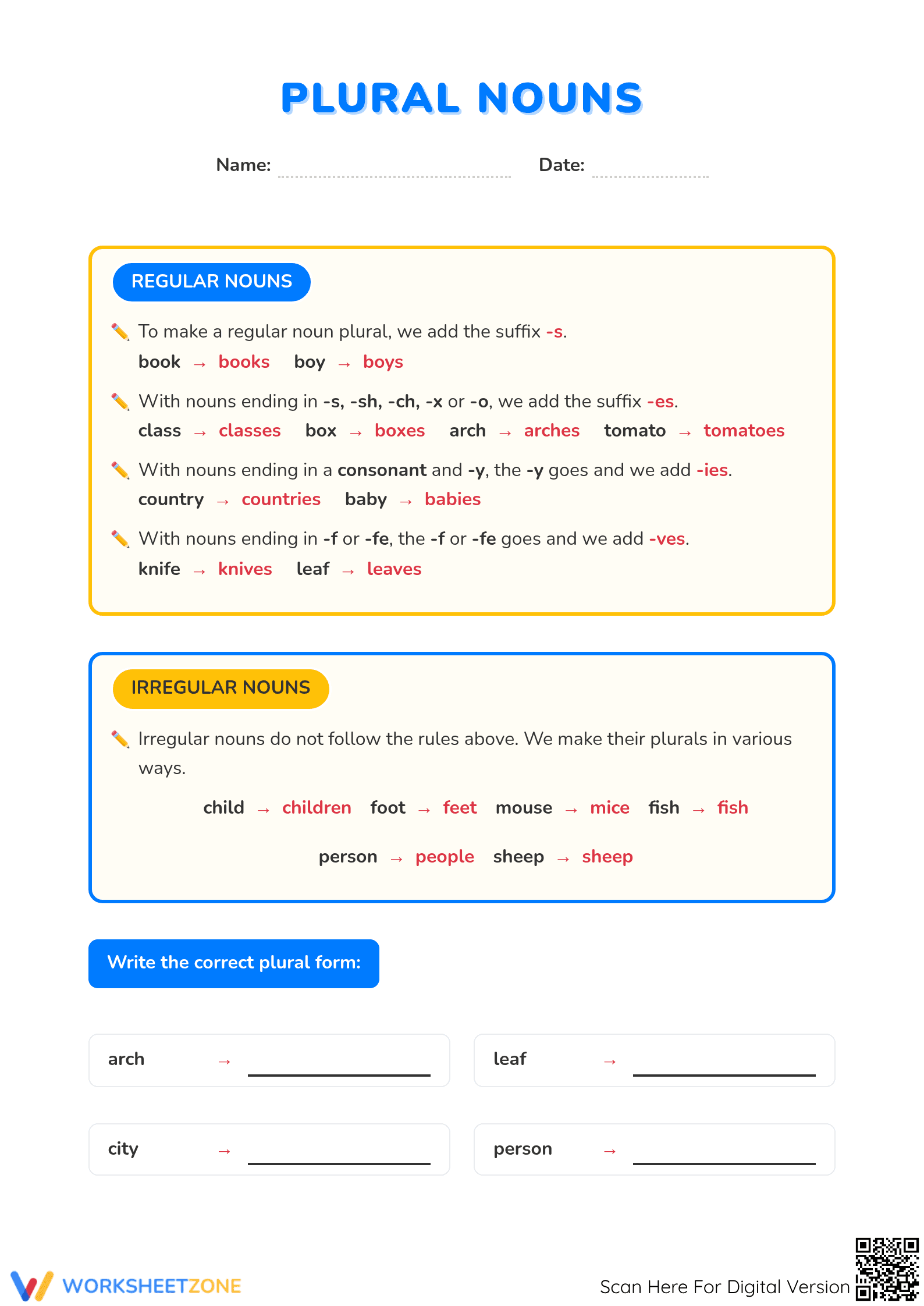
This two-page PDF features a structured layout designed for clarity. The first page contains two high-contrast instructional boxes: one detailing regular pluralization rules (adding -s, -es, -ies, and -ves) and another highlighting common irregular forms like "children" and "mice." Following the instructional guide, students encounter 20 fill-in-the-blank tasks that require converting singular nouns into their correct plural counterparts. A full answer key is provided to facilitate quick grading.
Skill Progression
- Guided Practice: The top half of the first page provides explicit rules and 14 visual examples that serve as a permanent reference for the student during the activity.
- Supported Practice: The bottom of page one offers 4 initial practice items where students can immediately apply the rules while the reference guide is still in view.
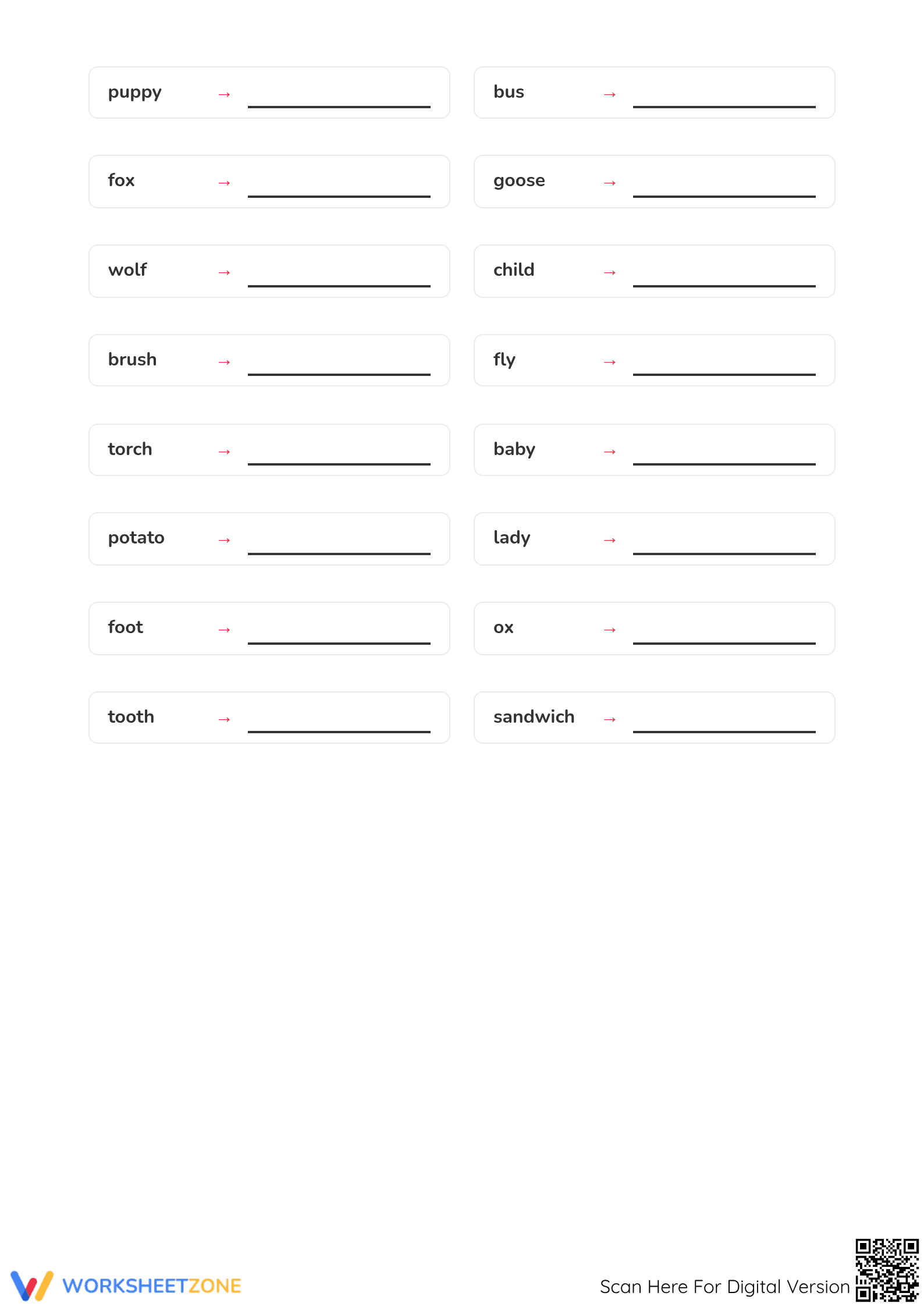
- Independent Practice: Page two presents 16 additional nouns, ranging from simple regular forms to challenging irregulars like "ox" and "goose," requiring students to retrieve rules from memory.
Standards Alignment
This resource is specifically designed to meet `CCSS.ELA-LITERACY.L.3.1.B`, which requires students to form and use regular and irregular plural nouns. It also supports Grade 2 standards regarding frequently occurring irregular plurals. Both standard codes can be copied directly into lesson plans, IEP goals, or district curriculum mapping tools.
How to Use It
Use this worksheet during the independent practice phase of a grammar lesson. After introducing the concept of pluralization, distribute the pages to allow students to work through the 20 items at their own pace. It also serves as an excellent formative assessment; by reviewing specific errors, teachers can identify exactly which spelling rule requires re-teaching. Expect completion in 15 to 20 minutes.
Who It's For
This resource is ideal for second and third-grade students, as well as English Language Learners (ELL) who often struggle with the inconsistent nature of English pluralization. It pairs naturally with a classroom anchor chart or a mentor text that features diverse noun types.
Effective grammar instruction requires a balance between explicit rule-based teaching and contextual application. According to Fisher & Frey (2014), the gradual release of responsibility is vital for linguistic mastery, moving students from teacher-led modeling to independent proficiency. This worksheet implements that research by providing clear "if-then" rules for suffixes like -es and -ves before challenging students with 20 distinct application tasks. By addressing both regular patterns and the high-frequency irregular exceptions mandated by standard L.3.1.B, the resource helps students internalize the morphological changes necessary for fluent writing. Research from the NAEP suggests that students who master these foundational mechanics early are better equipped for complex composition tasks in later grades. This printable PDF provides the structured repetition needed to move these pluralization rules from short-term memory into automatic written production.


