These irregular plural nouns printable worksheets for 2nd grade give teachers a focused set of practice tools for one of the more persistent sticking points in early grammar — words that refuse to follow the add-an-s rule. Each worksheet targets a specific category of irregular form, so students build pattern recognition before they face a mixed set of challenges. The result is practice that holds up in student writing weeks after the initial lesson.
Why Irregular Plurals Trip Up Second Graders
By second grade, most students have internalized the basic plural suffix logic pretty thoroughly. Adding -s or -es works reliably for the majority of words they write, so their confidence is real — and that's exactly what makes the irregular forms feel like a betrayal. When a student who correctly writes cats and boxes then writes gooses or tooths, the error isn't carelessness; it's the overapplication of a rule that has served them well. The instructional task at this grade is helping students recognize that a small set of high-frequency words requires an entirely different mental category.
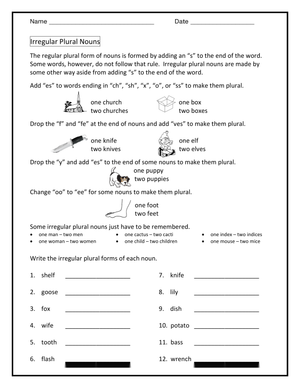
Three distinct patterns show up in this word group: internal vowel changes (man → men, tooth → teeth, goose → geese), complete stem changes (child → children, mouse → mice), and zero-change forms (sheep, deer, fish). Each creates its own confusion. Zero-change plurals are often the last to stick because students expect every plural to look different from its singular — so they write sheeps well into third grade if the word hasn't received direct, repeated attention in second.
The Specific Skills Targeted
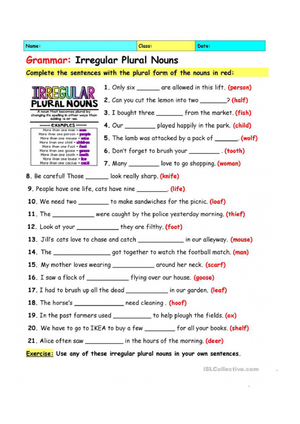
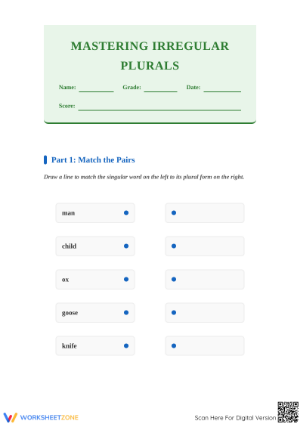
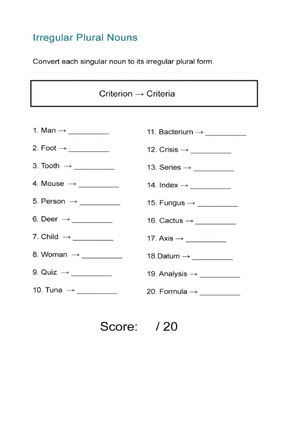
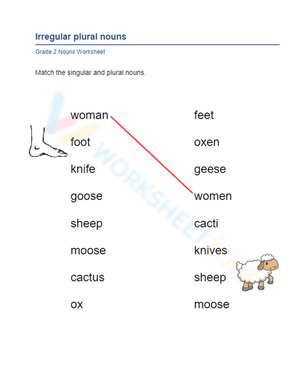
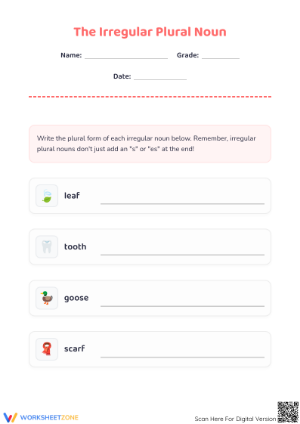
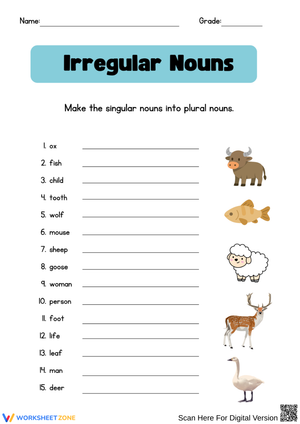
The worksheets move through all three irregular plural categories using four activity formats. Matching exercises pair singular and plural forms side by side, giving students a chance to build visual memory for the pairs before they're asked to produce spellings from recall. Fill-in-the-blank sentences require students to read for context — picking up on quantity words and surrounding meaning — and supply the correct irregular form, which mirrors the actual decision-making process during independent writing. Word sorts ask students to group words by the type of change they undergo, pushing thinking past rote memorization toward genuine pattern awareness. Sentence-writing tasks, placed toward the end of the unit sequence, ask students to generate their own examples — the point where it becomes clear whether a word has actually landed in long-term memory or just in short-term performance.
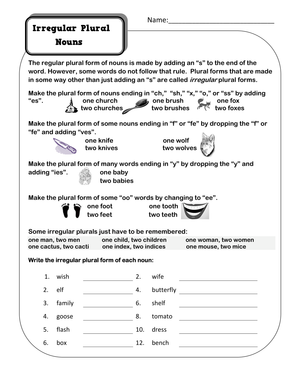
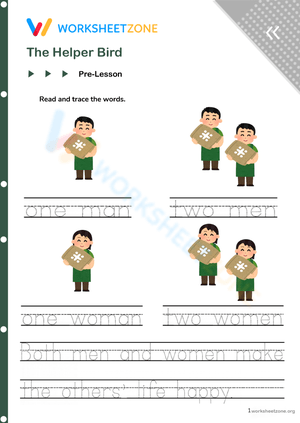
Several worksheets include small illustrations alongside the word pairs. For seven- and eight-year-olds, seeing a drawing of one mouse next to a cluster of mice anchors the irregular spelling to a real-world referent rather than an abstract letter swap. This is particularly useful for ELL students who cannot yet lean on English context clues to confirm meaning.
Standard Alignment
These worksheets directly address CCSS.ELA-LITERACY.L.2.1.b, which requires second graders to form and use frequently occurring irregular plural nouns. The standard names specific examples — feet, children, teeth, mice, fish — and the set covers all of them. In the typical second-grade language arts sequence, L.2.1.b gets its most productive instructional window during the second quarter, after students have consolidated foundational phonics skills and have enough reading fluency to direct real attention toward morphology. Teachers who front-load this standard in September frequently find they need to revisit it; students introduced to irregular plurals mid-year tend to arrive with some reading exposure already and need consolidation more than first teaching.
Frequent Mistakes Students Make — and Why They're So Predictable
The most consistent error in student work is over-regularization: writing mouses, childs, and tooths. This happens because the phonics rule is so well established that students apply it automatically, even when working carefully. The second pattern worth tracking is inconsistency across contexts — a student spells teeth correctly on a matching exercise Monday morning and writes tooths in a journal entry Wednesday afternoon. That gap is not a sign of carelessness; it's a retrieval problem. Spaced practice across several sessions, rather than a single concentrated drill on one day, does more to close that gap than any amount of additional repetition within one sitting.
Zero-change plurals deserve a specific heads-up before you hand out the first related worksheet. Students who have been explicitly taught that plurals look different from their singular forms will add an -s almost every time. A brief class moment — projecting a sentence like "Three sheep stood in the field" and counting the animals aloud while confirming the word stays sheep — preempts a significant chunk of the errors you'd otherwise see on the worksheet and have to chase individually.
How to Work These Worksheets Into Your Week
These irregular plural nouns printable worksheets for 2nd grade fit naturally into the transition slots that most literacy blocks already have: the eight minutes before a read-aloud, the tail end of word study before centers rotate, or a Monday morning warm-up after the weekend has interrupted whatever the class was building. Because each worksheet has a single clear focus, you can assign one during direct instruction and return to the same format as a review task two or three days later without it feeling repetitive. The familiar directions reduce the mental effort students spend figuring out the task so their attention goes to the actual spelling decisions.
In small-group settings during a guided reading block, the matching and word sort formats work with minimal teacher oversight — the word banks are explicit enough that students who misread an item can self-correct without asking for help. Fill-in-the-blank tasks work well as a quick formative pulse: a single pass around the table while students write tells you which students are still defaulting to mouses and childs and need a more targeted conversation before the next independent writing assignment. For homework, send only worksheets that review word pairs already introduced in class. When students bring home something unfamiliar, parents can't support the work accurately — and the errors that come back can actually undo some of what was built during the lesson.
Adjusting the Set for a Range of Learners
For students still working to lock in the core irregular pairs, the matching and word sort formats provide a structured entry point that doesn't require generating spellings from memory. Working from a closed word bank shifts the cognitive demand from recall to recognition — a meaningful distinction when a student is still building the visual memory for these forms. Starting there before moving to open-ended tasks gives students a genuine chance at early success rather than frustration.
Students who have the core pairs secure can push further with the sentence-writing tasks. Asking them to write two sentences — one using the singular, one using the plural — turns the activity into a grammar awareness exercise rather than just a spelling exercise. For students ready for more challenge, a short editing task where they identify and correct over-regularized plurals in a teacher-written paragraph offers the same content from the irregular plural nouns printable worksheets for 2nd grade in a more demanding, applied format that also builds editing habits.
ELL students often do their most accurate work when they keep a picture-supported matching worksheet visible as a reference while completing the sentence-writing tasks. The visual-semantic anchor helps more than a plain word list because it ties the irregular form to meaning, not just to spelling — which matters when the English label itself is still being solidified alongside the grammar rule.
Frequently Asked Questions
What exactly qualifies as an irregular plural noun?
An irregular plural noun is any noun that becomes plural without simply adding -s or -es to the end. The category covers three distinct patterns: internal vowel changes (foot → feet), complete stem changes (child → children), and words whose singular and plural forms are identical (sheep, deer, fish). Second-grade instruction focuses on the highest-frequency examples students actually encounter in the books they're reading.
How many irregular plural pairs should second graders know by year's end?
Most second-grade word study programs target somewhere between ten and fifteen high-frequency irregular pairs. The core list typically includes man/men, woman/women, child/children, tooth/teeth, foot/feet, mouse/mice, goose/geese, and the main zero-change forms. The irregular plural nouns printable worksheets for 2nd grade in this set cover the forms that appear most often in the texts students are reading and writing at this level, so practice stays connected to actual classroom use.
Can these worksheets be used for homework?
Yes — with one firm condition. Assign only worksheets that review word pairs already taught during class instruction. Sending home a worksheet with unfamiliar pairs creates a situation where parents are guessing at correct spellings, which works against what was built during the lesson. When students have seen the words in a class context first, the take-home worksheet functions as genuine retrieval practice, and what students bring back the next morning gives you useful information about who has retained the forms and who needs another pass.












 Interactive Worksheet Maker
 Quiz Maker
 Word Search Maker
 Crossword Puzzle Maker
 Word Scramble Generator
 Sentence Scramble Generator
 Handwriting Worksheet Generator
 Name Tracing Generator
 Fill In The Blank Generator