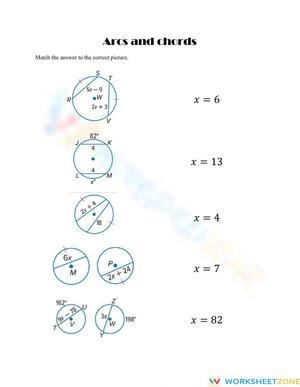
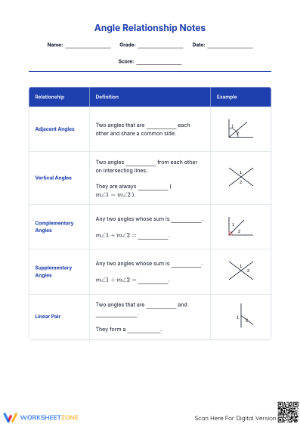
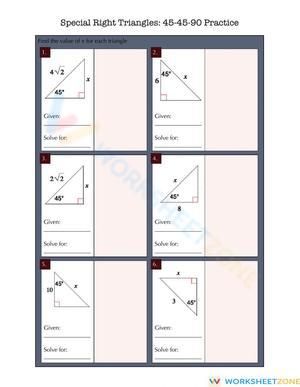
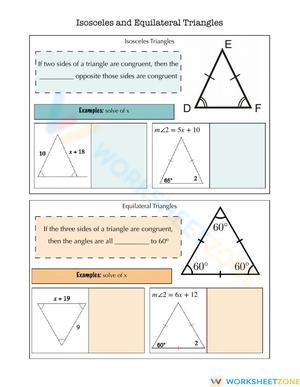
These geometry worksheets pdf for 12th grade cover the four domains that define a final-year math course: vectors in three-dimensional space, analytic treatment of conic sections, solid geometry with non-standard solids, and matrix-based transformations. Each worksheet targets a specific skill cluster rather than sampling broadly, so teachers can assign exactly what the class needs at exactly the right point in the unit.
What's Inside the Set
Vectors occupy the largest portion of the set. Each worksheet in the vector series progresses from 3D component notation into the dot product, the cross product, and the scalar and vector equations of lines and planes. The conic section worksheets ask students to derive standard equations by completing the square, extract foci and directrices from equation form alone, and sketch curves without a graphing tool. Solid geometry problems involve oblique prisms, truncated pyramids, and composite shapes — not the clean textbook solids, but the kind of decomposition problems where spatial reasoning actually gets tested. The transformation worksheets require matrix multiplication to find image coordinates after dilations, rotations, and shears, making the connection between linear algebra and geometry explicit.
Several additional topics appear across the set:
- Parametric equations of lines in 3D and their intersection conditions
- Distance formulas connecting points, lines, and planes
- Axis rotation to eliminate the xy-term from a general conic equation
- Volume of solids using known cross-sectional area, as a foundation for integration
- Identifying transformation types directly from 2×2 matrices
Where 12th-Grade Students Reliably Trip Up
The cross product produces a consistent directional error. Students calculate the magnitude correctly using the determinant method, then assign the wrong sign to one or more components — so where the answer is (4, −7, −2), they write (−4, 7, 2). The computation is right; the spatial orientation is not. They've treated the right-hand rule as a phrase to recall rather than a physical act to perform. The cross product worksheets include several problems designed specifically to surface this, placing the resulting vector in a context — like the normal to a given plane — where the wrong direction produces a visibly wrong geometric result.
With conic sections, the most persistent error is misidentifying which axis holds a in a vertical ellipse. Students who learned that a always sits under x in horizontal form apply that rule mechanically when the larger denominator is under y. The graph comes out rotated 90 degrees. It shows up on nearly every conic section quiz, and it's worth addressing before students ever pick up a pencil to sketch.
Matrix transformations produce a subtler problem. Students sometimes multiply in the wrong order — column vector times matrix instead of matrix times column vector — and the resulting transposed coordinates look plausible enough that the error passes unnoticed without a diagram to check against. These worksheets include labeled diagrams for exactly that reason.
How to Build These Worksheets Into Your Lesson Plans
The geometry worksheets pdf for 12th grade in this set work best as targeted practice the day after introducing a new procedure, before the concept has fully settled. Introduce the cross product on Monday, assign the corresponding worksheet that evening or during the next class period, and use the results as a quick formative check before moving to equations of planes. The errors that surface are small enough to correct in ten minutes rather than requiring a full reteach.
The conic section worksheets hold up well as Friday review — three or four identification and sketching problems, no notes, followed by a brief class discussion of where the disagreements landed. The problems are specific enough to reveal who hasn't consolidated the material, but the low-stakes format keeps students from shutting down. That's a more productive use of the last block of the week than another worked example.
For solid geometry, pair work is worth the setup. Students who talk through a decomposition problem out loud consistently outperform students working in silence, and the back-and-forth tends to catch the step that one partner skipped entirely. Fifteen minutes of structured pair work on a volume problem often accomplishes more than thirty minutes of independent practice.
Standard Alignment
These worksheets align with several clusters in the Common Core State Standards High School Geometry domain. HSG-GPE.A covers translating between geometric descriptions and equations for conic sections, which maps directly to the completing-the-square and foci problems here. HSG-GMD.A addresses volume formulas and Cavalieri's Principle, which grounds the cross-section and solid geometry worksheets. HSG-SRT.A covers similarity transformations and connects to the dilation and matrix transformation work. For courses following the CCSS Precalculus pathway, the 3D vector and parametric content also falls under HSN-VM, the vector and matrix operations domain. In most 12th-grade sequences these topics appear in the second semester, after students have the algebraic fluency to handle coordinate-geometry arguments but with enough time before final assessments to build real procedural confidence.
Adjusting the Set for a Mixed-Ability Classroom
The geometry worksheets pdf for 12th grade in this set are not all at the same difficulty level, which gives teachers room to assign selectively. Earlier problems in each worksheet series provide all necessary given information explicitly — values labeled, operations clearly indicated — so students who struggle with setting up problems can still access the procedure. Later problems require students to decide what they need before computing anything, which is the level that end-of-course assessments typically demand.
Students who struggle with 3D visualization benefit from annotating the diagrams on the solid geometry and vector worksheets before writing any equations — labeling coordinates, marking angles, drawing component arrows. That physical interaction with the diagram provides a concrete entry point into problems that otherwise feel entirely algebraic. It doesn't slow these students down; it gives them somewhere to start.
Students ready for extension work should be directed to the rotation-of-axes worksheet, which combines trigonometric substitution with conic equation manipulation to eliminate the xy-term. It's a multi-step problem type that appears on some university entrance assessments and genuinely challenges students who find the standard conic problems routine. This is also where the synthesis of algebra and geometry becomes most visible — which tends to be motivating for students who have been coasting.
Frequently Asked Questions
Do the worksheets include answer keys with worked solutions?
Yes. Each worksheet includes a full answer key that shows intermediate steps. For vector and matrix problems, the worked solutions flag where sign errors typically appear, which helps students identify exactly where their reasoning went wrong rather than simply checking whether the final value matches.
Are these appropriate for AP Precalculus and IB courses, or only standard 12th-grade math?
The geometry worksheets pdf for 12th grade in this set span both levels. The foundational vector and conic worksheets fit standard pre-calculus expectations, while the rotation-of-axes, parametric intersection, and volume-of-revolution problems match the depth expected in AP Precalculus and IB Mathematics HL.
How many problems does each worksheet contain?
Each worksheet runs between 8 and 14 problems depending on the topic's complexity. Cross product and 3D distance worksheets sit closer to 8, because each problem involves multiple steps. Conic identification worksheets run longer, since individual problems are shorter and build toward graphing tasks at the end.
Can these worksheets serve as test review rather than first-time practice?
For topics like conic sections and matrix transformations, the later problems in each worksheet are better suited to review than initial exposure. They assume the procedure is already familiar and move directly into application contexts that mirror the question formats students encounter on end-of-course exams.