


























Views
Downloads


Dodecagon Star Geometry Worksheet | Essential Grade 7-12
Paste this activity's link or code into your existing LMS (Google Classroom, Canvas, Teams, Schoology, Moodle, etc.).
Students can open and work on the activity right away, with no student login required.
You'll still be able to track student progress and results from your teacher account.
Analyze the intricate geometry of a 12-sided polygon with this focused worksheet. Students explore the relationship between central angles, vertices, and composite shapes within a dodecagon star. This resource bridges visual observation with mathematical calculation to ensure a deep understanding of multi-sided 2D polygons and their internal geometric construction.
At a Glance
- Grade: 7–12 · Subject: Geometry
- Standard:
HSG.MG.A.1— Use geometric shapes and their properties to describe objects- Skill Focus: Dodecagon properties & central angles
- Format: 3 pages · 6 problems · Answer key included · PDF
- Best For: Geometry warm-ups and shape analysis
- Time: 15–20 minutes
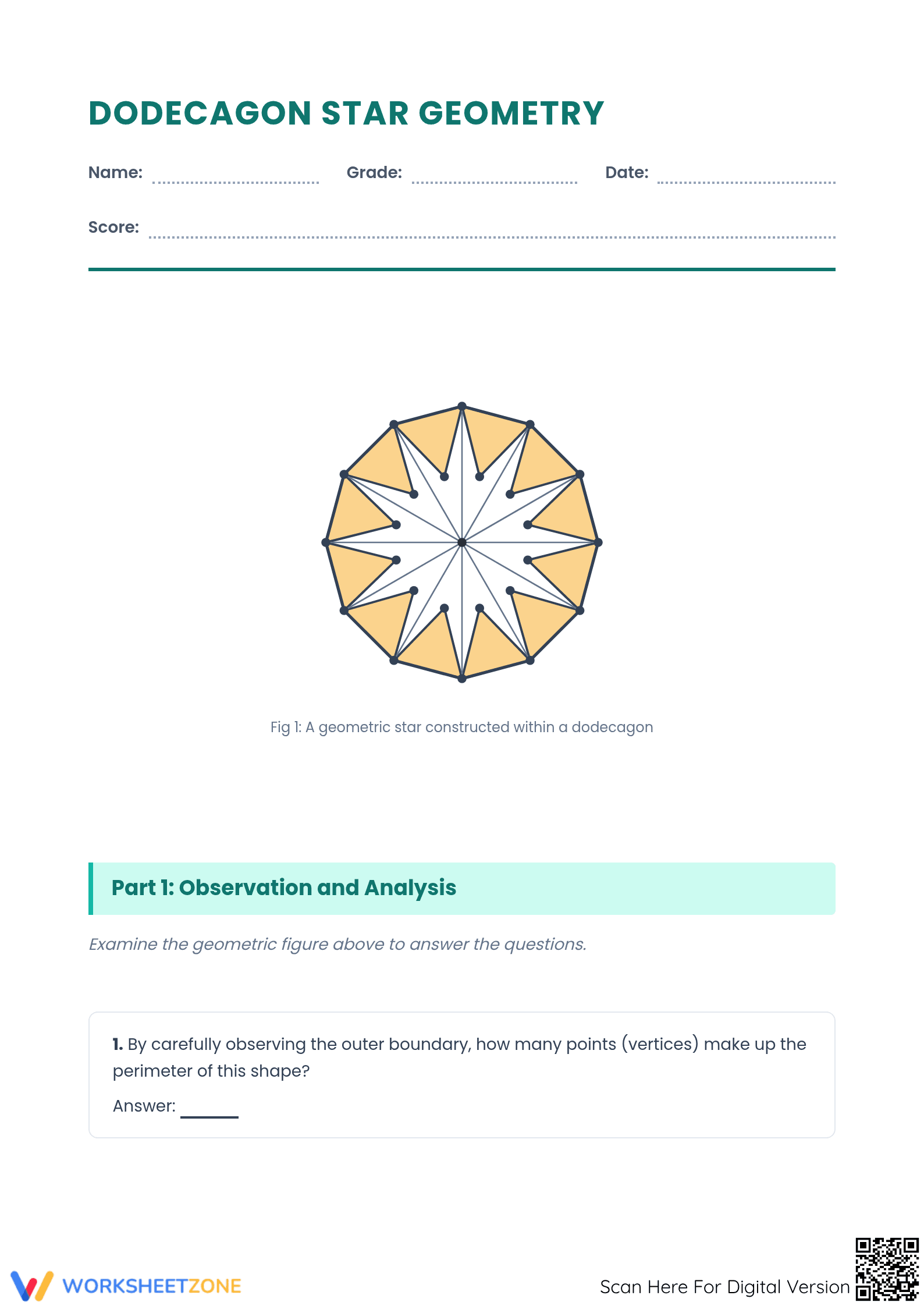
This three-page PDF features a large, detailed diagram of a geometric star constructed within a dodecagon. Students engage with six structured tasks, including open-ended observation questions about vertices and lines, and multiple-choice questions focusing on polygon identification and central angle calculations. The layout includes a full answer key for immediate feedback.
- Guided practice: Students begin by observing the outer boundary to identify the specific number of vertices and total points in the construction.
- Supported practice: Learners analyze internal lines radiating from the center point to determine connections between the core and the perimeter.
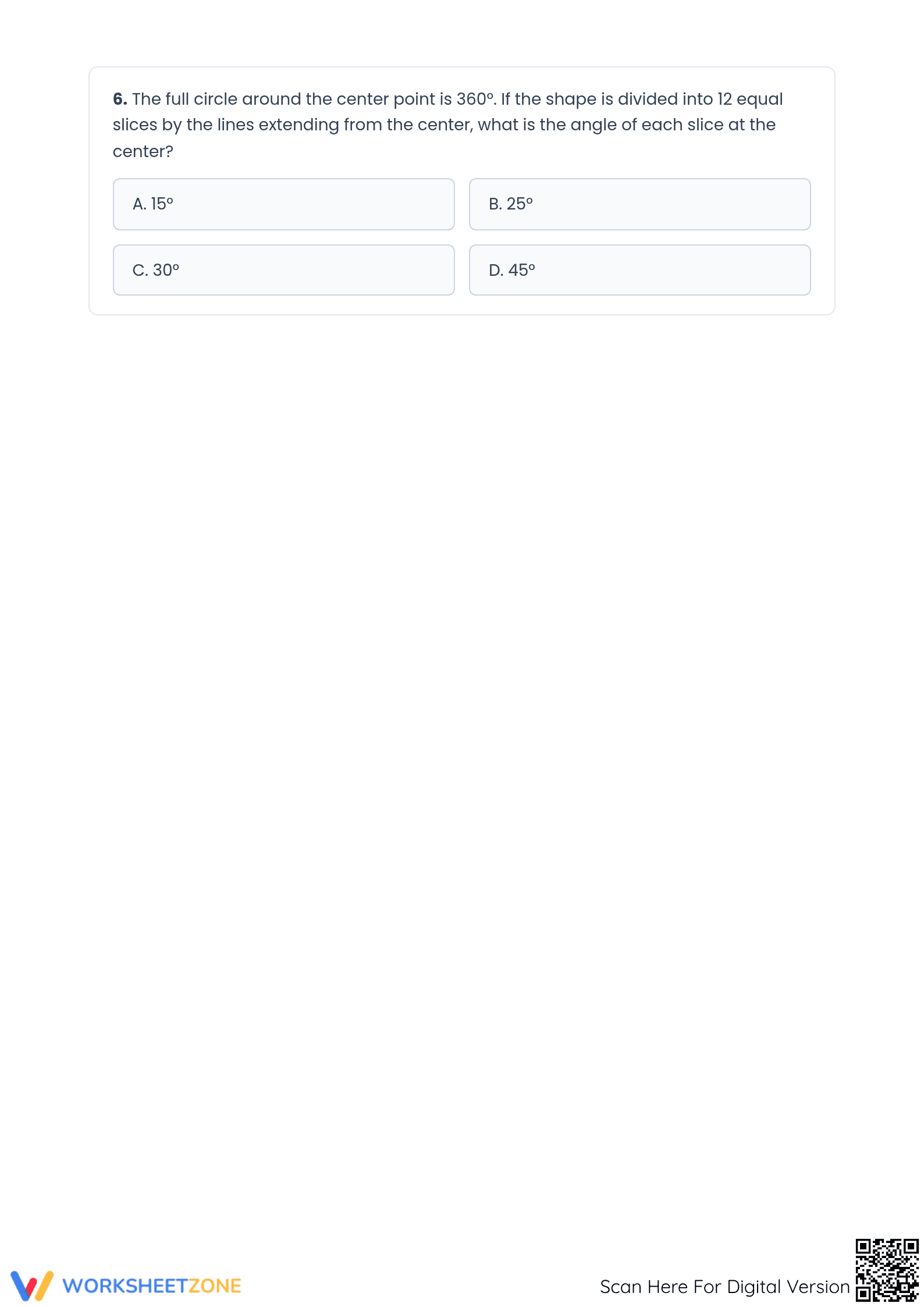
- Independent practice: The final section requires calculating specific central angles and identifying colored sub-polygons without visual scaffolds.
This progression follows the gradual-release model to ensure students master complex shape properties before moving to independent calculations.
The primary standard addressed is `HSG.MG.A.1`, which requires students to use geometric shapes, their measures, and their properties to describe objects. By calculating central angles and identifying nested triangles, students demonstrate proficiency in measuring and characterizing 12-sided polygons. Both standard codes can be copied directly into lesson plans, IEP goals, or district curriculum mapping tools.
How to Use It
Use this as a bell-ringer activity during a unit on polygons to assess prior knowledge of shape terminology. Alternatively, it serves as an excellent formative assessment tool after a lesson on central angles of regular polygons. Teachers should observe if students recognize the 12 equal slices as a method for finding angle degrees. Completion takes roughly 20 minutes.
Who It's For
This resource is designed for middle and high school students in Geometry or advanced Pre-Algebra courses. It offers natural differentiation for visual learners who benefit from examining complex diagrams. Pair this with a protractor or a digital drawing tool to extend the lesson into manual shape construction and vertex mapping.
This worksheet aligns with `HSG.MG.A.1` by requiring students to identify properties of a dodecagon and calculate central angles. Research from `Fisher & Frey (2014)` emphasizes that analyzing complex visual representations, such as the dodecagon star, significantly improves spatial reasoning and the retention of geometric definitions. The 6 targeted tasks provide sufficient data points for formative assessment without overwhelming learners. By breaking down the 360-degree rotation into 12 equal segments, the worksheet reinforces the fundamental relationship between a circle and regular polygon centers. Educators can confidently integrate this tool into curriculum maps focused on 2D shape mastery and polygonal architecture. This structured approach ensures that Grade 7-12 students transition from basic shape recognition to analytical geometric evaluation, preparing them for higher-level trigonometric concepts and spatial engineering applications.


