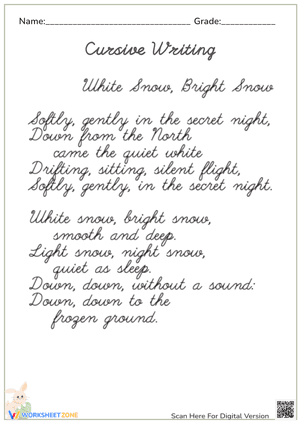
These handwriting printable worksheets for 12th grade address a problem teachers notice every fall: students who produce sophisticated written arguments in drafts become nearly illegible the moment a timed assessment begins. By senior year, most students have traded legibility for speed across thousands of assignments, and the tradeoff has become invisible to them. This set gives teachers a targeted, age-appropriate way to work on letter formation, slant consistency, and writing endurance — without making a 17-year-old feel like they have been handed something from third grade.
The Specific Skills Targeted
Each worksheet focuses on a distinct layer of penmanship performance rather than drilling the alphabet from start to finish. Students mark their own slant lines across a practice passage to identify where their angle shifts, rewrite short excerpts while holding a target x-height, and compare that controlled version to a timed pass of the same text. Other worksheets address letter joins specifically — the transitions between pairs like ea, ou, and th that collapse into ambiguous shapes when a student is writing quickly. One worksheet in the set assigns a 250-word passage and asks students to copy it twice: once at a deliberate pace, once at their natural writing speed, then compare legibility between the two versions side by side.
There is also a group of worksheets focused on hybrid writing — a connected print style that sits between standard cursive and block print. For many seniors, this turns out to be both faster and clearer than either option they typically default to. The content throughout uses passages drawn from argumentative writing, historical documents, and analytical prompts — the same register seniors encounter on timed assessments — so nothing feels remedial or age-inappropriate. Give a 17-year-old a worksheet that reads like second-grade practice material and they will disengage before they pick up a pen.
Error Patterns That Surface When Students Write at Speed
The most common problem in senior handwriting is not poor letter formation in isolation — it is x-height collapse. When a student writes at a comfortable pace, lowercase letters sit cleanly on the baseline. As speed increases, the middle zone shrinks: letters like a, e, m, and n lose height until a line of text reads as a near-uniform horizontal band. A student who produces a clear first sentence is often illegible by line four. These worksheets surface that shift by asking students to annotate their own writing after timed practice rather than simply repeat drills without any moment of reflection.
A second pattern worth preparing for is slant reversal under fatigue. Many seniors have developed a consistent mild forward slant that holds at moderate speed, but that slant shifts — often to backslant or fully upright — during the final stretch of a timed assessment, sometimes within a single paragraph. One diagnostic worksheet asks students to write the same three sentences at roughly 25%, 75%, and full speed, then examine slant consistency across all three attempts. Watching students do this exercise for the first time makes the pattern unmistakable: most of them have never noticed it. What distinguishes the better handwriting printable worksheets for 12th grade from generic drill sheets is exactly that kind of built-in self-assessment step — without it, students practice their habits rather than correct them.
Fitting These Worksheets Into an Already-Loaded Senior Schedule
The most practical entry point is the bell-ringer slot — three to five minutes at the start of English, AP Seminar, or history while attendance is being taken and the class settles. One worksheet per week in that slot, sustained across a semester, produces measurable change without displacing instructional time. Teachers who have used this approach report a consistent carry-over effect: students who spend five minutes on a controlled copy exercise tend to begin the day's in-class writing with more deliberate letter formation than those who went straight into the task.
Handwriting printable worksheets for 12th grade also fit naturally as a warm-up immediately before in-class essays. Five minutes with a focused letter-join or baseline-control drill before a timed AP practice prompt often carries into the first paragraph of a student's response — not through the whole essay, but far enough that the section a grader encounters first reads clearly. A few specific moments where this placement works particularly well:
- The Monday after a long weekend, when handwriting fluency is noticeably lower than it was on the previous Thursday
- The week before AP free-response practice sessions begin, as a targeted preparation activity
- The first week of second semester, when students returning from winter break often need to rebuild stamina
- During independent writing workshop time, while the teacher confers one-on-one with individual students
Adjusting the Set for Students at Different Stages of Writing Automaticity
Students in the same 12th-grade class can be years apart in motor automaticity — the degree to which handwriting runs in the background without consuming conscious attention. A student whose writing is already automatic needs a different challenge than one still consciously thinking through each letter shape. For students at the automatic end, the productive work is speed under legibility constraints: set a words-per-minute target and require them to hold a specific letter height throughout the timed passage. For students still consciously forming letters, the priority is volume — more repetitions of high-frequency letter combinations before worrying about speed at all. These two groups should not be working through the same worksheet on the same schedule.
Left-handed students are a specific case worth planning for. Many left-handed seniors have developed a hook grip or paper angle that functions for them but produces consistent smearing at certain letter joins. A few worksheets in the set include guidance specifically for left-hand writers on paper positioning and the transitions where smearing is most likely to occur. For students who have found handwriting printable worksheets for 12th grade from other sources frustrating or unhelpful, that kind of targeted, specific guidance often changes what they get out of the practice session entirely.
Frequently Asked Questions
Are these worksheets useful for seniors who already write legibly at a normal pace?
Yes, though the focus shifts. Students with already legible handwriting benefit most from the speed-and-endurance worksheets — especially the timed copy passages and the 250-word stamina exercise. The diagnostic approach of comparing timed to untimed writing consistently reveals slant inconsistencies or x-height drift even in students who consider themselves strong writers. Legibility at a comfortable pace is not the same thing as legibility during the final stretch of a two-hour exam.
How do I handle students who resist handwriting practice at this grade level?
Frame the practice in exam terms. When students understand that illegible handwriting shifts a grader's cognitive effort from evaluating the argument to decoding the letters — and that this happens within the first few lines of a response — the resistance often drops. Connecting the practice directly to AP free-response grading or college in-class essay expectations gives it a concrete payoff that seniors respond to in a way that abstract skill-building rarely achieves.
Do these work for students with fine motor challenges or dysgraphia?
These worksheets provide a general-population framework for legibility and fluency practice. Students with documented dysgraphia or fine motor conditions need supports that go beyond any worksheet set — occupational therapy guidance, extended testing time, and typed response accommodations remain the appropriate primary interventions. The set works alongside those supports for students building capacity within their current range, but it does not replace clinical care.
Which worksheet should I use first?
Start with the diagnostic comparison passage — the timed versus untimed exercise. It shows both teacher and student exactly which elements break down under speed pressure. That baseline makes every subsequent worksheet more purposeful, because students are working on a known, specific problem rather than practicing in the general direction of improvement.
















 Interactive Worksheet Maker
 Quiz Maker
 Word Search Maker
 Crossword Puzzle Maker
 Word Scramble Generator
 Sentence Scramble Generator
 Handwriting Worksheet Generator
 Name Tracing Generator
 Fill In The Blank Generator