


























Views
Downloads
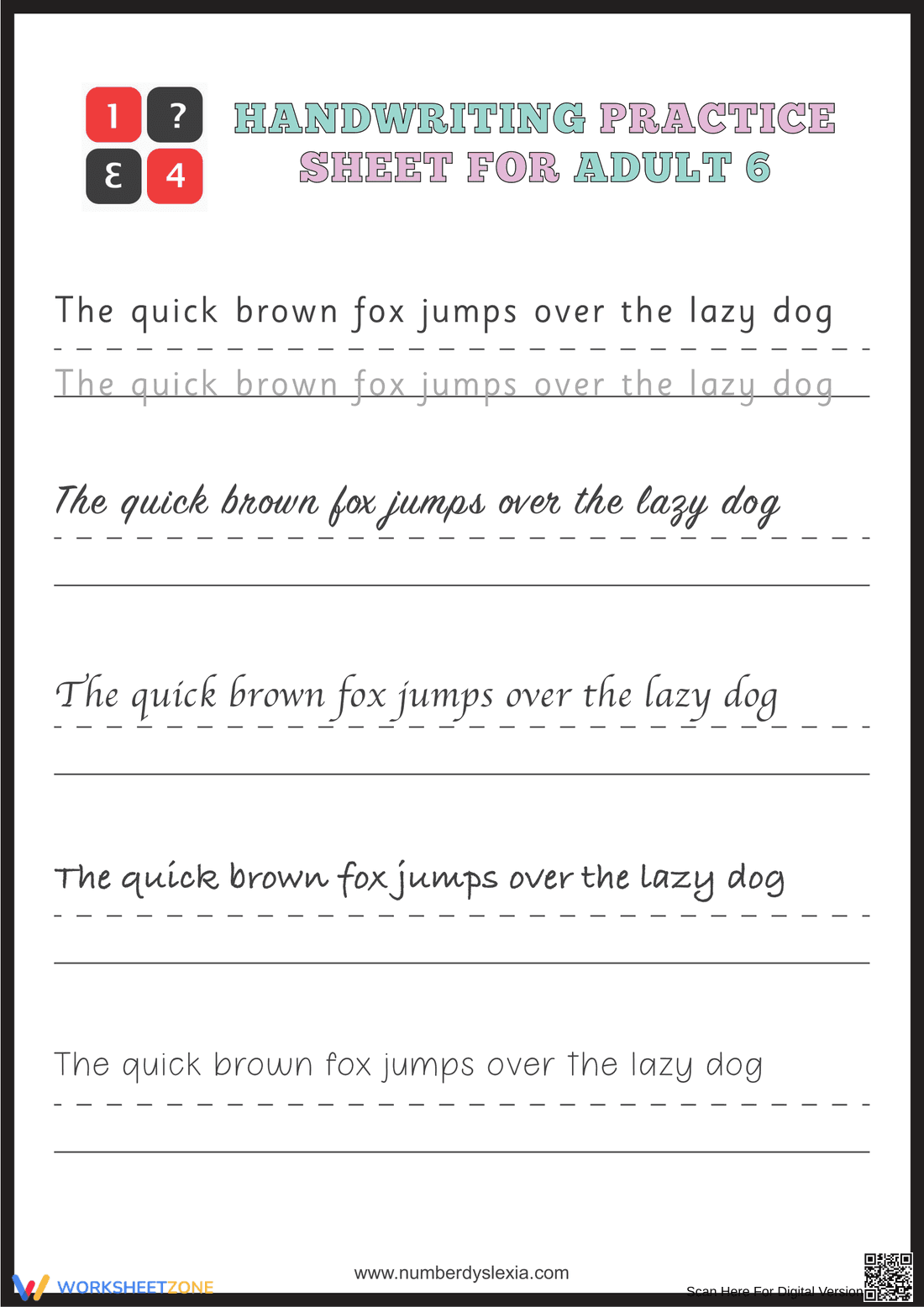

Adult Handwriting Practice | Grade 11-12 Printable
Paste this activity's link or code into your existing LMS (Google Classroom, Canvas, Teams, Schoology, Moodle, etc.).
Students can open and work on the activity right away, with no student login required.
You'll still be able to track student progress and results from your teacher account.
This Grade 11-12 handwriting practice worksheet helps older students and adults refine their penmanship across multiple font styles. By tracing and copying the classic pangram sentence, learners develop muscle memory for both print and cursive lettering, resulting in clearer, more legible everyday writing.
At a Glance
- Grade: 11-12 · Subject: Handwriting
- Standard:
CCSS.ELA-LITERACY.W.11-12.4— Produce clear and coherent writing- Skill Focus: Cursive and Print Penmanship
- Format: 1 page · 5 problems · No answer key needed · PDF
- Best For: Independent practice and remediation
- Time: 10–15 minutes
This single-page resource features five distinct lettering styles for students to practice. Each section presents the sentence "The quick brown fox jumps over the lazy dog" in a unique font, including standard print, traditional cursive, and italicized variations. Students are provided with standard handwriting guidelines featuring dashed middle lines to ensure proper letter height and spacing as they copy each sentence.
Zero-Prep Workflow
This worksheet is designed for immediate classroom implementation with absolutely no teacher preparation required.
- Print (1 minute): Simply send the PDF to your printer. The black-and-white design is ink-friendly and prints clearly.
- Distribute (1 minute): Hand out the sheets during morning work, advisory periods, or as a quick warm-up activity.
- Review (0 minutes): Because this is a self-guided motor skill exercise, no formal grading or answer key review is necessary.
With a total teacher prep time of under two minutes, this resource is an excellent addition to any emergency sub plan folder or independent study packet.
Standards Alignment
This practice sheet aligns with CCSS.ELA-LITERACY.W.11-12.4, which requires students to produce clear and coherent writing in which the development, organization, and style are appropriate to task, purpose, and audience. Legible handwriting is a foundational component of producing clear written communication. Both standard codes can be copied directly into lesson plans, IEP goals, or district curriculum mapping tools.
How to Use It
Integrate this worksheet into your daily routine as a calming, focused warm-up before intensive writing assignments. It serves as an excellent transition activity, taking approximately 10 to 15 minutes to complete. As a formative assessment observation tip, watch students' grip and posture while they write; gently correct any tension in their hands to promote fluid, sustainable writing habits over time.
Who It's For
This resource is specifically designed for high school students in grades 11 and 12, as well as adult learners seeking to improve their penmanship. It is highly effective for occupational therapy students, English Language Learners, or individuals requiring fine motor skill remediation. Pair this practice sheet with a creative writing prompt to allow students to immediately apply their refined handwriting skills in a practical context.
Research from the RAND AIRS 2024 study indicates that explicit handwriting instruction, even at the secondary and adult education levels, significantly improves overall writing fluency and cognitive retention. When students practice forming letters automatically, working memory is freed up to focus on higher-order composition and critical thinking skills. This resource directly supports that cognitive development by targeting CCSS.ELA-LITERACY.W.11-12.4, helping learners produce clear and coherent writing through focused, intentional repetition. By practicing the classic pangram across five distinct font styles, students engage multiple motor pathways, reinforcing the neural connections required for legible penmanship. Consistent practice with structured guidelines ensures that adult learners and high school students can correct ingrained habits, leading to more professional and readable written communication in both academic and real-world settings.


