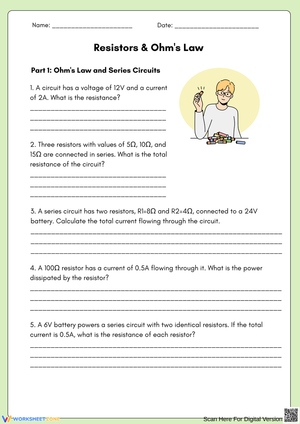
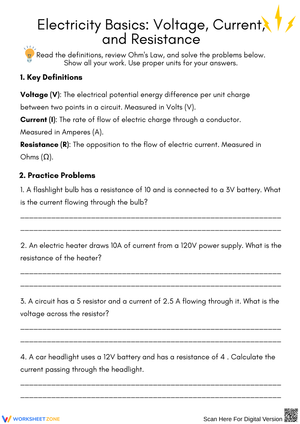
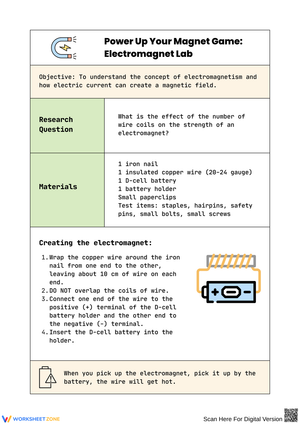
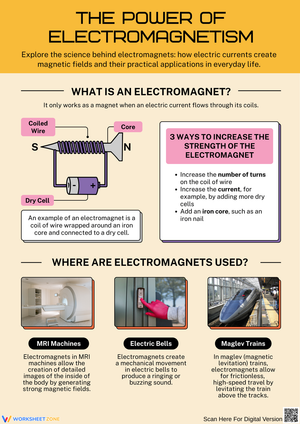
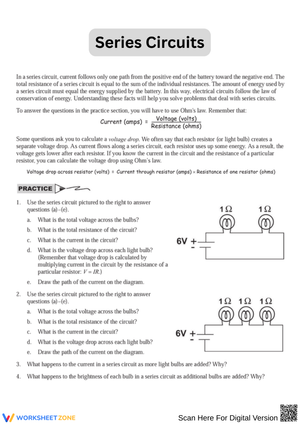
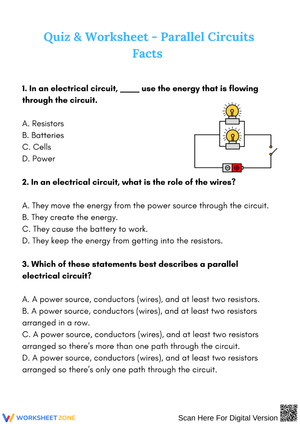
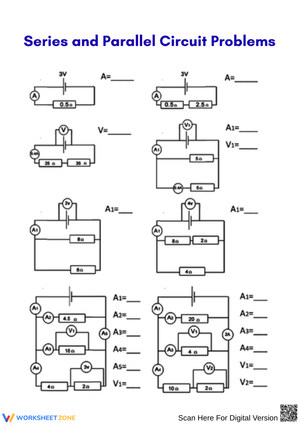
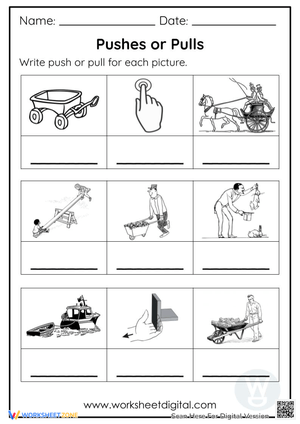
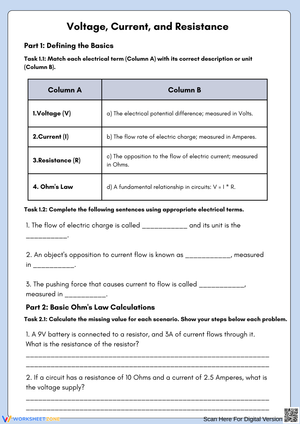
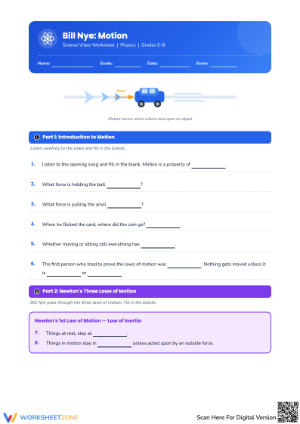
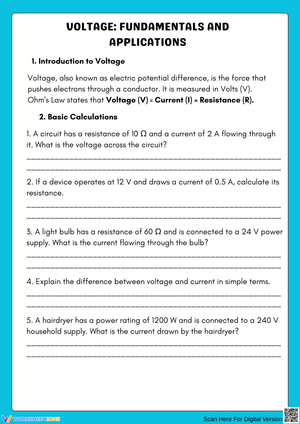
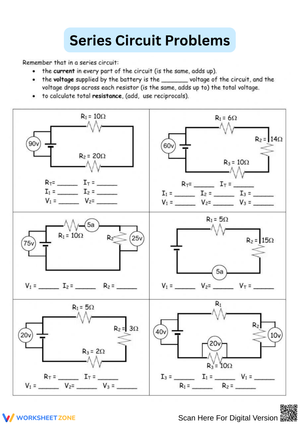
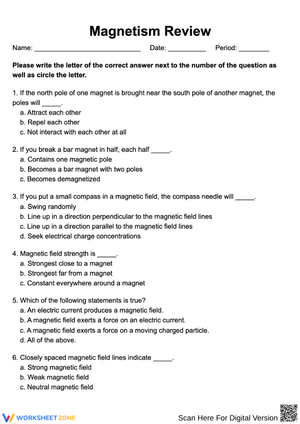
These 11th grade physics pdf worksheets cover the four units that anchor junior-year physics — kinematics, forces and dynamics, work and energy, and impulse-momentum — with each worksheet targeting a narrow skill rather than asking students to cycle through all four areas at once. A teacher can assign velocity-time graph interpretation the day after introducing it, or pull out a free-body diagram worksheet the morning before a quiz on Newton's second law. The set moves from introductory single-variable problems through multi-step scenarios where students choose which physics principle to apply before setting up any equations.
What Each Worksheet Targets
Kinematics worksheets ask students to interpret position-time and velocity-time graphs, apply the four kinematic equations, and handle both horizontal motion and free fall. The graph work carries more weight than it appears: the slope of a velocity-time graph is acceleration, and the area beneath it is displacement — but students who can state that rule will still misread a graph that dips below the x-axis or curves nonlinearly. Projectile motion worksheets require a labeled component diagram before any equation is written, which builds the habit of treating horizontal and vertical motion as independent problems rather than one combined equation.
Dynamics worksheets center on free-body diagrams and the net-force equation. Students identify every force on an object, resolve angled forces into components, and write F = ma before picking up a calculator. Work and energy worksheets ask students to judge when the work-energy theorem applies versus when conservation of mechanical energy is the right tool — a genuine decision, not formula substitution. Momentum worksheets address impulse, one-dimensional conservation, and the elastic-versus-inelastic distinction. The range these 11th grade physics pdf worksheets cover mirrors the arc of a standard junior-year course, unit by unit.
Errors That Appear Predictably in Student Work
The most persistent dynamics error is the phantom force: students draw a free-body diagram for a moving object and add an arrow in the direction of travel labeled "force of motion" even when no agent is applying that force. This reflects a durable intuition that moving objects require a continuing push — it survives lectures and demonstrations. These worksheets include a step where students name the agent responsible for each force before the diagram is accepted as complete, which makes the phantom force impossible to slide past.
Sign convention breaks down in multi-step kinematics more than anywhere else. A student sets downward as negative, works two steps correctly, then switches convention when the algebra gets uncomfortable — producing a result with the right magnitude and the wrong sign, or an answer implying negative elapsed time. Requiring students to write and circle their sign convention before step one surfaces this error during practice rather than after the unit ends. In projectile motion, the parallel failure is using launch speed directly in the vertical equation without decomposing it first: a ball launched at 30° above horizontal at 20 m/s has a vertical component of 10 m/s, not 20 m/s, but students who skip the vector triangle plug in 20 m/s and rarely notice the result is physically unreasonable.
Getting the Most From These Worksheets in Your Planning
The focused scope of each worksheet makes them easy to place in a lesson without disrupting the flow. Bell-ringers work well with a single graph-reading or free-body diagram problem — enough to activate prior knowledge in the first eight minutes of class without cutting into instruction time. For think-pair-share, force diagram problems are particularly productive: students almost always agree on the contact forces and disagree about gravity, or agree on gravity and disagree about the direction of the normal force, and that specific disagreement drives more useful discussion than a teacher-led correction would.
Station rotations pair naturally with the set's unit structure — one worksheet per station covering motion graphs, force diagrams, energy conservation, and collision problems, with groups rotating every 12 to 15 minutes. The narrow scope means students start immediately without reading through a lengthy problem setup. These 11th grade physics pdf worksheets also work as a pre-lab warm-up: a two-problem kinematics worksheet before a constant-acceleration cart lab keeps the math from being new when the data arrives, letting students focus on the experimental reasoning rather than the algebra.
Standard Alignment
The kinematics and dynamics content aligns with NGSS HS-PS2-1, which asks students to use mathematical representations to describe the relationship among net force, mass, and acceleration. Momentum worksheets address HS-PS2-2, which applies conservation of momentum to system-level problems. Work and energy content maps to HS-PS3-1 and HS-PS3-2, covering energy transfer and the relationship between kinetic and potential energy within a system. In most junior-year courses, HS-PS2 content runs first semester and HS-PS3 content second, so the worksheet set follows the same sequence and can be pulled unit by unit without jumping ahead of instruction.
Adjusting the Worksheets for Different Learners in the Room
Students who struggle with the algebra benefit from three practical adjustments:
- An equation reference sheet with the four kinematic equations and Newton's second law, so they can locate the formula rather than retrieving it while simultaneously tracking units and sign conventions
- Partially labeled free-body diagrams with one or two forces already drawn in, which removes blank-page paralysis without simplifying the force-identification task itself
- A consistent variable legend for each unit, listing what each symbol represents, so students recognize that initial velocity, starting speed, and v-naught are the same quantity in different notations
Students who work through the core problems quickly gain the most from a stripped-down version: remove the labeled list of given quantities and replace it with a written scenario, requiring them to identify what matters before setting up any equation. Multi-force incline problems with friction extend the same worksheet format without needing a separate resource. The most demanding extension combines methods — use conservation of energy to find speed at the bottom of a ramp, then use kinematic equations to find where the resulting projectile lands — and it is genuinely difficult in a way that keeps advanced students engaged while their peers finish the core assignment.
Frequently Asked Questions
Are these worksheets appropriate for AP Physics 1 students, or only for standard algebra-based courses?
AP Physics 1 is algebra-based, so the problem types here are appropriate for AP prep. Kinematics, dynamics, and momentum are all heavily tested on the AP exam, and the multi-step problems in the set reflect the reasoning depth the exam requires. Students preparing for AP benefit from working through these unit by unit before moving on to multi-object systems and rotational motion. Students in a non-AP junior physics course will find the same worksheets useful without encountering anything that feels exam-specific or out of place.
When in a unit should these be assigned — early, mid-unit, or as end-of-unit review?
Mostly during and after direct instruction. These 11th grade physics pdf worksheets work best when students have seen the concept and need structured repetition to make it reliable — assigning a kinematics worksheet the day after teaching velocity-time graphs is more effective than holding it until the week before the test. A single straightforward problem can also serve as an anticipatory opener to surface what students think they already know, but that is a discussion prompt, not independent practice.
Do these work well for students who are concurrently enrolled in pre-calculus?
Yes, and the timing lines up well. Students in pre-calculus are developing sine and cosine fluency at the same time they encounter vector decomposition in physics. A student who just finished trigonometric ratios in math class finds force-component problems considerably more accessible than one who studied trig a year earlier and hasn't applied it since. Pointing the connection out directly — this is the same right-triangle reasoning from pre-calc, applied to forces — reduces the unfamiliarity of the physics without changing what the worksheet asks students to do.












 Interactive Worksheet Maker
 Quiz Maker
 Word Search Maker
 Crossword Puzzle Maker
 Word Scramble Generator
 Sentence Scramble Generator
 Handwriting Worksheet Generator
 Name Tracing Generator
 Fill In The Blank Generator