These 11th grade gas laws printable worksheets give chemistry and physics teachers a focused set of tools for moving students from surface-level formula memorization toward genuine proportional reasoning about pressure, volume, and temperature. The set covers Boyle's Law, Charles's Law, Gay-Lussac's Law, the Combined Gas Law, and the Ideal Gas Law — each addressed in its own worksheet so teachers can sequence instruction by concept rather than assigning a broad review packet. Kinetic Molecular Theory worksheets are included as well, giving students a particle-level explanation for the mathematical relationships they calculate.
The Specific Skills Each Worksheet Targets
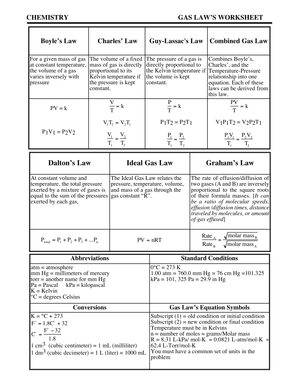
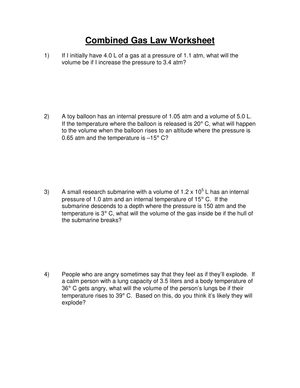
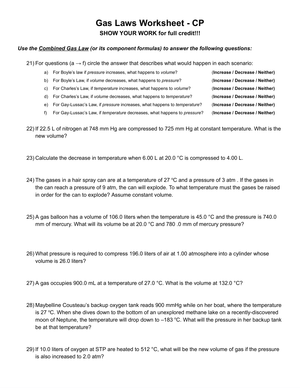
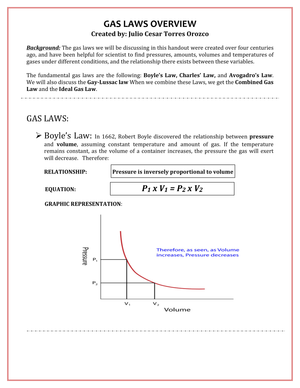
The Boyle's Law worksheets ask students to calculate final pressure or volume after a compression or expansion at constant temperature. Students identify the variable being held constant, set up the P₁V₁ = P₂V₂ relationship, and solve. Pressure values appear in atmospheres, kilopascals, and millimeters of mercury across different problems — the unit variation is intentional, because managing pressure units is one of the places where students produce wrong answers that still look numerically plausible.
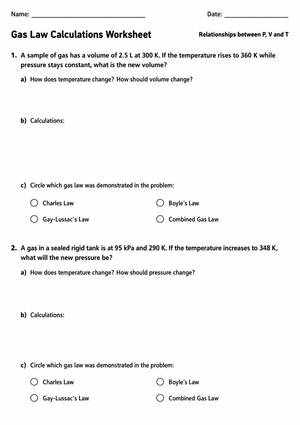
Charles's Law worksheets introduce the Kelvin requirement immediately. Temperature values arrive in Celsius in the problem stem, and students convert before setting up the proportion. Several worksheets include a two-column data table where students calculate V/T for multiple trials and confirm that the ratio stays constant — an inductive approach that builds the concept before the algebraic form of the law appears.
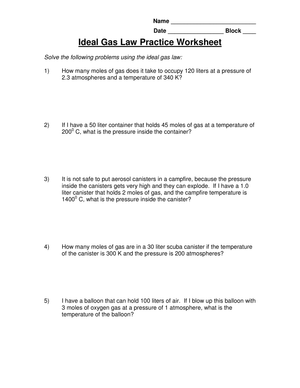
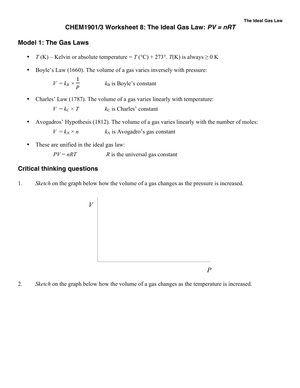
The Ideal Gas Law worksheets cover PV = nRT in both directions: solving for pressure or volume when moles are known, and solving for moles from pressure, volume, and temperature readings. Problems use both R = 0.0821 L·atm/mol·K and R = 8.314 L·kPa/mol·K so students practice matching the gas constant to the pressure units in each problem rather than memorizing a single value. A separate worksheet addresses Standard Temperature and Pressure, including both the 22.4 L/mol shortcut and the current IUPAC value of 22.71 L at 100 kPa and 273.15 K, since both numbers appear in textbooks and on standardized assessments.
These 11th grade gas laws printable worksheets also include conceptual short-answer worksheets grounded in Kinetic Molecular Theory. Students sketch particle diagrams under different pressure and temperature conditions, explain collision frequency and force in their own words, and evaluate whether a described scenario is likely to produce ideal or non-ideal gas behavior. Short-answer format is used throughout rather than multiple choice because the goal is to expose the quality of a student's reasoning — not their ability to eliminate wrong options.
Common Misconceptions to Watch For and Address
The Kelvin conversion error is the most reliable mistake in this unit. Students who handle the conversion correctly on a Tuesday lab handout will plug a Celsius value directly into a Charles's Law ratio on Thursday without blinking. The habit takes sustained repetition to stick, and these worksheets build the conversion step into every temperature-related problem. Worth watching for specifically: students who add 273 instead of 273.15. On most problems, the difference barely changes the answer, but it signals a memorized rule rather than any understanding of what absolute zero actually represents.
The R-value mistake is subtler and harder to catch at a glance. A student who selects R = 0.0821 L·atm/mol·K with a pressure given in kilopascals will complete the calculation without any visible error — the arithmetic proceeds, produces a number, and the number looks reasonable. Mixing pressure units deliberately across the Ideal Gas Law problems in this set forces students to pause and confirm unit consistency before choosing a gas constant value.
In Boyle's Law problems, the inverse relationship produces a predictable algebraic slip: students write P₂ = P₁ × (V₂/V₁) — the right variables, but the ratio inverted. This happens most often when students rearrange the formula mentally in one step. Having them write out P₁V₁ = P₂V₂ fully on paper and then divide, rather than rearranging in their heads, eliminates this error more reliably than any number of reminders about inverse proportionality.
How to Build These Worksheets Into Your Lesson Plans
The individual law worksheets fit naturally as same-period practice after a demonstration. The marshmallow-in-a-vacuum demonstration anchors Boyle's Law visually; a balloon dipped in liquid nitrogen does the same for Charles's Law. When students move directly from watching the physical event to working through the calculation worksheet in the same class block, the connection between observation and formula is concrete in a way it simply is not when practice is delayed by three days. These worksheets are sized for that in-class follow-up window — roughly fifteen to twenty minutes of calculation work after a brief demonstration.
The 11th grade gas laws printable worksheets also work well as Monday warm-ups during the two or three weeks following initial instruction. Running two problems at the start of class keeps the proportional reasoning active without eating into new instruction time and gives teachers a quick read on which students are still confusing direct and inverse relationships. The KMT conceptual worksheets fit better mid-unit rather than at the start — students who attempt particle-level explanations before working through at least two individual laws tend to produce vague answers about "molecules moving around" rather than precise claims about collision frequency and kinetic energy.
For formative assessment, assigning one Boyle's Law worksheet, one Charles's Law worksheet, and one Ideal Gas Law worksheet on three separate days gives a clearer picture of individual skill gaps than a single combined review does. A student who struggles only with unit conversion shows up very differently from one who does not understand which variable to hold constant, and that distinction shapes what reteaching looks like.
Differentiating These Worksheets Across a Range of Learners
Students who are still working on algebraic fluency benefit from pairing the Boyle's and Charles's Law worksheets with a structured reference card showing the formula, the step-by-step isolation of the unknown, and a worked example. Remove the card once a student completes two consecutive worksheets accurately without referring to it. This approach keeps struggling students working on gas law reasoning rather than stalled at the algebra step — proportional thinking is the point of the unit; solving two-step equations is a prerequisite tool, not the goal.
Students ready for more demanding work can use the 11th grade gas laws printable worksheets in this set that address real gas deviations. Given a high-pressure scenario, they calculate both the ideal prediction using PV = nRT and an experimentally observed value, then explain the discrepancy in terms of particle volume and intermolecular attraction. The KMT worksheets can be pushed further by asking students to derive the relationship between temperature and root-mean-square speed rather than simply describing it qualitatively — a natural extension for students working toward AP Chemistry or AP Physics 2.
Standard Alignment
The calculation worksheets align to NGSS HS-PS3-2, which asks students to develop and use models illustrating how energy relates to forces between molecules. Connecting macroscopic gas measurements — pressure, volume, temperature — to molecular-level collision behavior is precisely the kind of modeling this standard targets. HS-PS1-7 becomes directly relevant when students use the Ideal Gas Law to find the number of moles of a gaseous product in a stoichiometry problem, mapping to the expectation that students apply mathematical representations to support claims about conservation of matter. Teachers in states using CCSS math standards will find that the unit-conversion and proportional-reasoning work throughout this set reinforces CCSS.MATH.CONTENT.HSN-Q.A.1, which addresses selecting and interpreting appropriate units in quantitative problem-solving contexts.
Frequently Asked Questions
Why do all temperature values in these worksheets require conversion to Kelvin, even when the Celsius number looks simple?
Gas laws describe proportional relationships between volume, pressure, and absolute temperature. Using Celsius breaks those proportions because 0°C is not actually zero temperature — it is the freezing point of water, an arbitrary reference point. A gas at 0°C still has particles in motion and still occupies volume. The Kelvin scale starts at approximately −273.15°C, the point where particle motion theoretically stops. When students plug a Celsius value into a Charles's Law ratio, they are effectively treating 0°C as if it means no molecular motion at all, which produces physically impossible results. Building the conversion into every temperature-related problem is the most direct way to make it automatic before it appears on an exam or in a lab report.
Can these worksheets be used in a physics course, or are they written specifically for chemistry?
The Boyle's Law, Charles's Law, and Combined Gas Law worksheets are directly usable in physics courses — including AP Physics 2 — without modification. The Ideal Gas Law worksheets that connect to moles and reaction stoichiometry are written primarily for chemistry, though the PV = nRT equation itself appears in physics thermodynamics units as well. Physics teachers should preview the Ideal Gas Law worksheets and note which problems assume familiarity with molar mass before assigning them to a class that has not covered that concept.
How many problems does each worksheet contain?
Boyle's Law and Charles's Law worksheets each include eight to twelve calculation problems plus two or three short-answer items asking students to describe what is happening at the particle level. The Ideal Gas Law worksheets run slightly longer — ten to fifteen problems — because the range of problem types (solving for P, V, n, or T; selecting the correct R value; applying the STP shortcut versus using the full equation) requires more variety to give adequate practice. The KMT conceptual worksheets are shorter, typically five to eight items, because written responses take considerably more time per question than numerical calculations do.












 Interactive Worksheet Maker
 Quiz Maker
 Word Search Maker
 Crossword Puzzle Maker
 Word Scramble Generator
 Sentence Scramble Generator
 Handwriting Worksheet Generator
 Name Tracing Generator
 Fill In The Blank Generator