




























1 / 3
0
Views
0
Downloads



0.0
0
Save
0 Likes
Share
Series vs Parallel Circuit Set Worksheet
0 Views
0 Downloads

Paste this activity's link or code into your existing LMS (Google Classroom, Canvas, Teams, Schoology, Moodle, etc.).
Students can open and work on the activity right away, with no student login required.
You'll still be able to track student progress and results from your teacher account.
Information
Description
What It Is:
A three-page science worksheet that teaches students how to identify, compare, and draw series and parallel electrical circuits. Includes circuit diagrams, classification tasks, conceptual comparison questions, and drawing prompts requiring students to label batteries, bulbs, and wires.
Why Use It:
This worksheet strengthens understanding of fundamental electricity concepts, helping students differentiate how current flows in series vs. parallel circuits. It builds analytical thinking, diagram interpretation skills, and hands-on circuit representation—important foundations for physics, engineering, and STEM coursework.
How to Use It:
• Begin with Part 1 to identify each diagram as series or parallel.
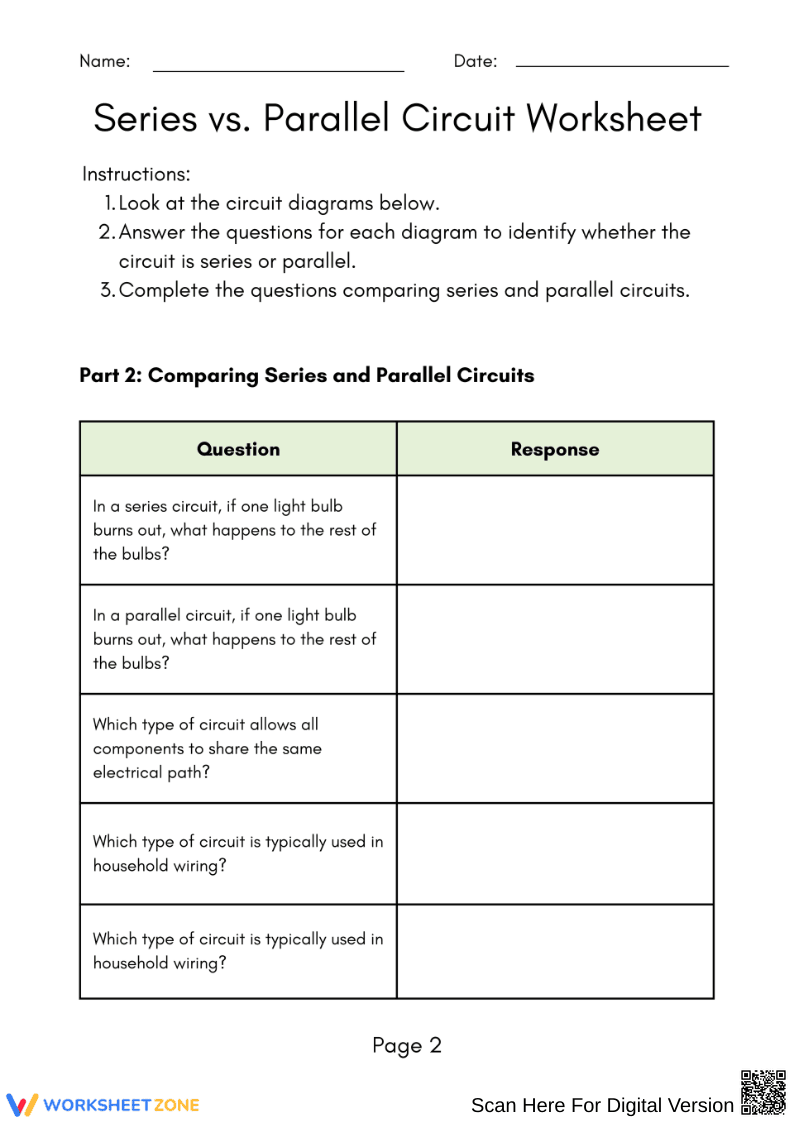
• Use Part 2 questions to compare circuit behavior, such as what happens when a bulb burns out.
• Complete Part 3 by drawing and labeling circuits to reinforce mastery.
• Extend for high school by adding voltage and current calculations or real-world applications like household wiring safety.
Grade Suitability:
Best suited for Grades 5–10.
• Middle school: ideal for introductory electricity units.
• High school: useful for physics warm-ups, concept review, or pre-lab practice.
Target Users:
Teachers, tutors, homeschool parents, and students learning about electric circuits, current flow, and practical circuit applications.
A three-page science worksheet that teaches students how to identify, compare, and draw series and parallel electrical circuits. Includes circuit diagrams, classification tasks, conceptual comparison questions, and drawing prompts requiring students to label batteries, bulbs, and wires.
Why Use It:
This worksheet strengthens understanding of fundamental electricity concepts, helping students differentiate how current flows in series vs. parallel circuits. It builds analytical thinking, diagram interpretation skills, and hands-on circuit representation—important foundations for physics, engineering, and STEM coursework.
How to Use It:
• Begin with Part 1 to identify each diagram as series or parallel.
• Use Part 2 questions to compare circuit behavior, such as what happens when a bulb burns out.
• Complete Part 3 by drawing and labeling circuits to reinforce mastery.
• Extend for high school by adding voltage and current calculations or real-world applications like household wiring safety.
Grade Suitability:
Best suited for Grades 5–10.
• Middle school: ideal for introductory electricity units.
• High school: useful for physics warm-ups, concept review, or pre-lab practice.
Target Users:
Teachers, tutors, homeschool parents, and students learning about electric circuits, current flow, and practical circuit applications.


