Mastering Gas Behaviors: Charles's Law Printable Worksheets for 11th Grade Physics
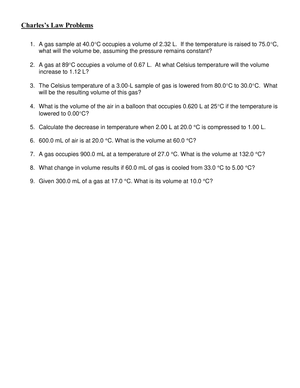
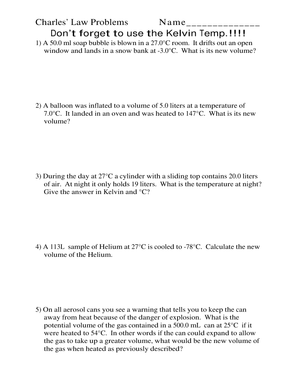
These charles law printable worksheets for 11th grade address the two points where students reliably go wrong: skipping the Celsius-to-Kelvin conversion before plugging into V1/T1 = V2/T2, and failing to check whether the final volume should be larger or smaller than the starting value before accepting a calculated answer. The set covers the full range of the topic — from clean one-variable problems to multi-step word problems set in contexts like collapsing balloons in liquid nitrogen and expanding gas cylinders left in a hot car.
What the Set Covers
Each worksheet targets a specific layer of the skill rather than mixing everything into one undifferentiated problem set. The opening worksheets ask students to identify which variable is unknown, write the Charles's Law formula from memory, and then isolate the missing term through cross-multiplication. That rearrangement step — solving for V2 versus T1 versus T2 — is where the algebra trips students up, so each worksheet makes the algebraic manipulation explicit before requiring a numerical answer.
Later worksheets introduce temperature conversion as an integrated requirement. Students are given temperatures in Celsius and must convert to Kelvin (K = °C + 273) before the ratio makes physical sense. These problems include a two-column format where students record both the raw Celsius value and its Kelvin equivalent side by side — a layout that makes the conversion visible in the written work rather than buried in a calculator entry sequence.
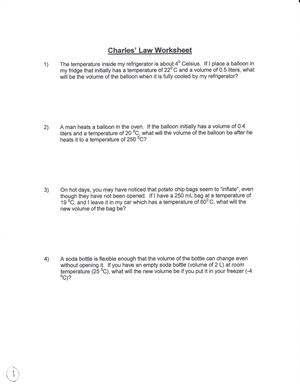
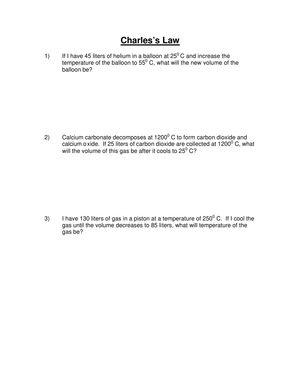
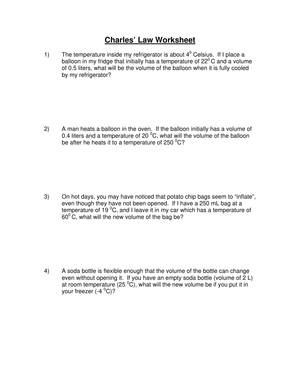
The applied worksheets at the end of the set use real-context scenarios: a sealed balloon moved from a warm laboratory into a cold storage room, a gas cylinder heated by an open flame. Students read the scenario, extract and label the known values, set up the formula with units, and solve. Each applied worksheet closes with a short written-response prompt asking students to explain in one or two sentences why the volume changed in the direction it did — a check that catches students who arrived at the correct number through faulty reasoning.
Frequent Student Errors Worth Anticipating
The Kelvin conversion error is the most predictable and the most consequential. A student who sets T1 = 25 instead of T1 = 298 will get an answer that is off by a factor of nearly twelve — large enough to fail a problem but close enough in some configurations that the student assumes an arithmetic slip rather than a conceptual one. These worksheets make Kelvin conversion a mandatory written step, which lets teachers see in the student's work exactly where the error entered rather than simply marking the final answer wrong.
A second pattern appears when the unknown is in the denominator. Students who solve V2 = (V1 × T2) / T1 without trouble will stall when asked to solve for T1. The most common wrong move is writing T1 = (V1 × T2) / V2, which produces a numerically close result on certain problem configurations — making it easy to miss when teachers check only the final answer. Each worksheet in the set includes at least one problem where T1 or T2 is the target variable, specifically to surface this error before it shows up on a test.
There is also a direction-check error the written-response prompts are built to catch. Students occasionally calculate a volume increase correctly, then write "the volume decreased because the temperature dropped" — inverting the relationship in words even after producing the right number. That disconnect between the numerical answer and the stated reasoning almost never appears when teachers assign calculation-only problem sets, because there is no place for the student's conceptual model to show itself.
Building These Worksheets Into Your Gas Laws Unit
Most teachers introduce Charles's Law after Boyle's Law, and the timing of these worksheets matters within that sequence. The formula-isolation and unit-conversion worksheets work well as warm-up practice during the two or three class days following the initial lesson — five to eight minutes of focused repetition before the main activity. The applied word-problem worksheets fit better after students have seen at least one teacher-modeled example of extracting variables from a scenario; otherwise the word problems read as reading comprehension tests rather than physics practice.
These charles law printable worksheets for 11th grade also serve well as a formative checkpoint before the class moves on to Gay-Lussac's Law or the combined gas law. Scanning completed worksheets takes about three minutes per student — the Kelvin column makes conversion errors visible at a glance, and the direction-check prompts reveal whether students have internalized the direct proportionality or are running the formula mechanically without a physical model behind it.
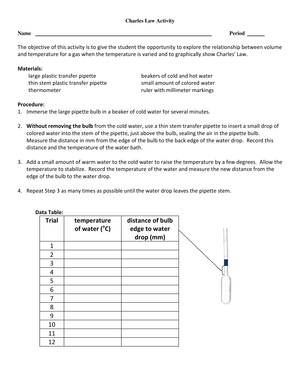
For classes that run a lab session alongside the gas laws unit, the applied worksheets pair naturally with a Charles's Law demonstration using sealed syringes in warm and cold water baths. Students who complete the worksheet before the lab bring a calculated prediction to the bench. Students who complete it after compare their prediction to the measured result and account for any discrepancy in writing — which adds a real-data layer to the work without requiring additional materials or a separate lab report format.
Adjusting the Set Across Ability Levels
Students who are still developing algebraic fluency benefit from the formula-isolation worksheets done as guided practice in pairs before attempting them independently. Providing a reference card that shows the rearranged formula for each possible unknown — V2, T1, and T2 — gives those students a model to work from while they build confidence with the manipulations. The goal is correct formula use before expecting independent derivation of each rearrangement.
These charles law printable worksheets for 11th grade extend naturally for advanced students. Remove the Kelvin conversion column from the applied worksheets and require students to perform the conversion in a separate workspace — this adds a procedural layer without changing the problem itself. The direction-check prompts can be pushed further as well: instead of one or two sentences, ask advanced students to write a paragraph connecting the volume change to the Kinetic Molecular Theory, naming specifically what happens to particle velocity and collision frequency as temperature rises.
Students who struggle specifically with word problems — not the formula, but parsing the scenario — benefit from a pre-reading routine where they mark known values in one color and the unknown in another before setting up any equations. This reduces the working memory load at the setup stage, which is where these students most often introduce errors rather than in the arithmetic itself.
Standard Alignment
These worksheets align to NGSS HS-PS3-2, which requires students to develop and use models to illustrate that energy at the macroscopic scale reflects the motions and interactions of particles. Charles's Law is one of the primary quantitative tools students use to make that connection explicit — increasing temperature raises particle kinetic energy, and in a flexible container the gas expands to maintain constant pressure. The applied worksheets and the written direction-check prompts function as formative evidence that students understand the particle-level mechanism, not just the formula mechanics. Teachers in states that follow Common Core Math Standards may also note that the algebraic rearrangements across the set address HSA-CED.A.4, which covers rearranging literal equations to isolate a specific quantity — a skill students need here every time the unknown sits in the denominator.
Frequently Asked Questions
Why must students use Kelvin rather than Celsius in these calculations?
Charles's Law describes a direct proportionality between volume and temperature — when temperature doubles, volume doubles. That proportionality only holds on an absolute scale where zero means zero molecular motion. The Celsius scale has an arbitrary zero point based on the freezing point of water, so a gas at 0°C still has significant kinetic energy and a real, nonzero volume. Using 0 in a ratio instead of 273 produces a mathematically undefined or physically impossible result. Converting to Kelvin anchors the temperature value to actual thermal energy, which is what the formula requires.
Do these worksheets include answer keys?
Yes. Each worksheet comes with a complete answer key showing the Kelvin conversion step, the algebraic rearrangement used, and the final numerical answer with units. The applied worksheets include a sample written response for the direction-check prompt. Teachers should accept any response that correctly identifies the direct proportionality and names the temperature change as the cause of the volume change — not only responses that match the sample phrasing.
Do these work in a chemistry course, or only in physics?
These charles law printable worksheets for 11th grade appear in both physics and chemistry syllabi depending on the school, and the set works in either context without modification. The formula and Kelvin conversion requirements are identical whether the course is labeled chemistry or physics. The applied scenarios — balloons, syringes, sealed cylinders — are equally relevant in a chemistry gas laws unit and a thermodynamics unit in physics, and the direction-check prompts reference the Kinetic Molecular Theory, which is covered in both disciplines at this grade level.
How much class time should I plan for each worksheet?
The formula-isolation and conversion worksheets run 10 to 15 minutes for most students working independently. The applied word-problem worksheets, which include the written-response prompt, typically take 20 to 25 minutes. Both estimates assume calculator access. Teachers who use these as timed warm-ups generally assign the shorter formula-isolation worksheets only, saving the applied problem worksheets for a full class block or a day paired with a laboratory demonstration.
Clear All