These boyles law worksheets for 11th grade give chemistry and physics teachers a focused set of practice resources that move students from formula recall toward genuine reasoning about the inverse pressure-volume relationship. The set covers variable isolation, unit conversion across three pressure systems, and word problems where students must first determine whether Boyle's Law even applies before picking up a calculator.
The Specific Skills Targeted
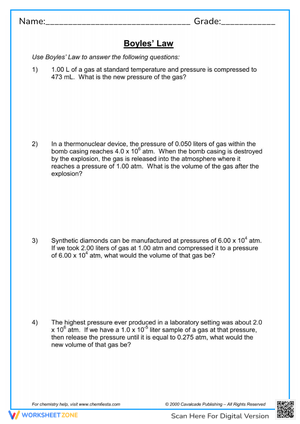
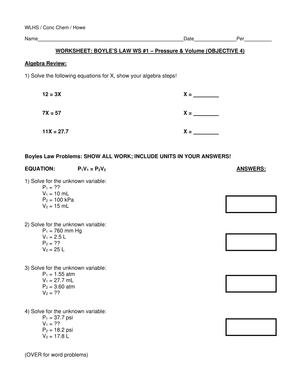
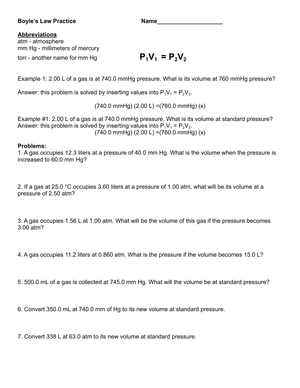
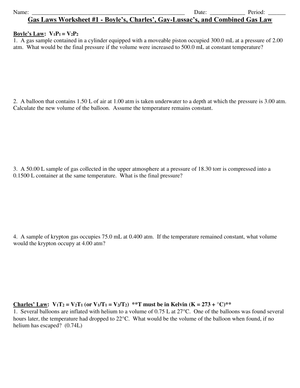
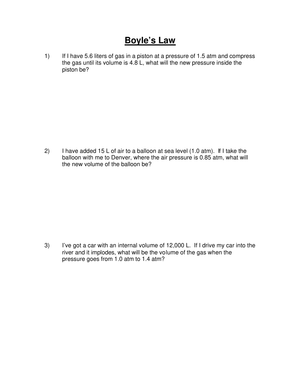
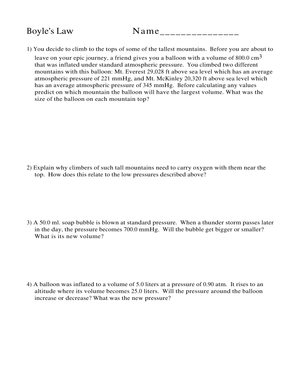
Each worksheet addresses a distinct layer of the problem-solving process rather than repeating the same calculation type across every problem. Some focus narrowly on rearranging P1V1 = P2V2 to isolate any one of the four variables — an exercise that surfaces algebra gaps before they compound into larger errors. Others embed the same math inside narrative contexts: sealed syringes, compressed air cylinders, diving tanks at depth. A separate worksheet handles unit conversion explicitly, asking students to normalize pressure values in atm, kPa, and mmHg before the equation can be applied at all.
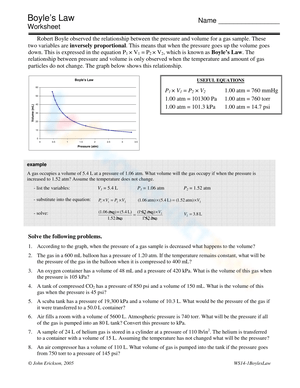
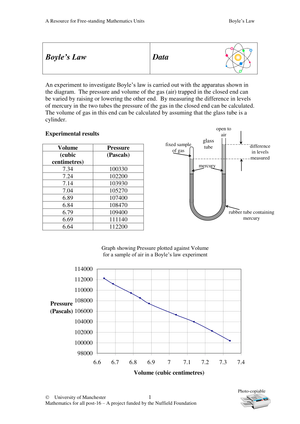
One worksheet asks students to graph pressure versus volume for a fixed gas sample and identify the shape of the resulting curve. That task connects the equation to the behavior it describes — students who can only plug numbers into P1V1 = P2V2 often have no mental image of what the hyperbola means. A final worksheet in the set includes "apply or not" scenarios where temperature is given as changing, requiring students to recognize that Boyle's Law is a special case and does not hold when thermal conditions shift. That boundary-recognition skill rarely appears in textbook exercises but shows up consistently in multi-concept test questions.
Mistakes Students Make That These Worksheets Help You Catch
The most persistent error is treating the relationship as direct rather than inverse. A student will correctly execute the algebra, arrive at a larger V2 in response to an increased P2, and not catch the contradiction because they followed the formula without tracking the physics. Watching for this in early independent practice tells you immediately that the student can manipulate the equation but doesn't grasp what it represents. These boyles law worksheets for 11th grade include a brief sanity-check line after each calculation — "if pressure increased, your volume should have ___" — which forces students to evaluate their answer against the physical expectation before moving on.
A second consistent problem is unit mixing. When P1 is given in kPa and P2 in mmHg, many students simply plug both numbers in without converting. The result is numerically plausible, which is why students rarely question it. The worksheets address this by separating value fields from unit fields in the "list your givens" section — a small formatting choice that slows students down at exactly the step where most errors accumulate.
Lesson-Planning Ideas to Get the Most From These Worksheets
These resources work at several points in the gas laws unit rather than belonging exclusively to one lesson. On the day following an initial lab demonstration — a syringe activity or a manometer setup — the basic variable-isolation worksheet bridges observation and equation. Students who just watched pressure rise as they compressed the syringe are ready to quantify that relationship. The transition from lab to paper lands better at that moment than it would a week earlier, before any physical intuition has formed.
For the unit-conversion content, pairing the relevant worksheet with a short explicit instruction block on dimensional analysis produces noticeably better first-attempt accuracy than assigning it the night before a quiz. Using these boyles law worksheets for 11th grade in a partner structure also works well: one student handles the givens list while the other rearranges and solves, then they switch roles for the next problem. That division makes each step visible, and students catch each other's unit errors more reliably than they catch their own.
Standard Alignment
Boyle's Law instruction in 11th grade falls within NGSS HS-PS1 (Matter and Its Interactions), specifically disciplinary core idea PS1.A, which addresses how atomic and molecular structure explains the macroscopic properties of substances. The pressure-volume relationship is a measurable, calculable instance of that principle, and working through these problems supports Science and Engineering Practice 5 — Using Mathematics and Computational Thinking. Instructionally, the topic typically appears after kinetic molecular theory and before the Combined Gas Law, so the worksheets fit most cleanly into the third or fourth week of a gas laws unit, after students have a particle-level explanation for why volume and pressure move in opposite directions.
Adapting These Worksheets for Different Student Levels
Students who struggle with equation manipulation benefit from a reference card showing all four rearranged forms of P1V1 = P2V2 — one for each target variable — available during the first round of practice. This keeps attention on the gas law reasoning rather than on the algebra, and it's a reasonable support during initial instruction even if it's pulled back before formal assessment. Students who tend to rush through unit labels benefit from completing the unit-conversion worksheet first, separately, before encountering problems that combine conversion with multi-step calculation.
For students ready to move further, any word problem in the set can be extended by asking them to plot pressure-volume data from three or four problems on the same axes and describe the pattern in writing. This connects the numerical skill to the graphical representation without introducing new content — it simply asks more from what they already have. Students preparing for AP Chemistry can be asked to derive the inverse relationship from the ideal gas law rather than accepting it as given, which reframes Boyle's Law as a logical consequence of a more general principle rather than a standalone formula to memorize.
Frequently Asked Questions
Can students complete these worksheets before covering kinetic molecular theory?
Students can apply P1V1 = P2V2 mechanically without knowing why it's true, so the worksheets are usable before kinetic molecular theory is formally introduced. That said, students who understand particle collisions make fewer errors and catch more of their own mistakes. The conceptual explanations in the answer keys reference particle behavior, so revisiting earlier worksheets after covering KMT is a straightforward spaced-retrieval strategy.
What pressure units appear in the problems?
Most problems use atm and kPa, with a smaller number using mmHg — the same distribution students encounter on standardized chemistry and physics exams. Each worksheet specifies units clearly in the problem stem. The unit-conversion worksheet addresses all three systems in sequence before combining them in multi-unit problems.
Are answer keys included?
Yes. Each worksheet comes with a full answer key showing the equation rearrangement and all unit conversions step by step. The keys are formatted so students can use them for self-checking during independent practice rather than only at the end of an assignment.
How do these worksheets connect to the Combined Gas Law?
Understanding that Boyle's Law requires constant temperature is the conceptual bridge to the Combined Gas Law, which adds temperature as a third variable. These boyles law worksheets for 11th grade include a short extension note on each answer key explaining where Boyle's Law sits inside the broader Combined Gas Law equation, so students see the relationship between the two rather than treating each gas law as a separate, isolated formula.












 Interactive Worksheet Maker
 Quiz Maker
 Word Search Maker
 Crossword Puzzle Maker
 Word Scramble Generator
 Sentence Scramble Generator
 Handwriting Worksheet Generator
 Name Tracing Generator
 Fill In The Blank Generator