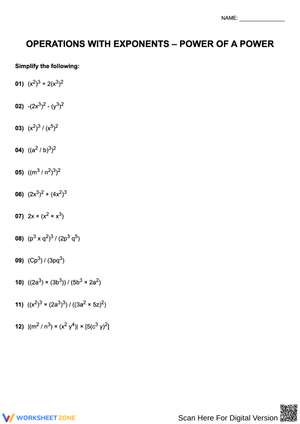
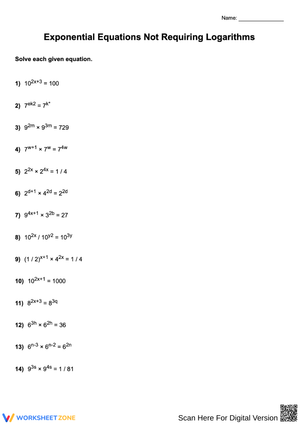
Solving equations worksheets for 11th grade put students in direct contact with the equation types that stall even strong algebra students — rational expressions with polynomial denominators, radical equations that produce extraneous roots, three-variable linear systems, and the exponential-logarithmic pair that reappears constantly in calculus and physics. The set covers each of these categories with targeted practice, structured workspace, and explicit prompts that push students beyond answer-finding toward checking and justifying their work.
Equation Types Across the Set
Rational equations at this level require more than cross-multiplying. Students clear denominators by identifying the least common multiple of polynomial expressions — which often means factoring a quadratic before the real solving even begins. Radical equations add another layer: isolate the radical, raise both sides to the appropriate power, then verify. Every worksheet in the radical section includes a built-in check step, because the habit of substituting answers back into the original equation has to be practiced before it becomes automatic.
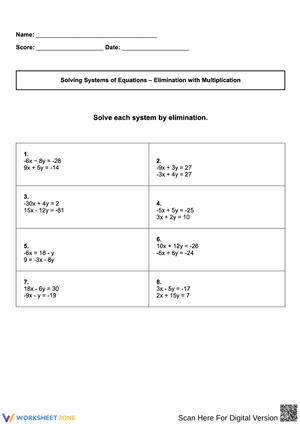
Systems of three variables demand a different kind of discipline. The individual algebra steps are not especially difficult, but the sheer length of the process — three equations, paired eliminations, back-substitution — creates many opportunities for small arithmetic errors to compound into wrong final answers. Each worksheet in that section provides structured workspace that keeps work organized across multiple stages. The set also includes non-linear systems: line-parabola intersections and circle-hyperbola pairs, which many students encounter for the first time at this level.
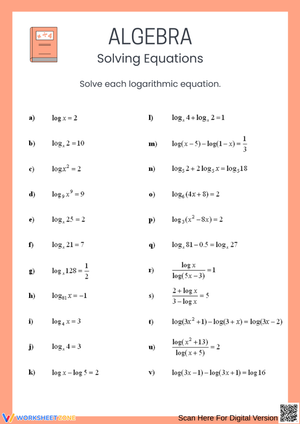
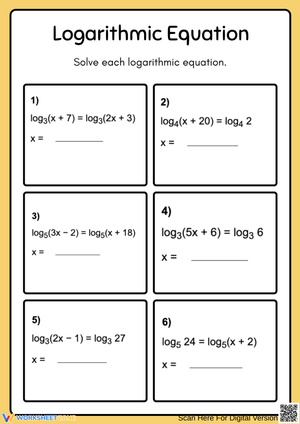
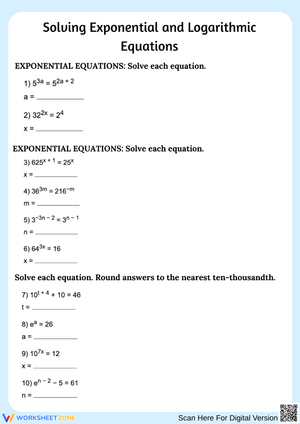
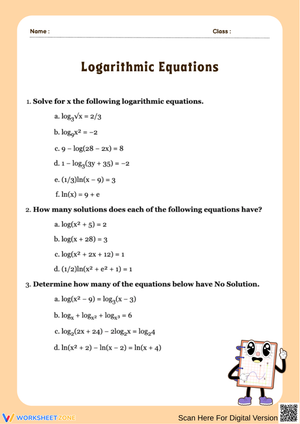
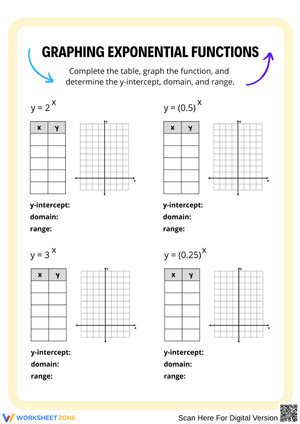
The exponential and logarithmic worksheets treat these two function families as the inverses they are. Students practice converting between forms, applying log properties to bring variables out of exponents, and modeling growth and decay situations. These skills carry significant weight in precalculus and AP Physics, so fluency here matters beyond the current unit.
Mistakes Students Make That These Worksheets Help You Catch
Three error patterns show up consistently in 11th-grade equation work. The first is failing to identify extraneous solutions in radical equations. Students who correctly isolate the radical and square both sides arrive at a clean algebraic answer — and then stop. The answer feels right because the arithmetic worked. A student who gets x = 9 from √(x − 5) = −2 will see immediately that the left side cannot equal a negative number, but only if they substitute back into the original equation before it was squared. Requiring that check step on the rubric is the only reliable way to make it happen.
The second pattern is sign collapse during three-variable elimination. When students multiply an equation through by a negative to cancel a variable, they frequently drop the sign on one term midway through the rewrite. The mistake is invisible until back-substitution fails, at which point most students trace the error to the wrong step — usually the last one they touched. Labeling each original equation and numbering each derived equation on the worksheet reduces this significantly because it creates a record students can actually trace backward.
The third error involves logarithm properties, specifically the assumption that log(a + b) equals log(a) plus log(b). Students who have internalized the product rule — log(ab) = log(a) + log(b) — overgeneralize it to addition inside the argument. This is a conceptual gap, not a careless mistake. A specific counterexample using real numbers — compare log(7 + 3) with log(7) + log(3) on a calculator — usually stops it, but the correction needs to surface more than once across the unit to stick.
Building These Worksheets Into a Weekly Plan
The most effective use pattern is assigning solving equations worksheets for 11th grade in three distinct modes across the week. A single challenging problem — one logarithmic equation or one three-variable system — works well as a daily warm-up that activates prior knowledge and immediately shows who needs support before the lesson moves forward. Mid-unit, worksheets shift to independent or paired practice following direct instruction. For exam review, a station rotation works well: arrange the room so each station holds a different worksheet type, give students 8–10 minutes per station, and run the debrief whole-class at the end.
One strategy worth embedding into instruction for rational and radical equations: before students begin algebraic manipulation, have them sketch a quick graph of both sides of the equation on the same coordinate plane. The intersection points they see predict how many valid solutions exist. When they later solve algebraically and discover an extraneous root, the graph makes concrete why that solution does not appear as an actual intersection — which is considerably more persuasive than telling students to "always check their answers" without showing them why.
Error analysis also fits well here. Present students with a completed worksheet where the work is wrong in a specific, plausible way — a dropped negative during elimination, or an extraneous solution accepted without verification. Ask them to locate the error, explain the flawed reasoning in writing, and correct it. Students tend to be more precise in their own work after they have identified the same mistake in someone else's.
Standard Alignment
The rational and radical worksheets align to CCSS HSA-REI.A.2, which asks students to solve rational and radical equations in one variable and identify extraneous solutions. In practice, this standard is often underweighted — teachers cover the solving procedure but do not press the verification step, which is explicitly part of the standard's language. The three-variable system worksheets address CCSS HSA-REI.C.6, the requirement to solve systems of linear equations exactly using algebraic methods. The exponential and logarithmic worksheets connect to CCSS HSF-LE.A.4, using logarithms to solve exponential equations and interpreting solutions in context — a standard that appears frequently on both SAT Math and ACT Math, making fluency here directly relevant to test performance.
Differentiating the Set Across Readiness Levels
For students who need additional support, start with worksheets where one variable has already been eliminated in a three-variable system, or where the radical has been isolated before the problem begins. Reducing the entry point to one or two manageable steps lets these students build procedural confidence before taking on a full problem. A partially completed example at the top — not the answer, just the first two steps — is often enough to get students moving without removing the cognitive work they need to do.
Advanced students benefit less from more problems and more from different constraints. Ask them to solve the same equation using two distinct algebraic methods and write a brief comparison of which approach is more efficient and why. For exponential equations, push them to consider what happens when the solution is not rational — how do they express the exact value, and what precision does a decimal approximation lose? These prompts do not require separate worksheets; they require a different question attached to the same problem.
Solving equations worksheets for 11th grade also work well as diagnostic tools at the start of a unit. A short set of problems across equation types — one rational, one radical, one three-variable, one logarithmic — quickly shows which categories students carry in from prior instruction and which need to be rebuilt before new content is introduced.
Frequently Asked Questions
How do you get students to reliably catch extraneous solutions in radical equations?
Make verification a graded step, not an optional reminder. If the rubric requires students to substitute each solution back into the original unsquared equation and label any false results as extraneous, they do it. Pairing that check with a graph — where the extraneous solution corresponds to no actual intersection point — gives the rule a concrete anchor. Students who understand why the ghost answer appears, rather than just that it must be discarded, make the check a natural part of the process rather than an afterthought.
What helps students stay organized through three-variable elimination?
Label everything from the start. Students should number each of the three original equations, label each new equation derived through elimination, and note which two equations produced each new one. Solving equations worksheets for 11th grade that include structured workspace for this labeling process significantly reduce the sign errors and tracking failures that derail these problems midway through. Group work helps as well — a partner following the same system will catch a dropped negative before it propagates through four more lines of work.
When should students use graphing rather than algebraic methods to find a solution?
Graphing is most useful for estimating, for verifying algebraic answers, and for understanding why a solution does or does not exist. When a problem requires an exact answer — especially one involving irrational numbers or complex fractions — algebraic methods are necessary. At 11th grade, students should default to algebra and use graphs as a check, not the reverse. The exception is when a problem explicitly asks for a graphical estimate or when technology is available and an approximate decimal answer is acceptable.
What is the most persistent misconception about logarithm properties at this level?
Students routinely apply the product rule to addition, writing log(x + 3) as log(x) + log(3). This is not a careless error — it reflects a genuine misunderstanding of what the product rule describes. The product rule governs multiplication inside the argument, not addition, and the two situations are not parallel. A quick numerical counterexample — log(7 + 3) is log(10) = 1, while log(7) + log(3) is approximately 1.72 — usually stops the confusion cold. Returning to that counterexample across multiple worksheets, rather than addressing it only once, is what makes the correction hold.












 Interactive Worksheet Maker
 Quiz Maker
 Word Search Maker
 Crossword Puzzle Maker
 Word Scramble Generator
 Sentence Scramble Generator
 Handwriting Worksheet Generator
 Name Tracing Generator
 Fill In The Blank Generator