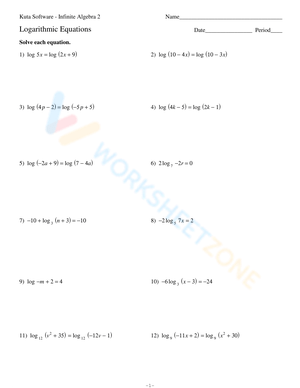
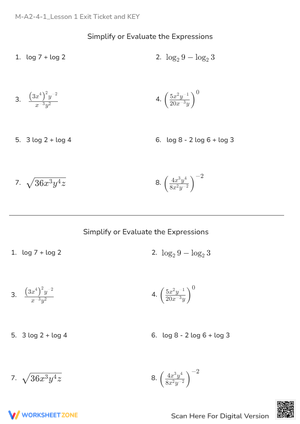
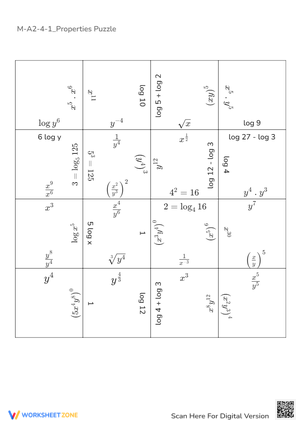
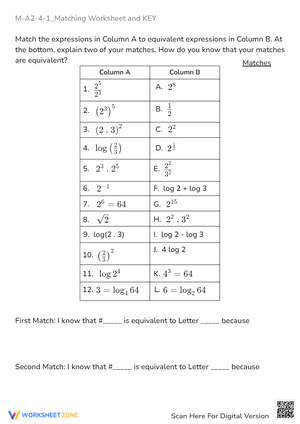
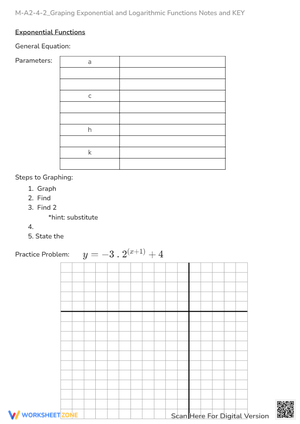
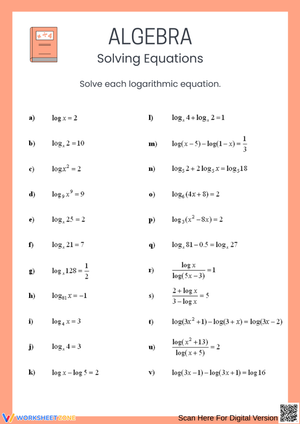
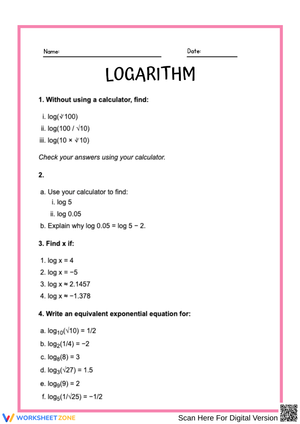
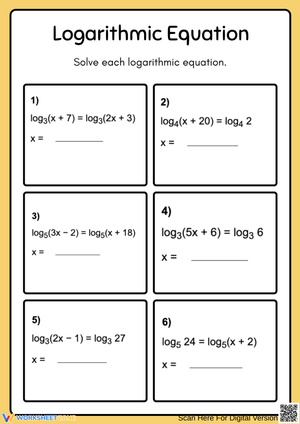
These 11th grade solving logarithmic equations pdf worksheets give teachers a set of targeted problems that moves students from basic exponential-form conversions through multi-step equations requiring log condensing, domain checking, and quadratic solving — the full problem-solving sequence that juniors need to own before precalculus or any exam covering function behavior.
The Specific Skills Targeted
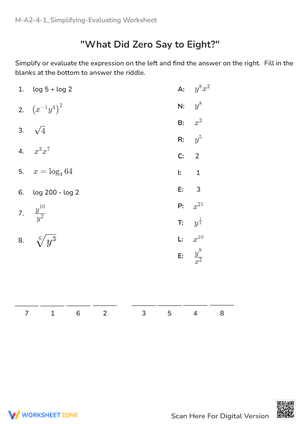
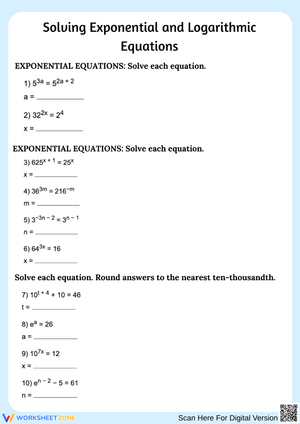
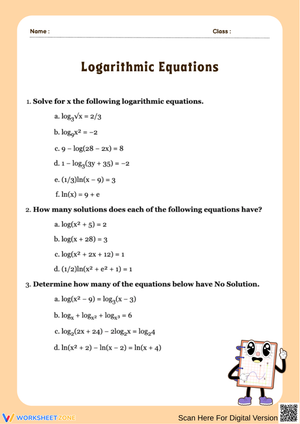
Each worksheet addresses a distinct layer of the solving process. Early problems ask students to convert a single logarithmic expression to exponential form and isolate the variable — for example, rewriting log base 2 of (x + 5) equals 3 as 2 cubed equals x + 5, then solving directly. The 11th grade solving logarithmic equations pdf worksheets then extend into equations where both sides carry the same base, applying the one-to-one property to set arguments equal without converting to exponential form.
Later problems bring in the product, quotient, and power rules. Students condense two or three separate log terms into a single expression before solving — a multi-step sequence that requires holding the structure of the problem in mind while executing each rule correctly. Several worksheets produce a quadratic after condensing, which means students also practice factoring or using the quadratic formula as part of the logarithmic solving sequence.
Student Mistakes Worth Catching Before They Become Habits
The error that costs students the most points is accepting both roots of a quadratic without verifying domain. In a problem like log(x) + log(x – 3) = 1, correct algebraic steps yield x = 5 and x = –2. Both come cleanly out of the factored quadratic. But x = –2 requires evaluating log(–2), which is undefined — the solution is extraneous and must be discarded. Students who skip the domain check mark both values correct without noticing the original equation rejects one of them.
A second pattern is misapplying the product rule to a sum inside the argument. Students rewrite log(x + 4) as log(x) + log(4), treating addition inside the argument the same as a product between two separate factors. The product rule applies to log(x · 4), not to log(x + 4). When students are moving quickly and pattern-matching rather than reading the argument carefully, this error appears consistently — and it usually produces a nonsensical equation that students accept anyway.
A third issue comes up with the power rule. When students rewrite log(x²) as 2·log(x), they implicitly restrict the domain to x greater than zero. But log(x²) is defined for all x except zero, since x² is always positive for any nonzero x. An equation like log(x²) = log(4) has two valid solutions, x = 2 and x = –2, but a student who begins by converting to 2·log(x) will find only x = 2 and miss the negative solution entirely.
Building These Worksheets Into Your Unit Pacing
The 11th grade solving logarithmic equations pdf worksheets work at several points in a unit — as mid-lesson practice after introducing condensing rules, end-of-section review, or warm-ups the day after a new property is taught. One protocol that consistently reduces extraneous solution errors: before students perform any algebraic steps, require them to write the domain restriction for every log term in the problem. If the equation contains log(x – 3), students write x is greater than 3 at the top of the workspace before anything else. This takes under two minutes and shifts domain checking from a forgettable final step into an active part of students' written work from the start.
For cooperative structures, pairs outperform groups of four on these problems. Two students can compare each condensing step in real time and catch sign errors as they go — a group of four typically lets one student run the work while the others disengage. A 15-minute paired block followed by two individual verification problems gives a clean formative read on who has the domain piece and who still needs a targeted re-teach.
Standard Alignment
These worksheets align with HSF-LE.A.4, which asks students to express the solution to an exponential equation using logarithms and understand the inverse relationship between the two function types. Solving logarithmic equations sits at the applied end of this standard — students are not just naming the inverse relationship but using it actively to isolate variables, set up equivalent forms, and evaluate whether a solution holds in the original equation. In most 11th grade course sequences, this standard appears after students have modeled exponential growth and decay and now need algebraic tools for solving directly for an unknown exponent.
Differentiating the Set Across Student Readiness Levels
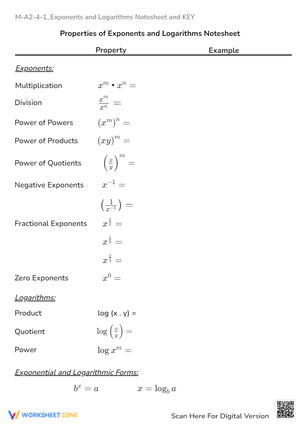
Students who are still uncertain about what a logarithm produces — what log base b of x actually means — need single-step conversion problems before they encounter condensing rules. Give those students a written reference strip with the four log properties and the definition, not as a permanent support but as a temporary working reference that keeps them inside the solving process rather than shutting down at notation they don't recognize. Once they can convert and solve single-log equations reliably, move them to one-to-one property problems before introducing multi-term condensing.
For students who have the fundamentals secure, the 11th grade solving logarithmic equations pdf worksheets with quadratic outcomes are where the work gets real. Assign those problems and require students to write a single sentence explaining why any rejected solution is extraneous — not just "it's negative" but specifically what expression becomes undefined and why the domain excludes it. That level of written justification separates students who can execute the procedure from students who understand what they are doing.
Frequently Asked Questions
What prior knowledge do students need before starting these worksheets?
Students need fluency with linear and quadratic equation solving, including factoring and the quadratic formula, since those skills come up inside the log-solving process once condensing is applied. They also need a working understanding of exponent rules and the basic definition of a logarithm. Students who arrive uncertain about factoring will stall on the multi-step problems — not because they don't understand logs, but because the downstream algebra is unfamiliar.
How do you handle students who keep forgetting to check for extraneous solutions?
The domain-first protocol is the most durable fix — require domain restrictions to be written before any algebraic steps begin. The habit forms when checking is embedded in the setup rather than treated as a final step that's easy to skip. For students who understand the concept but still forget, connecting the check to the graph helps: ask them to mark on a sketch of y = log(x) where a negative argument would fall, and the reason the restriction exists becomes visual rather than abstract.
When do students use exponential conversion versus the one-to-one property?
Exponential conversion applies when there is a single log expression on one side and a constant on the other — convert, then solve using standard algebra. The one-to-one property applies when a single log with the same base appears on both sides — set the arguments equal and solve the resulting equation. The most common procedural error on both-sides problems is attempting to apply the one-to-one property before condensing multiple log terms on one or both sides into a single expression. The property only works once each side is reduced to a single log with a matching base.












 Interactive Worksheet Maker
 Quiz Maker
 Word Search Maker
 Crossword Puzzle Maker
 Word Scramble Generator
 Sentence Scramble Generator
 Handwriting Worksheet Generator
 Name Tracing Generator
 Fill In The Blank Generator