11th Grade Solving Exponential Equations Worksheets
These 11th grade solving exponential equations worksheets address the point in Algebra 2 where the variable leaves the base and moves into the exponent — and students quickly find that the rules they relied on for polynomials no longer hold. Each worksheet targets a specific method or problem type, giving teachers something they can sequence into a unit without constructing review problems from scratch.
What Each Worksheet Covers
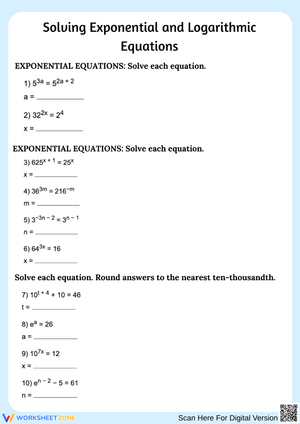
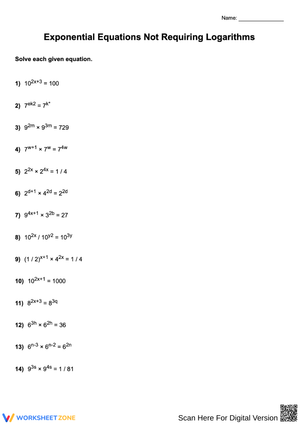
The set divides across two core solution strategies. The first group focuses on the common-base method: students rewrite both sides of an equation using a matching base, then set exponents equal. This approach works cleanly for equations built around recognizable powers of 2, 3, 5, and 10. An equation like 9^x = 27 becomes straightforward once both sides are expressed in base 3 — (3^2)^x = 3^3 collapses to 3^(2x) = 3^3, and the resulting equation 2x = 3 is linear. Students who hit a wall here almost always have gaps in their exponent laws, and those gaps surface immediately.
The second group requires logarithms — specifically for cases where no common base is obvious. Students isolate the exponential expression, apply a logarithm to both sides, and use the Power Property to bring the variable exponent down as a coefficient, converting the equation into a linear one. The worksheets also ask students to choose between the common logarithm and the natural logarithm. That choice matters most when the base is e: because ln(e) equals 1, using the natural log collapses those expressions immediately and keeps the algebra clean. Several worksheets close with application problems — compound interest, radioactive half-life, bacterial growth — where students must interpret a decimal result in context, not simply produce one.
Frequent Student Errors Worth Watching For
The most persistent error involves treating logarithms as though they distribute across addition. When a student sees 2^x + 5 = 13 and immediately writes log(2^x + 5) = log(13), they often follow up by splitting the left side into log(2^x) + log(5). That's wrong — logarithm rules apply to products and quotients, not sums — and once a student commits to that move, every subsequent step is built on a false premise. The correct approach is to subtract 5 first, leaving 2^x = 8, before a logarithm appears anywhere. Making isolation a non-negotiable first step — not a suggested one — is the fix that actually holds.
A second consistent error appears when the exponential term carries a coefficient. In an equation like 4 · 3^x = 108, students frequently jump to log(4 · 3^x) = log(108) without dividing by 4 first. That commits them to applying the product rule on the left side — an extra step most of them mishandle. Dividing both sides by 4 first produces 3^x = 27, which most students can solve by inspection without a logarithm at all. Catching this pattern early prevents a significant amount of rework later in the unit.
Working These Worksheets Into Your Unit Plan
The common-base worksheets belong at the start of the unit, before logarithms are formally introduced. They build exponent-law fluency and establish the underlying logic — equal exponential expressions with the same base require equal exponents — which makes the logarithmic method feel like a natural extension of that idea rather than an unrelated procedure. Once that foundation is in place, the shift to logarithms is far less jarring for students.
Used across the unit together, 11th grade solving exponential equations worksheets from both method groups give teachers a complete sequence from conceptual entry point through applied reasoning. Error-analysis problems work particularly well once logarithms are on the table. Present a worked solution containing one mistake — a student who applied the log before isolating, or who wrote log(5^x) as log(5) + x instead of x · log(5) — and ask students to locate and correct it. This format surfaces misconceptions more reliably than a standard problem set, and it fits neatly into the last six or seven minutes of a period when starting a new problem from scratch feels too ambitious. For a mid-unit check, pull one worksheet as a brief exit task: students who correctly isolate before applying the log are ready for application problems; students still distributing the log across addition need focused reteaching first.
Standard Alignment
These worksheets align to CCSS.MATH.CONTENT.HSF.LE.A.4, which asks students to express the solution to an exponential equation as a logarithm and evaluate it using technology when an exact form isn't available. Instructionally, this standard lands in the second half of Algebra 2 or the opening of Pre-Calculus — after students have worked through logarithm properties (HSF.BF.B.5) but before they encounter logarithmic equations as the primary object of study. The worksheets fill that gap directly: they require students to apply properties they've just learned in a new problem context, without yet adding the complexity of equations where the logarithm itself is isolated and solved.
Adjusting the Set for a Range of Learners
For students still unsteady on exponent laws, the 11th grade solving exponential equations worksheets that focus on the common-base method are a better entry point than jumping straight to logarithms. Pairing those worksheets with a reference sheet listing common powers — 2^1 through 2^10, 3^1 through 3^6, 5^1 through 5^4 — lets students concentrate on the structure of the method without losing time searching for equivalent expressions they haven't memorized yet. Once they move reliably through those problems, the logarithmic method follows more naturally.
For students who finish early and need a more demanding task, compound interest problems that require solving for time provide a genuine extension. Using A = P(1 + r/n)^(nt) and isolating t involves the same algebraic moves as the standard practice problems but adds an interpretive layer: a student who correctly calculates a time value still needs to assess whether that answer makes sense for the scenario and how to round given the real-world constraints. That interpretive demand is a different cognitive task than symbol manipulation alone, and it reflects the kind of reasoning students encounter in AP coursework and college quantitative courses.
Frequently Asked Questions
Can these worksheets be used before logarithms are formally introduced?
The common-base worksheets work without any prior logarithm instruction — they rely entirely on exponent laws and the property of exponential equality. Reserve the logarithmic-method worksheets for after students understand the Power Property and know how to evaluate expressions like log(12) / log(5) on a calculator.
How many problems does each worksheet include?
Typically 10 to 16 problems per worksheet. The common-base worksheets run longer because each problem involves fewer steps. The logarithmic-method and application worksheets carry fewer items since each one requires more work to complete.
Do the application problems require a graphing calculator?
The 11th grade solving exponential equations worksheets that include compound interest and half-life problems expect students to evaluate expressions like ln(0.5) / ln(0.9) using a scientific or graphing calculator. The purely algebraic worksheets — common base and integer-answer logarithmic problems — work without a calculator and are appropriate for no-technology quiz conditions.
Do the worksheets come with answer keys?
Yes. Each worksheet includes a complete answer key. For multi-step problems, the key shows intermediate work — the isolation step and the logarithm setup — before the final answer. That makes it easier to identify exactly where a student's reasoning went wrong, rather than simply marking an answer incorrect and leaving the student without a clear path to correction.
Clear All