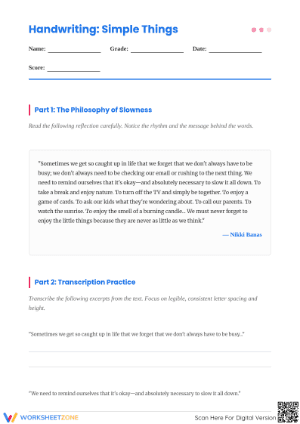
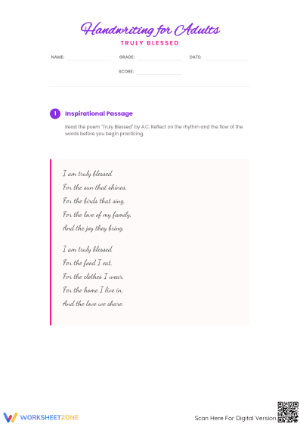
Handwriting worksheets at this level are not about tracing the alphabet. They target legibility, writing speed, and stamina for the tasks juniors actually face: timed essays, dense lecture notes, lab records, and handwritten exam responses. For special education teachers, occupational therapists, and resource staff, these sheets support specific, measurable goals rather than beginner penmanship. The real challenge is matching practice to a 16- or 17-year-old's workload without making it feel like elementary busywork that teens will quietly refuse to do.
Handwriting difficulty also does not disappear after the early grades. A 2015 German survey of 1,907 teachers rated 30% of girls and 50% of boys as poor writers, a reminder that legibility problems follow many students well into their teen years. When you plan for grade 11, assume a real slice of your roster still needs targeted support, then build practice that reflects their age and the writing they do every day.
What Illegible Writing Costs on Graded Work
Legibility is not only a neatness issue; it changes scores. In one analysis of high school teachers grading the same essays, handwriting quality shifted content scores by an average of 8.7 points, which means a strong argument written in a messy hand can lose credit for reasons that have nothing to do with the ideas on the page. For juniors building a GPA, assembling writing portfolios, and preparing for college applications, that is a gap worth closing well before senior year.
The practical takeaway is that handwriting remediation in grade 11 doubles as a grade-protection strategy. If a student's content is solid but their scores lag, timed handwriting samples can reveal whether legibility is the hidden variable. Have students write a paragraph under a two-minute limit, then read it cold the next day. If they cannot decode their own handwriting, a teacher moving quickly through forty essays will not decode it either, and the content score suffers for it.
Tying Handwriting Goals to IEPs and 504 Plans
For students with handwriting goals in their plans, worksheets become documentation, not just practice. Wrightslaw's guidance on occupational therapy services in the IEP frames handwriting as a related service that supports access to the general curriculum, which means practice should connect to measurable classroom tasks. Keep dated samples so progress toward a legibility or speed goal is visible and defensible at review time.
Discretion matters with teens. Deliver practice inside routines the whole class already does—a bell-ringer, a note-taking check, an exit ticket—so a junior working on legibility is doing the same visible task as everyone else. This keeps 504 and IEP support from singling anyone out and lowers the resistance that older students bring to anything that looks remedial.
Classroom Implementation
Keep sessions short and frequent. Five to eight minutes of targeted daily practice beats a single long weekly block, especially for building stamina and changing habits. In a resource room or co-taught setting, open with a quick timed sample, spend a few minutes on one target skill, and close with a fast self-check the student scores first.
- Use a simple self-assessment rubric: readable, mostly readable, or hard to read, marked by the student and then confirmed by the teacher.
- Rotate targets by day—legibility Monday, spacing Tuesday, speed Wednesday—so each session stays focused on one thing.
- Watch for fatigue; if letters break down after a few lines, build stamina gradually rather than pushing longer sessions.
- Keep dated samples in a folder to show growth at conferences and plan reviews.
Match the material to the student's age. Choose sheets with mature prompts, real academic content, and adult formatting instead of cartoons or wide primary-lined paper. When the practice looks like the work of a junior, teens engage with it rather than treating it as something meant for much younger kids.
Frequently Asked Questions
1. Why would a grade 11 student still need handwriting worksheets?
Legibility and writing speed don't automatically mature with age. If a junior's notes are hard to read, their timed essays run out of time, or their graded writing scores below the quality of their ideas, targeted practice helps. At this level the goal is readable, efficient writing—not learning letter shapes from scratch.
2. How can teachers support IEP or 504 handwriting goals without singling out students?
Fold practice into routines everyone does—bell-ringers, note checks, exit tickets—so support looks identical across the class. Keep dated writing samples as evidence toward the plan's legibility or speed goal, and coordinate with the occupational therapist or case manager so worksheet targets match the written accommodation.
3. Which handwriting skills matter most for exams at this level?
Legible writing under time pressure matters most. AP free-response questions, SAT and ACT essays, and in-class timed writing reward students who produce readable text quickly without their hand tiring. Practice that pairs a clock with real prompts builds the exact skill these assessments measure.
4. How much class or intervention time should go to handwriting practice?
Short and frequent wins. Five to eight minutes of focused daily practice supports habit change and stamina better than one long weekly session. In intervention settings, a brief timed sample plus one target skill per day keeps the load manageable and gives you clean progress data.
5. What is the difference between remedial handwriting practice and penmanship enrichment for teens?
Remedial practice targets specific breakdowns—illegible letters, slow pace, early fatigue—usually tied to an IEP, 504, or intervention goal and tracked with samples. Enrichment, such as cursive or calligraphy-style penmanship, is optional polish for students who already write legibly and want a cleaner or faster hand.
















 Interactive Worksheet Maker
 Quiz Maker
 Word Search Maker
 Crossword Puzzle Maker
 Word Scramble Generator
 Sentence Scramble Generator
 Handwriting Worksheet Generator
 Name Tracing Generator
 Fill In The Blank Generator