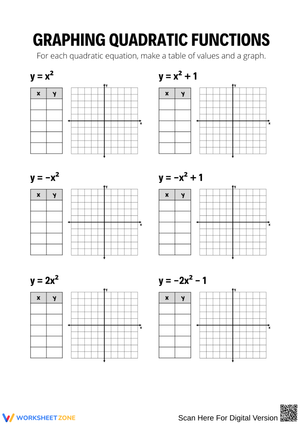
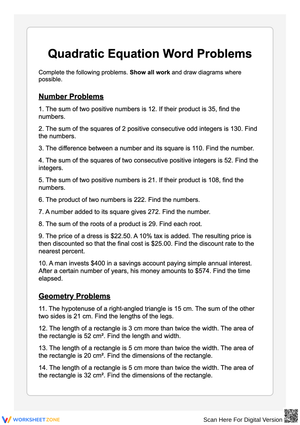
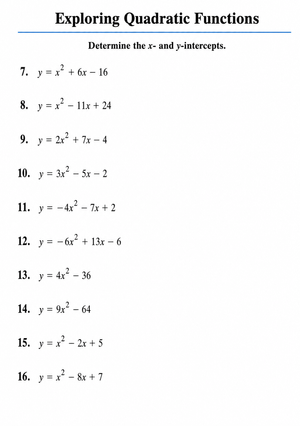
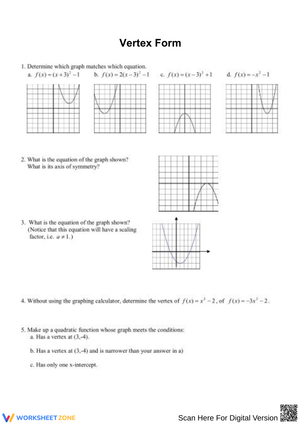
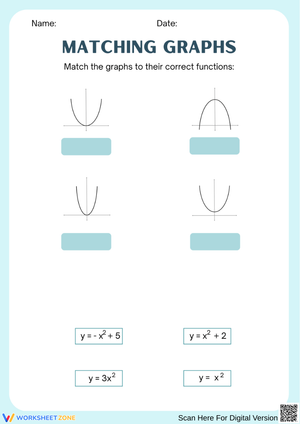
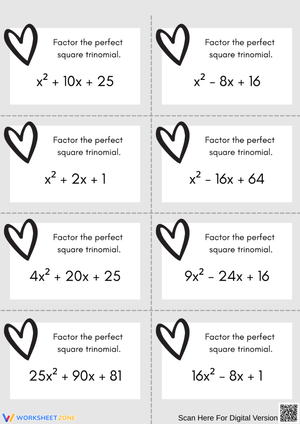
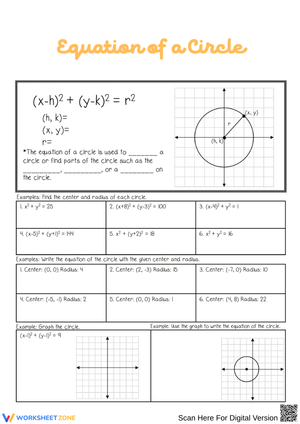
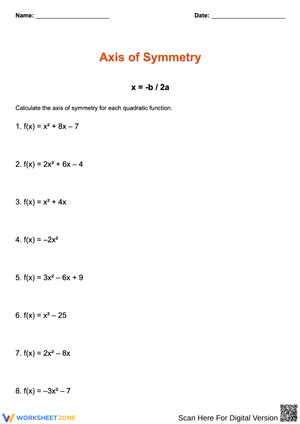
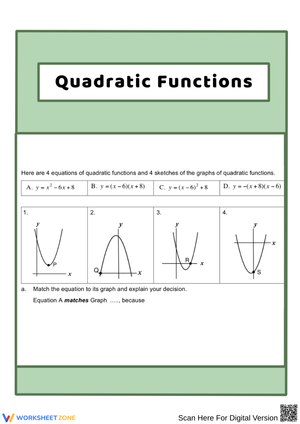
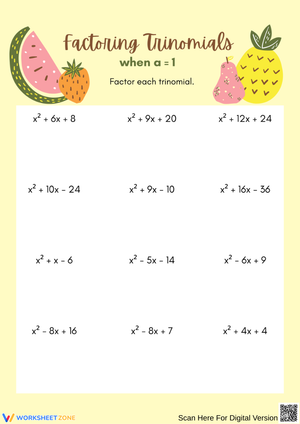
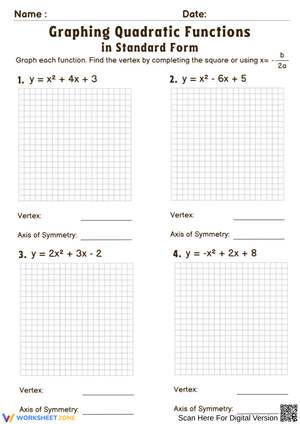
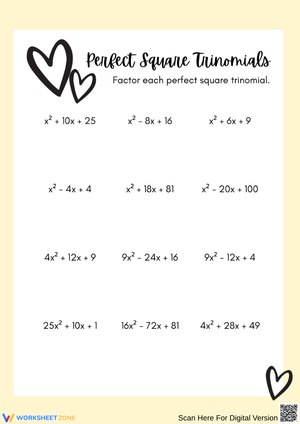
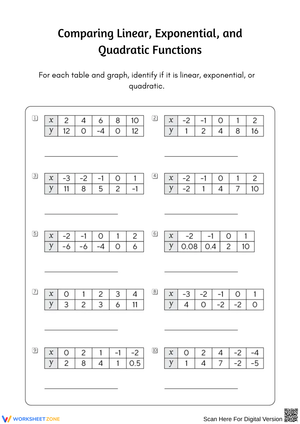
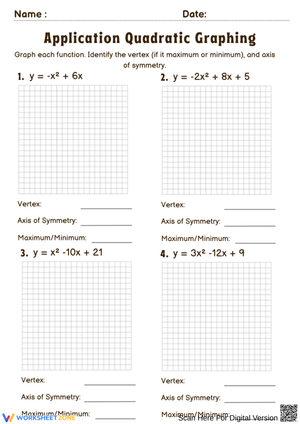
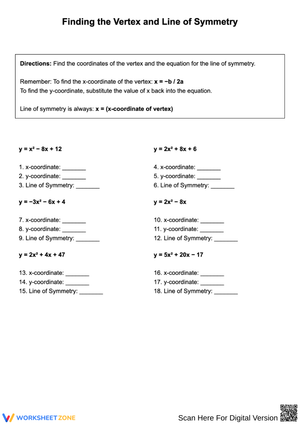
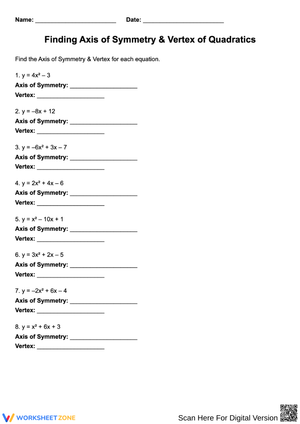
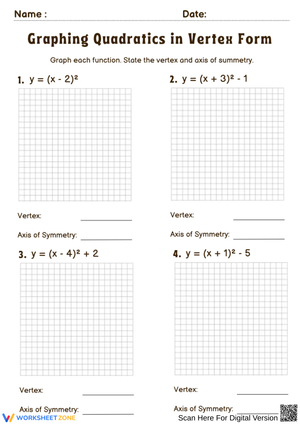
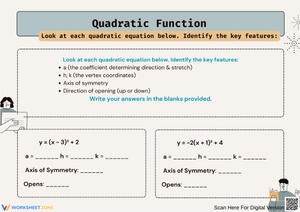
These quadratic function printable worksheets for 10th grade give teachers a focused collection of practice tools that spans the full parabola unit — from reading key features off a graph to applying three distinct solving methods with real fluency. Each worksheet targets a specific skill cluster rather than covering the entire unit at once, which is what makes them practical as daily warm-ups, mid-lesson checkpoints, or targeted review before assessment.
What the Set Covers
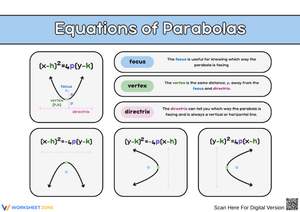
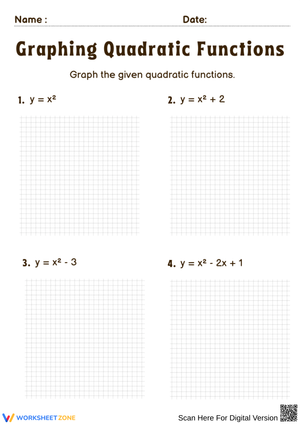
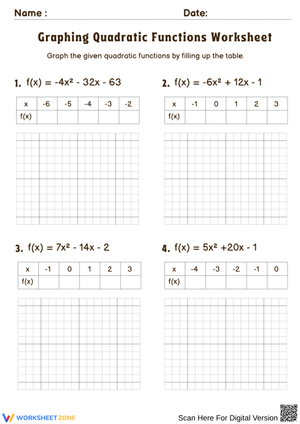
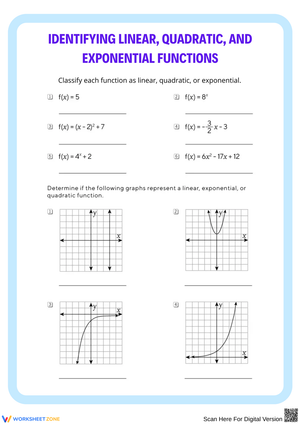
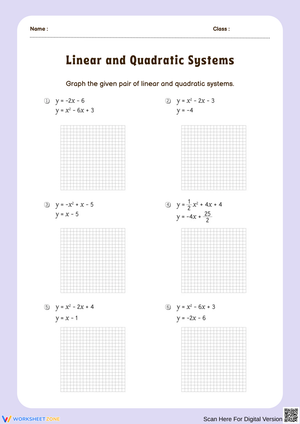
The skills addressed run in roughly the sequence most Algebra I or Integrated Math II teachers follow. Graphing worksheets ask students to identify the vertex and axis of symmetry from standard form — f(x) = ax² + bx + c — using x = -b/(2a) before substituting back to find the y-coordinate. From there, students build T-charts, plot symmetric point pairs, and sketch the curve by hand. A separate cluster of worksheets handles the three forms — standard, vertex, and factored — with conversion exercises running in both directions so students understand what each form reveals rather than treating conversions as isolated procedures.
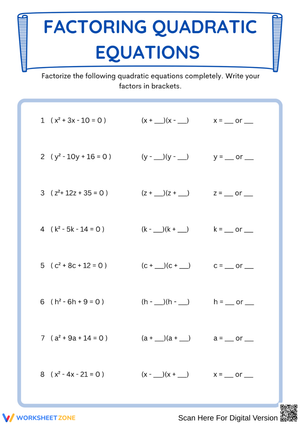
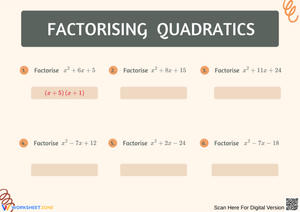
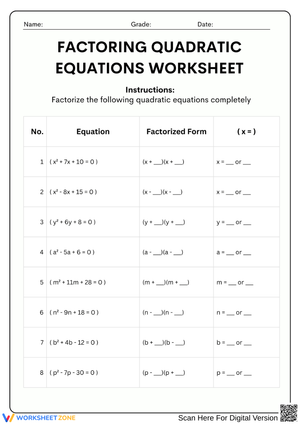
Factoring practice is organized by case. The first worksheets in the factoring sequence work with monic quadratics — leading coefficient of one — where students find a factor pair that multiplies to c and sums to b. Later worksheets introduce non-monic trinomials using the AC method, then move into special products: perfect square trinomials and difference of squares. These get their own dedicated exercises because students who factor x² - 9x + 20 fluently will still miss that x² - 25 has no middle term and belongs to the difference-of-squares pattern.
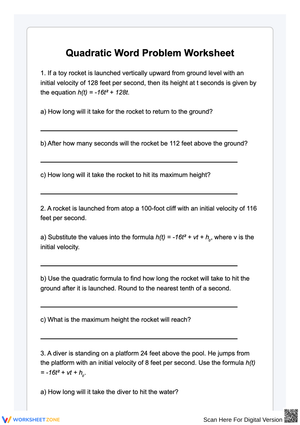
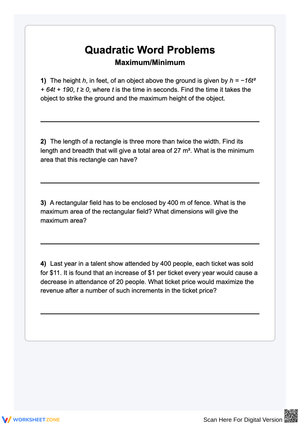
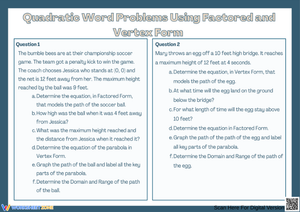
The quadratic formula worksheets focus on reliable execution. Students list a, b, and c in a dedicated area before substituting — a structural move that eliminates a significant share of sign errors. A companion set addresses the discriminant in isolation, asking students to calculate b² - 4ac and classify the roots without completing the full solve. Real-world modeling problems — projectile motion, area optimization — appear in their own worksheets and require students to write the quadratic equation from a verbal description before solving, which is where many students discover they understood the solving procedure but hadn't internalized what the variables represent.
Mistakes Students Make That Are Worth Anticipating
The most consistent error across the factoring worksheets involves sign handling in factored form. Students learn that f(x) = (x - 3)(x + 2) has roots at 3 and -2, and then immediately write that f(x) = (x - 5)(x - 4) has roots at -5 and -4. The negative sign in each factor carries over rather than reversing. Students who can state the rule correctly during class discussion still flip signs when working independently. The fastest correction: require them to verify each root by substituting back into the original equation. Once that verification habit forms, the error rate drops noticeably.
A different pattern surfaces on vertex form conversion worksheets. When completing the square, students add the completing-the-square constant inside the parentheses and forget to subtract it outside. They write f(x) = (x + 3)² + 7 when the correct answer is f(x) = (x + 3)² - 2, because the 9 added inside was never balanced elsewhere in the equation. This is a genuine misunderstanding of algebraic equivalence, not carelessness. Worksheets that give the compensation step its own dedicated blank — visually separated from the main algebraic work — make it straightforward to identify exactly where the process breaks down during a quick room scan.
On discriminant worksheets, students frequently compute b² - 4ac correctly up to a point, then misread the final sign. A discriminant of -16 gets described as "positive because -4 times -4 is positive 16." They're computing b² accurately and then misapplying that reasoning to the entire expression. This surfaces a signed-number fluency gap worth addressing directly before moving into complex roots.
Building These Worksheets Into Your Week
Most worksheets in this set work best in the 12–15 minute guided practice window that follows direct instruction, while the examples are still visible on the board. The factoring worksheets in particular benefit from a teacher model on one or two problems before students go independent — not because the directions are unclear, but because a reference problem on the board reduces the anxiety that comes with blank-slate algebra and keeps students from stalling before they start.
The discriminant and vertex form conversion worksheets are strong candidates for the warm-up slot two or three days after the original lesson, when spaced retrieval starts to matter. Running those problems at the start of class — before reviewing homework — surfaces retention gaps at a point when reteaching is still practical. The modeling worksheets work well as paired tasks because the setup step, translating the verbal description into an equation, generates productive disagreement about how to define the variable. That kind of mathematical conversation is worth carving out class time for.
Standard Alignment
These worksheets address CCSS.MATH.CONTENT.HSA.REI.B.4 — solving quadratic equations in one variable — which designates both completing the square and the quadratic formula as required methods, not merely acceptable alternatives. They also address CCSS.MATH.CONTENT.HSF.IF.C.7a, which asks students to graph quadratic functions and show and interpret intercepts, maxima, and minima. In classroom terms, the graphing and key-features worksheets belong in the first two weeks of the unit, while formula and discriminant work fits weeks three and four, once algebraic fluency with standard form is established. Teachers in states using CCSS-aligned frameworks under different branding will find the worksheets map cleanly onto the equivalent high school algebra standards in those documents.
Adjusting the Set for a Range of Learners
Students who are still unsteady on signed-number arithmetic get more out of the quadratic formula worksheets when they begin with a problem set where a, b, and c produce a clean discriminant and rational roots. This removes the cognitive load of simplifying radicals while students build procedural fluency with the formula itself. Once that's solid, introducing irrational and then complex roots goes more smoothly because students are working on one new idea at a time.
Quadratic function printable worksheets for 10th grade that feature non-monic trinomials with leading coefficients of 2, 3, or 5 — rather than larger primes — give advanced students a meaningful challenge without the problems becoming arithmetic exercises disguised as algebra. For students working significantly below grade level, pair the graphing worksheets with a completed T-chart where the x-values are already selected; students calculate the y-values and plot the points, building graph-reading fluency before they manage the full problem setup on their own.
Frequently Asked Questions
What order works best for introducing the three solving methods?
Factoring first, completing the square second, quadratic formula third is the sequence that holds up best in practice. Factoring builds number sense that pays dividends throughout the unit. Completing the square is harder but produces the vertex form conversion as a natural byproduct, justifying the difficulty. The formula arrives last as a guaranteed method — students understand why it exists because they've already encountered equations that resist factoring. Quadratic function printable worksheets for 10th grade organized in this order let teachers move students through the progression without backtracking to fill gaps.
How do the completing-the-square worksheets handle the compensation step?
Each conversion worksheet breaks the process into discrete steps: a dedicated blank for the half-of-b calculation, a separate blank for the squared value, and a required final step where students write the fully balanced equation with the compensation shown explicitly. This structure makes it easy to locate exactly where a student's work breaks down during a room scan, rather than having to read through an entire algebraic chain to find the error.
Are the modeling worksheets appropriate for students without a physics background?
Yes. The projectile motion problems supply the formula, the units, and the physical context — everything a student needs to proceed algebraically. Students don't need to understand why the formula looks the way it does. What they do need is practice reading carefully enough to extract a, b, and c from a description, and to interpret the vertex as a maximum height rather than just a coordinate pair. That interpretive step is the genuine mathematical target, and the worksheets require it explicitly rather than treating it as optional.
Do these work for older students reviewing quadratics in Algebra II or Pre-Calculus?
Quadratic function printable worksheets for 10th grade work equally well for 11th or 12th graders revisiting the content. The skill gaps in that population — sign errors in the quadratic formula and confusion between factored form factors and their corresponding roots — are exactly what these worksheets are built to address. The problems carry no grade-level branding that would feel condescending to an older student closing a foundational gap.













 Interactive Worksheet Maker
 Quiz Maker
 Word Search Maker
 Crossword Puzzle Maker
 Word Scramble Generator
 Sentence Scramble Generator
 Handwriting Worksheet Generator
 Name Tracing Generator
 Fill In The Blank Generator