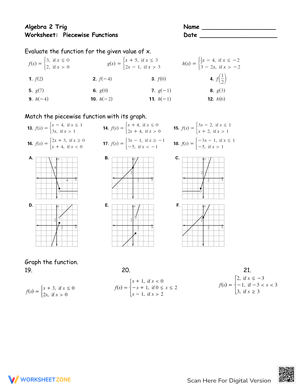
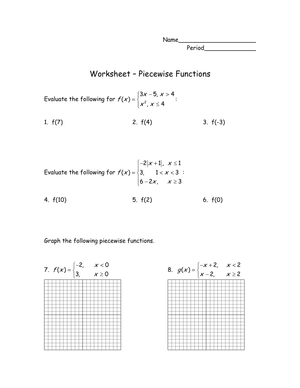
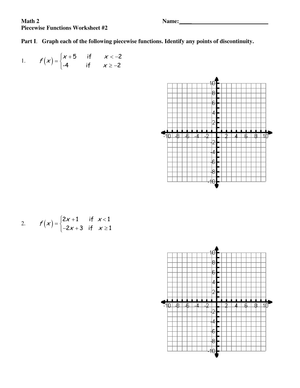
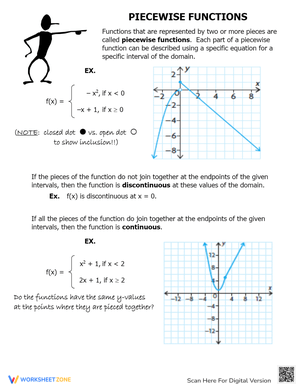
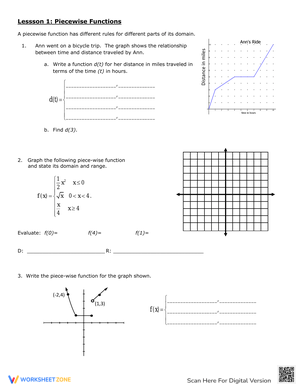
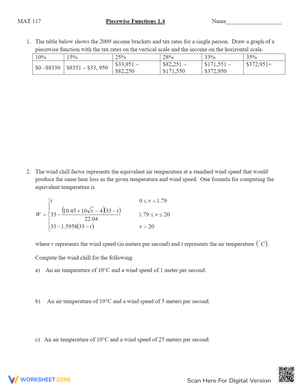
These evaluating piecewise functions printable worksheets for 10th grade focus on the cognitive move that separates a correct answer from a consistent error: testing the input against the stated condition before any calculation begins. Piecewise functions ask students to make a genuine decision — which rule applies here? — and then compute. That sequencing is what makes this topic harder than standard function evaluation, and it is where these worksheets concentrate their practice.
The Cognitive Work at the Core of This Skill
When a student encounters f(x) = {3x + 1 if x < 2; x² if x ≥ 2} and is asked for f(2), the arithmetic is trivial. The challenge is recognizing that x = 2 satisfies the second condition, not the first. That requires holding the inequality symbol in mind, comparing it to the given input, and only then evaluating. Students who bypass that comparison and default to the first expression they see produce wrong answers even when their algebra is sound.
This skill sits at Grade 10 for a specific reason. Students have seen inequalities on number lines and have worked with function notation in earlier units, but piecewise functions combine those two ideas inside a single problem — a new context that demands transferring existing knowledge rather than building something entirely new. That transfer is where direct, deliberate instruction matters most.
Skills These Worksheets Build
The set moves across five task types, each targeting a different layer of the skill. Using them in order gives teachers clear evidence of where students are accurate and where they still need focused attention.
- Direct evaluation from symbolic notation: Students identify the correct rule from strict and non-strict inequalities, then substitute the given input. Problems include integer inputs, negative values, and fractions — not only tidy whole numbers.
- Boundary-value practice: Each worksheet in this cluster centers on inputs that land exactly at a defined endpoint. Students mark whether the condition includes or excludes that value before computing.
- Graph interpretation: Students read open and closed circles, determine which branch is defined at a specified x-value, and write the output. Several items place two branches close together to prevent careless visual guessing.
- Error analysis: A completed solution contains one deliberate mistake — typically a wrong interval choice or an endpoint misread. Students locate the error, explain it in a sentence, and rewrite the correct solution.
- Multi-condition problems: Functions with three defined pieces, including one involving an absolute value expression, extend the decision-making process after core accuracy is established.
Predictable Errors in Student Work on Piecewise Functions
The most consistent pattern is selecting the first rule regardless of the input. A student who sees f(x) defined with three conditions and is asked for f(−4) will frequently substitute −4 into the top expression without checking whether −4 satisfies that condition at all. This is not a careless algebra mistake — it reflects an underdeveloped habit of checking preconditions before computing. The error analysis worksheet surfaces this pattern directly, because students must explain the mistake in writing, which forces them to articulate the rule-selection step explicitly rather than simply redo the arithmetic.
A second pattern emerges at boundaries. When a function is defined with x < 3 for one piece and x ≥ 3 for another, students frequently claim x = 3 is undefined, importing a visual memory from earlier number line work where open circles appeared on both sides of an excluded value. The written condition is right in front of them, but they stop reading before reaching the ≥ symbol. Pairing the inequality notation with the corresponding graph — a closed circle on one branch, an open circle on the other — addresses this more reliably than re-explaining the rule alone.
A third error appears when students have the rule-selection step right but rush through the arithmetic: given f(x) = x² for x ≥ 3, a student who correctly selects that rule for input x = 3 will sometimes write f(3) = 3 rather than f(3) = 9 — substituting the input but not completing the squaring operation. The rule was correct; the computation was not. That mistake appears in roughly the same place in student work every time this topic is taught.
Fitting These Worksheets Into Your Planning Cycle
The evaluating piecewise functions printable worksheets for 10th grade work best when assigned in deliberate stages rather than as one extended block. Use the direct evaluation worksheet for guided practice: project one function, ask students to underline the matching condition before they touch the expression, and repeat that annotation step two or three times together. Once the habit is established, students move to independent work on the remaining items. The annotation routine sticks when it is modeled, named, and expected before any solo practice begins.
Three boundary-value problems make an efficient warm-up — they take about six minutes and immediately reveal which students are still uncertain about open versus closed endpoint conditions. That information drives the lesson before the main activity starts. Error analysis items work well as exit tickets: the format is compact, the thinking is substantive, and the written-explanation component gives teachers readable evidence of whether students understand rule selection or are reaching correct answers by other means.
In sub plans, these worksheets carry their own structure. Directions on each worksheet walk students through the annotation step, so the lesson does not require extended verbal setup from a substitute.
Standard Alignment
These worksheets align to CCSS.MATH.CONTENT.HSF.IF.C.7b, which expects students to graph and interpret functions defined by cases, including piecewise-defined and absolute value functions. The evaluation practice here supports that standard at its foundation: students cannot interpret or graph a piecewise function accurately unless they can first determine which piece governs a given domain value. Teachers in states with alternate frameworks will find equivalent placement at the Algebra 2 or Functions level, typically in the unit covering domain, range, and multiple representations of functions.
Using the Worksheets Across Different Readiness Levels
For students still working out inequality direction and interval notation, begin with the direct evaluation worksheet using functions that have exactly two pieces and integer boundaries. Remove fraction and negative inputs in the first pass — those students need to confirm the decision process before adding computational friction. A useful structure is to have them write "check: does [input] satisfy this condition?" beside each problem before doing any algebra. That prompt makes the thinking visible without changing the mathematical demand.
Students who are accurate with notation but uncertain about graphs benefit from the graph-reading worksheet paired with its written-rule equivalent. Asking them to write the symbolic condition next to each open or closed circle before finding any output builds the connection between notation and visual representation — the evaluation is almost secondary at that point.
The multi-condition and error analysis worksheets serve students ready for deeper work. For that group, add a short writing requirement: after finding f(x) for a given input, they identify which input value would switch the applicable rule and explain why. The evaluating piecewise functions printable worksheets for 10th grade include answer keys that display the chosen rule alongside the final value, a feature that makes small-group review more efficient because the conversation can focus on where the reasoning diverged rather than just whether the answer matched.
Frequently Asked Questions
What should I do when students keep selecting the wrong rule?
Require the annotation step before substitution is allowed. Students write the input, underline the matching condition, and mark it before they evaluate. When that routine is enforced consistently for the first several problems, the pattern of defaulting to the first expression breaks down. The error analysis worksheet reinforces this further because students must describe the rule-selection mistake in writing — they cannot explain what went wrong without engaging the step they have been skipping.
Do these worksheets cover three-piece functions, or only two-piece?
Both. The direct evaluation and boundary-value worksheets use two-piece functions to establish the core habit cleanly. The multi-condition worksheet introduces three-piece functions, including one with an absolute value expression. That sequence gives teachers control over when to add complexity without sourcing a separate resource for each readiness level.
How many problems fit comfortably in a single class period?
Eight to twelve, depending on problem type. A worksheet focused on direct evaluation runs toward twelve because the decision process becomes more automatic as students progress through it. A worksheet mixing direct evaluation, graph reading, and an error-analysis item should stay closer to eight. The evaluating piecewise functions printable worksheets for 10th grade are sized for that range, so one worksheet delivers focused practice and pairing two creates a complete lesson cycle without running over time.













 Interactive Worksheet Maker
 Quiz Maker
 Word Search Maker
 Crossword Puzzle Maker
 Word Scramble Generator
 Sentence Scramble Generator
 Handwriting Worksheet Generator
 Name Tracing Generator
 Fill In The Blank Generator