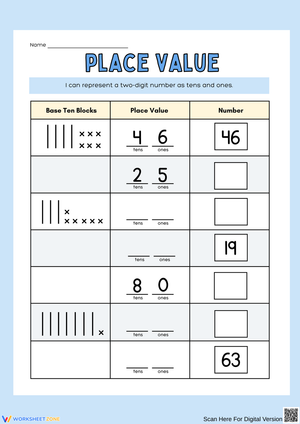
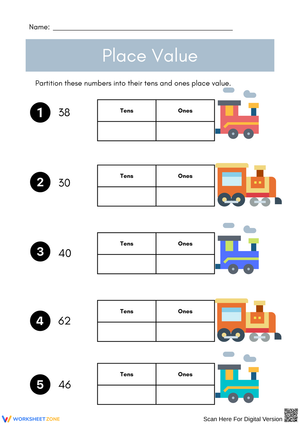
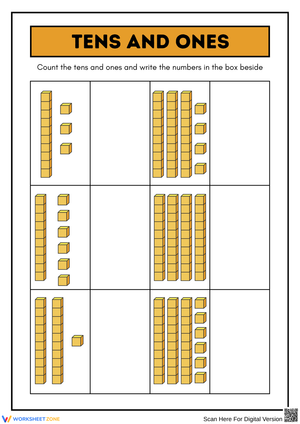
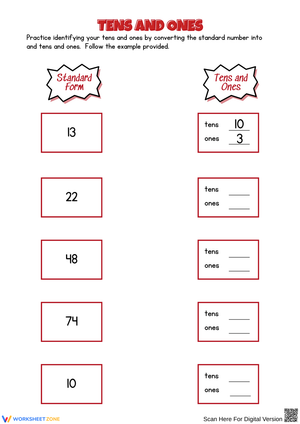
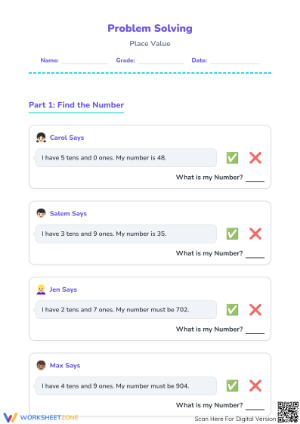
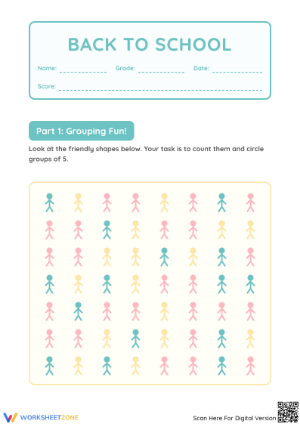
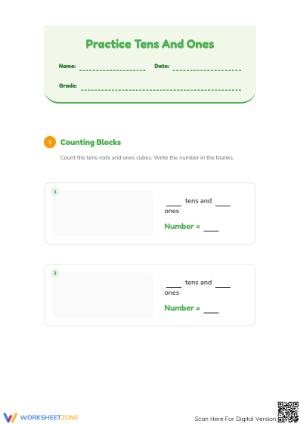
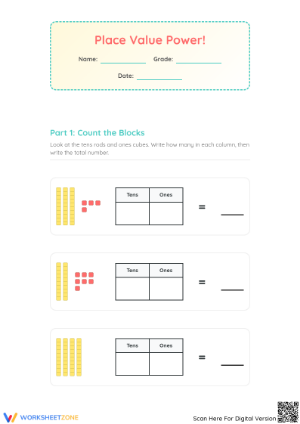
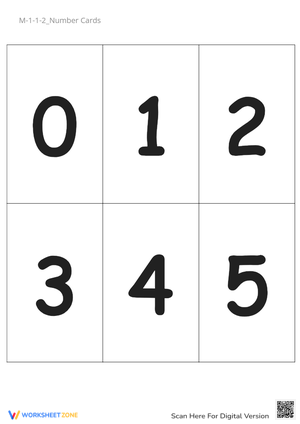
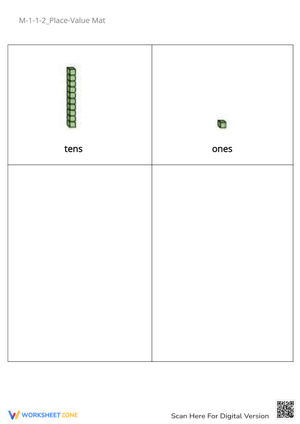
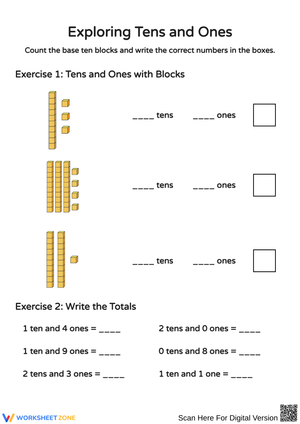
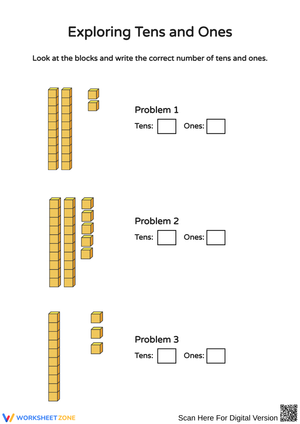
These 1st grade tens and ones worksheets resources give teachers printable practice that moves students from counting individual objects to reading two-digit numbers as composed groups. Each worksheet presents the same core concept through a different task — identifying base-ten models, writing numerals, drawing tens and ones, breaking apart numbers — so students encounter place value repeatedly without the work feeling like rote copying. That format variety also surfaces diagnostic information a single problem type never could: a child who reads models accurately but reverses digits when writing is showing something very different from one who draws the model wrong entirely.
The Specific Skills Targeted
The tasks in this set address the full arc of early place value understanding, not just number identification. Students move through four distinct kinds of work across the worksheets:
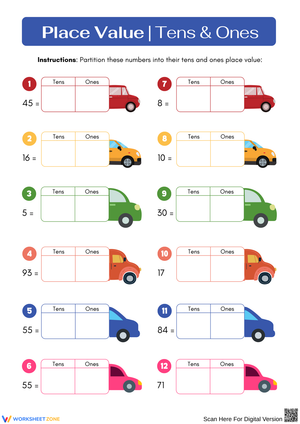
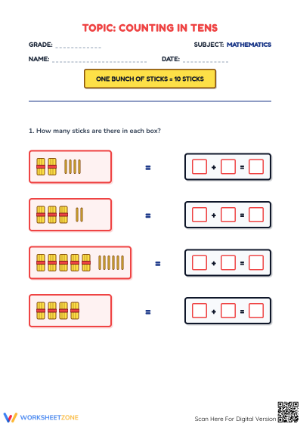
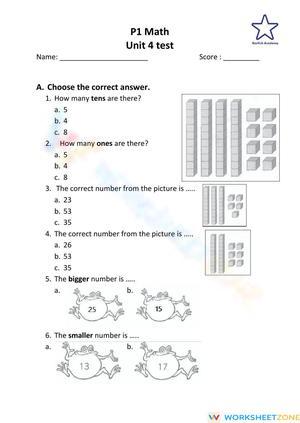
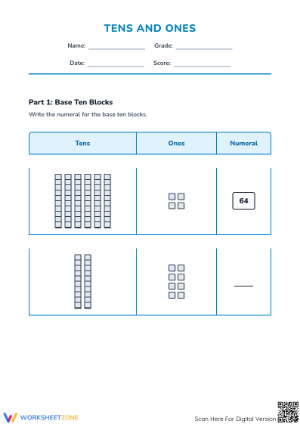
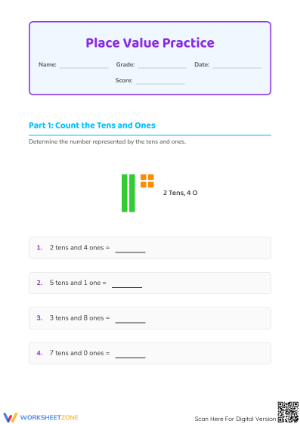
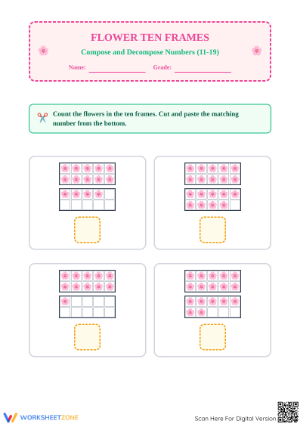
- Reading a model: Students count pre-drawn tens rods and ones cubes, then record how many tens and how many ones they see and write the matching numeral.
- Composing a number: Given a tens count and a ones count — say, 4 tens and 3 ones — students write the two-digit number without a visual prompt.
- Drawing the model: Students start with a numeral such as 57 and draw 5 rods and 7 cubes. This is where understanding becomes visible; many children can read a model but cannot produce one from a number alone.
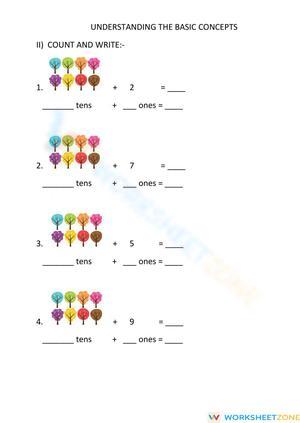
- Decomposing in writing: Students complete sentence frames like "__ tens and __ ones" from a given number, building the language alongside the concept.
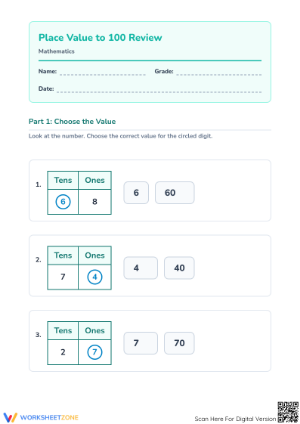
One task type that often gets skipped in published materials — and that this set includes — is asking students to identify which digit in a two-digit number represents tens and which represents ones. Circling or labeling individual digits pushes the work toward abstraction in a way that counting rods alone does not.
Mistakes Students Make That These Worksheets Help You Catch
The most consistent error at this stage is digit reversal. A student who counts 6 tens and 2 ones correctly will write 26 instead of 62 — not because they misread the model, but because they recorded ones first and tens second, mirroring the counting sequence rather than place value position. This happens often enough that it is worth a short whole-group discussion before students work independently: which digit goes where, and why does position matter.
A second pattern shows up when students draw models from numerals. Given the number 73, some children draw 7 dots and 3 more dots — ten isolated items — rather than 7 rods and 3 cubes. They understand that there are two parts, but the idea that one part represents a group of ten has not solidified. These students need more time with physical bundles or connecting-cube towers before additional paper practice carries meaning.
There is also a counting-by-ones fallback. Even when tens are clearly drawn as bundled rods, some first graders count every segment of a rod individually. They arrive at a correct answer when the rod happens to have ten marks, but they are not using the grouped structure at all. Asking students to write their answer without re-counting — just record what you see — helps reveal whether the grouping concept is internalized or whether counting by ones is still the default strategy.
How to Build These Worksheets Into Your Lesson Plans
The most effective entry point for 1st grade tens and ones worksheets practice is as a concrete-to-representational bridge. After students spend ten to fifteen minutes building two-digit numbers with linking cubes or base-ten blocks, hand out one worksheet and ask them to record what they just built. That sequence — hands first, paper second — keeps the worksheet from becoming an abstract guessing exercise and gives the pictured rods and cubes real meaning.
For morning warm-up, four to six identifying-and-writing problems are the right amount. More than that and first graders lose focus before the day's lesson begins; fewer and there is not enough repetition to build fluency. The drawing tasks are better placed in math workshop or center time, where students have five to eight uninterrupted minutes and access to manipulatives if they want to check their work.
Exit tickets work especially well with this set. Cut one worksheet into three or four strips, each with a single problem, and hand one strip to each student in the last three minutes of math block. You get a fast read on who understood the day's lesson without grading a full worksheet per student. Monday warm-ups after morning meeting are another natural fit — one strip from the previous week's worksheet, used as spaced retrieval before introducing anything new.
Standard Alignment
These worksheets address CCSS.MATH.CONTENT.1.NBT.B.2, which requires first graders to understand that the two digits of a two-digit number represent amounts of tens and ones. A 1st grade tens and ones worksheets set focused on this standard gives teachers a concrete tool for assessing where each student sits within this progression before moving to comparison or addition work. Standard 1.NBT.B.2 is the conceptual foundation for nearly every other Number and Operations in Base Ten skill in first grade — comparing two-digit numbers (1.NBT.B.3), adding within 100 (1.NBT.C.4), and mentally finding 10 more or 10 less (1.NBT.C.5) all depend on students holding a clear internal model of how a two-digit number is structured. Teachers pacing against a district scope and sequence typically introduce this standard in the second or third unit, once number sense within 20 is secure.
Adjusting the Set for a Range of Learners
For students who are not yet secure with the idea of grouping, start with the identifying worksheets only — the ones that provide a pre-drawn model — and pair each worksheet with physical manipulatives. Ask these students to build the same quantity the picture shows before they write anything. That physical step reinforces the grouping concept without adding the demand of drawing or composing from scratch.
On-level students work through the full set in order: identify, compose, draw, decompose. That progression moves from supported (the model is given) to independent (the student produces the model), which matches appropriate pacing for most of the class at this standard.
For students who move through the set quickly, add a writing layer. After completing a decomposing problem, ask them to write a new two-digit number that has the same number of ones but one more group of ten — so if they decomposed 43, they write 53 and explain the difference. This extends thinking into patterns without requiring entirely new materials.
Frequently Asked Questions
Do students need base-ten blocks to use these worksheets?
No, but access to manipulatives during the first several lessons makes the worksheet practice more meaningful. Once students connect the pictured rods and cubes to physical objects they have handled, the drawings carry enough meaning to support independent work. Students introduced to the worksheets without any hands-on foundation first tend to treat the problems as a counting task rather than a grouping task — and that distinction matters for everything that follows in place value.
How many worksheets should I use before moving to the next skill?
Most first graders benefit from repeated exposure across two to three weeks rather than intensive practice packed into a single session. Using one or two worksheets per week as part of a warm-up or center rotation — and checking student work between uses — gives teachers the information they need to decide when to move forward. The target is whether students can explain a two-digit number in tens-and-ones language without a model in front of them.
Can these worksheets support kindergartners or second graders?
Kindergartners who are ready for early place value work can use the identifying worksheets with direct teacher support, though the drawing and composing tasks are likely premature for most. Second graders who are still shaky on tens-and-ones structure — often visible when they make regrouping errors in addition — can use the 1st grade tens and ones worksheets resources as targeted review; the visual clarity of the tasks makes them accessible without the format feeling age-inappropriate.
What should I look at when grading these worksheets?
Look beyond whether the final numeral is correct. A student who writes 47 correctly but drew 4 individual dots and 7 other dots has a different understanding gap than one who drew the right model but transposed the digits. The drawing tasks on each worksheet give the most diagnostic information; note those separately and use what you see to plan your next small-group lesson rather than marking problems simply right or wrong.













 Interactive Worksheet Maker
 Quiz Maker
 Word Search Maker
 Crossword Puzzle Maker
 Word Scramble Generator
 Sentence Scramble Generator
 Handwriting Worksheet Generator
 Name Tracing Generator
 Fill In The Blank Generator