




























Views
Downloads


Essential Tens and Ones Worksheet | Grade 1-2 Math

Paste this activity's link or code into your existing LMS (Google Classroom, Canvas, Teams, Schoology, Moodle, etc.).
Students can open and work on the activity right away, with no student login required.
You'll still be able to track student progress and results from your teacher account.
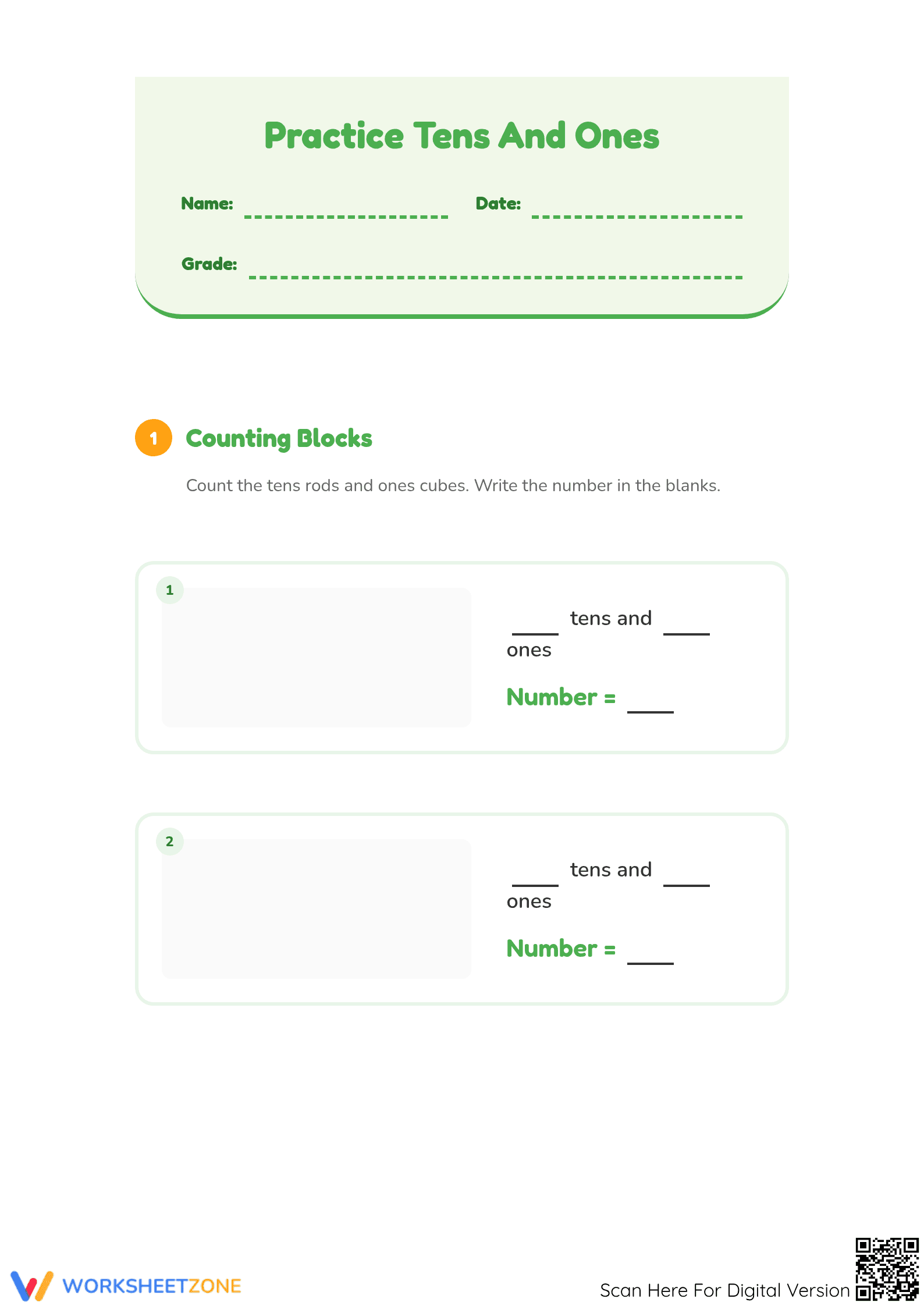
Mastering place value is the cornerstone of early mathematics. This printable worksheet focuses on the fundamental concepts of tens and ones, helping students visualize numbers as groups rather than isolated digits. By engaging with these structured exercises, learners develop a concrete understanding of how numbers are built and decomposed.
At a Glance
- Grade: 1 · 2 · Subject: Math
- Standard:
1.NBT.B.2— Understand two-digit numbers represent specific amounts of tens and ones- Skill Focus: Place Value (Tens and Ones)
- Format: 3 pages · 8 problems · Answer key included · PDF
- Best For: Daily math centers or independent practice
- Time: 15–25 minutes
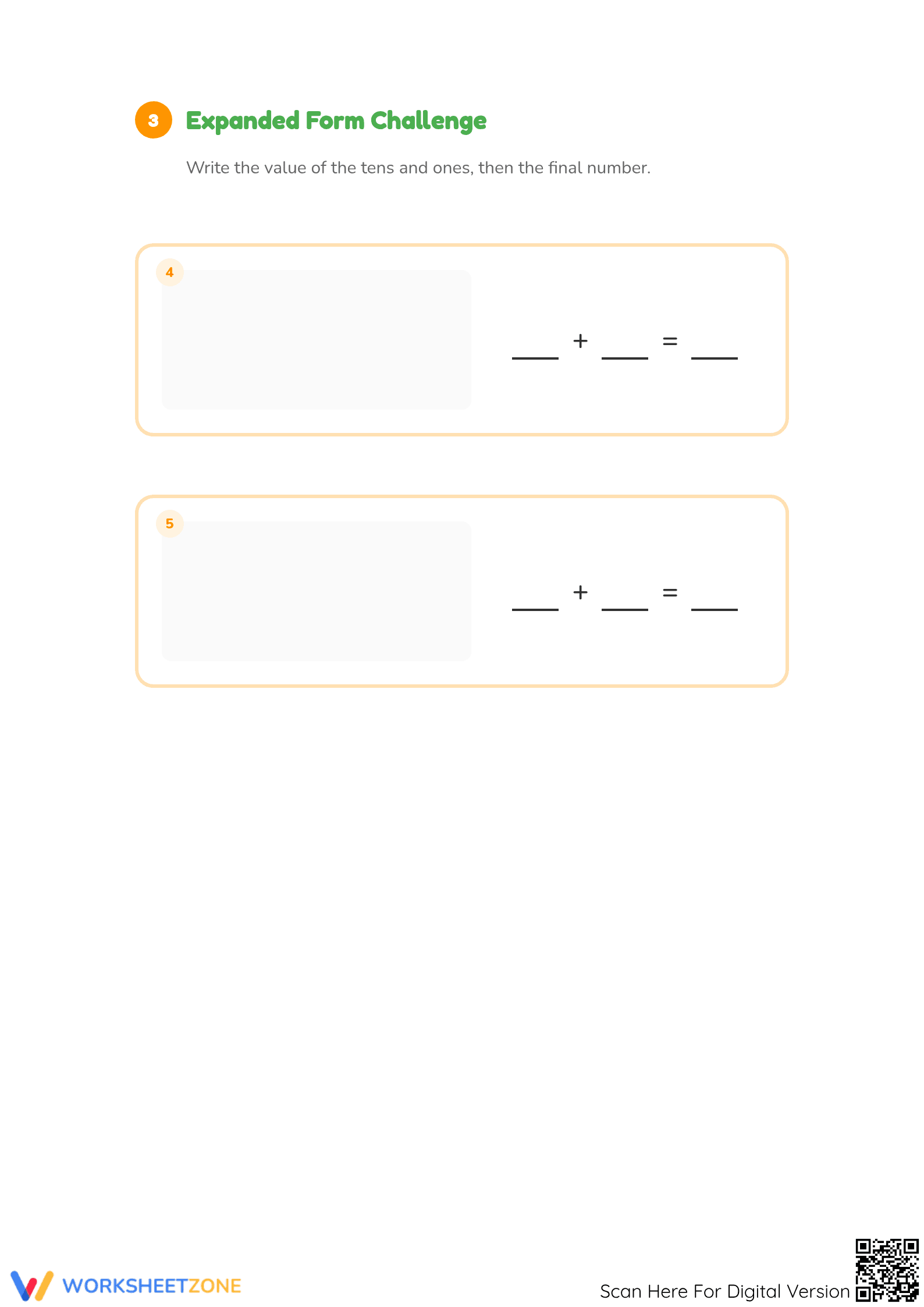
This three-page resource features eight tasks to reinforce place value. It includes counting rods and cubes, an organizational place value table, and an expanded form challenge. A full answer key is provided for efficient grading or self-correction, making it ideal for both classroom and home use.
Skill Progression
- Guided practice: Students count tens rods and ones cubes to identify specific quantities and write the resulting number, establishing a direct link between visual models and numeric values.
- Supported practice: Learners utilize a Place Value Table to organize visual data into numeric columns, practicing the categorization of digits by their positional value.
- Independent practice: The Expanded Form Challenge requires translating visual blocks into addition sentences (e.g., 20 + 4 = 24), solidifying the mathematical representation of base-ten concepts.
This sequence employs a gradual-release model, moving from concrete identification to abstract mathematical notation.
Standards Alignment
This resource is aligned to 1.NBT.B.2, requiring students to understand that two-digit numbers represent amounts of tens and ones. Both standard codes can be copied directly into lesson plans, IEP goals, or district curriculum mapping tools to ensure instructional compliance.
How to Use It
Use this during independent practice or as a formative assessment. Observe if students correctly identify a 'ten rod' as a single unit of ten. Completion time ranges from 15 to 25 minutes, making it suitable for a focused seat-work session or a quick review activity.
Who It's For
Designed for Grade 1 and 2 students building base-ten sense. It is effective for learners requiring visual scaffolds to bridge the gap between counting and arithmetic. Pair with physical manipulatives or a place value anchor chart to provide additional support.
According to the RAND AIRS 2024 report, early exposure to concrete representations of base-ten concepts is fundamental for developing abstract numerical fluency. This worksheet targets 1.NBT.B.2 by requiring students to translate visual stimuli—tens rods and ones cubes—into numeric values through a structured sequence. By moving from simple counting to tabular organization and finally to expanded notation, the resource supports the cognitive shift from perceptual counting to conceptual subitizing. Effective place value instruction must bridge the gap between physical grouping and the positional notation system used in multi-digit arithmetic. Systematic practice with these 'tens and ones' associations provides the scaffolding necessary for students to master addition with regrouping in later units. This essential printable resource ensures that learners internalize number decomposition, a core competency identified by NAEP as a significant predictor of long-term mathematical success in elementary education.


