




























Views
Downloads


Printable Counting in Tens Worksheet | Grade 1-3 Math

Paste this activity's link or code into your existing LMS (Google Classroom, Canvas, Teams, Schoology, Moodle, etc.).
Students can open and work on the activity right away, with no student login required.
You'll still be able to track student progress and results from your teacher account.
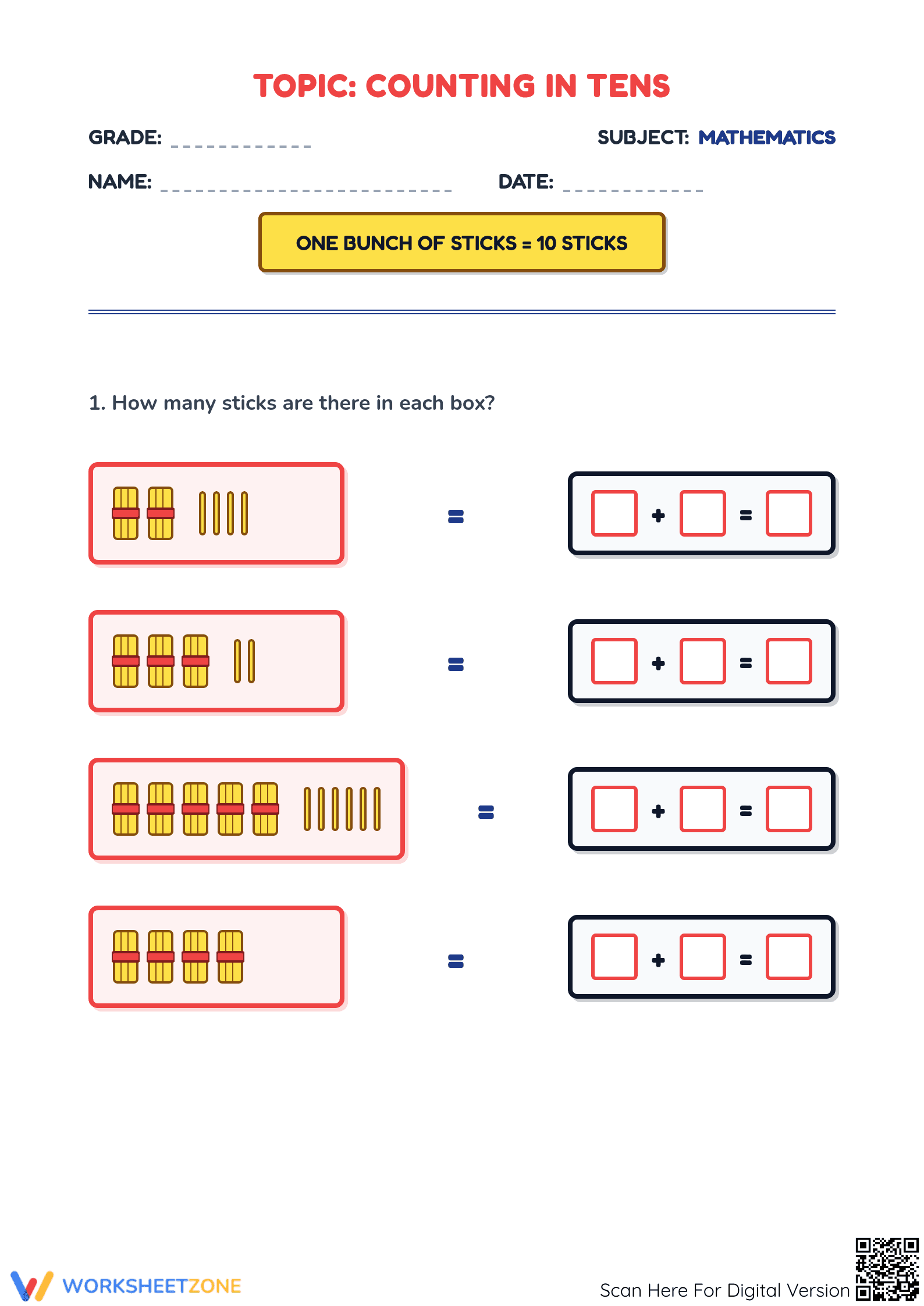
This Grade 1-3 math worksheet provides targeted practice for mastering base-ten concepts through visual models and equation building. Students identify bunches of ten sticks and individual ones, translating these physical representations into numerical values. By completing these activities, learners will demonstrate a solid understanding of two-digit place value and foundational addition structures.
At a Glance
- Grade: 1-3 · Subject: Math
- Standard:
CCSS.MATH.CONTENT.1.NBT.B.2— Understand that the two digits of a two-digit number represent tens and ones- Skill Focus: Place value and counting tens/ones
- Format: 5 pages · 20 problems · Answer key included · PDF
- Best For: Independent practice and formative assessment
- Time: 20–30 minutes
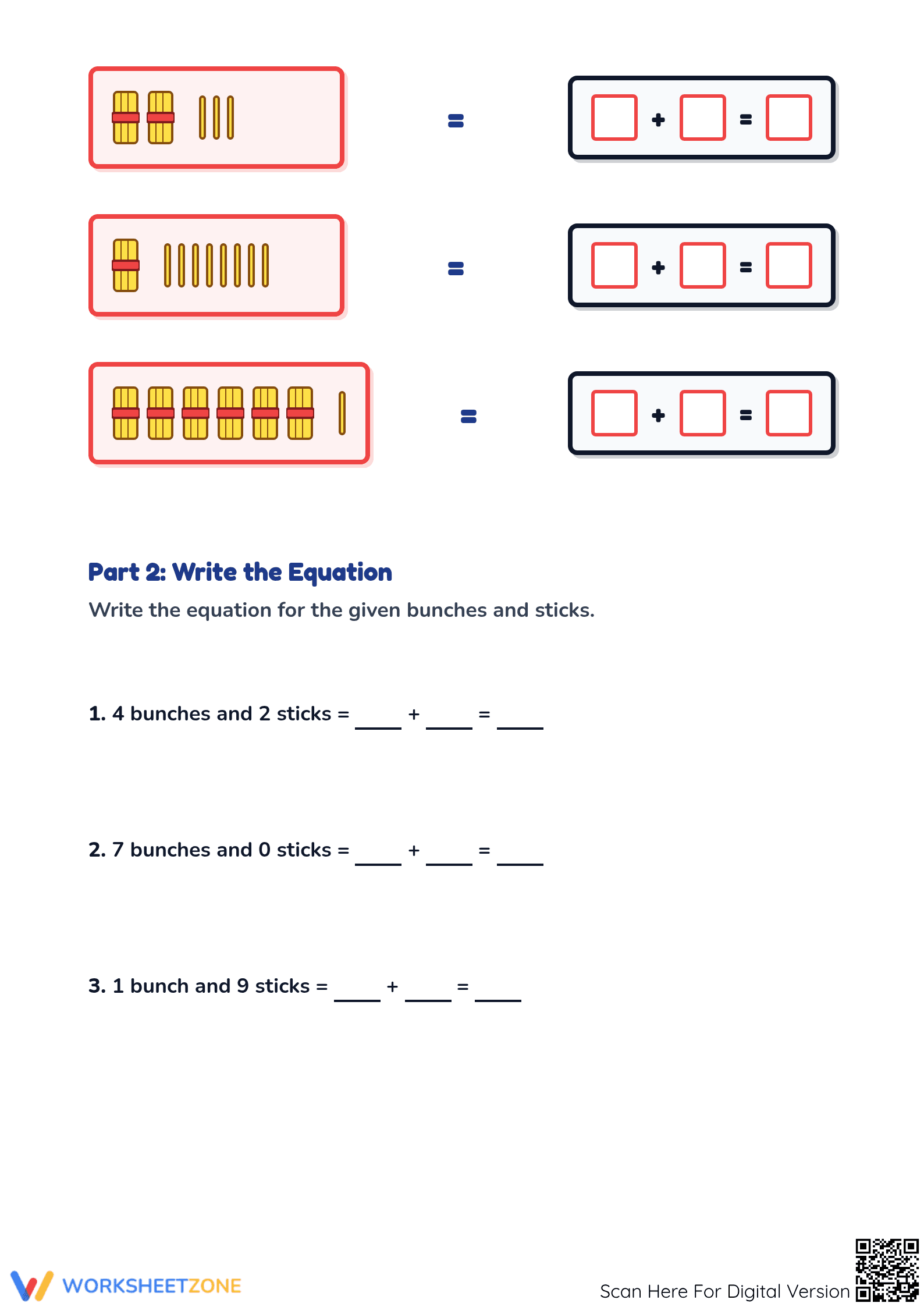
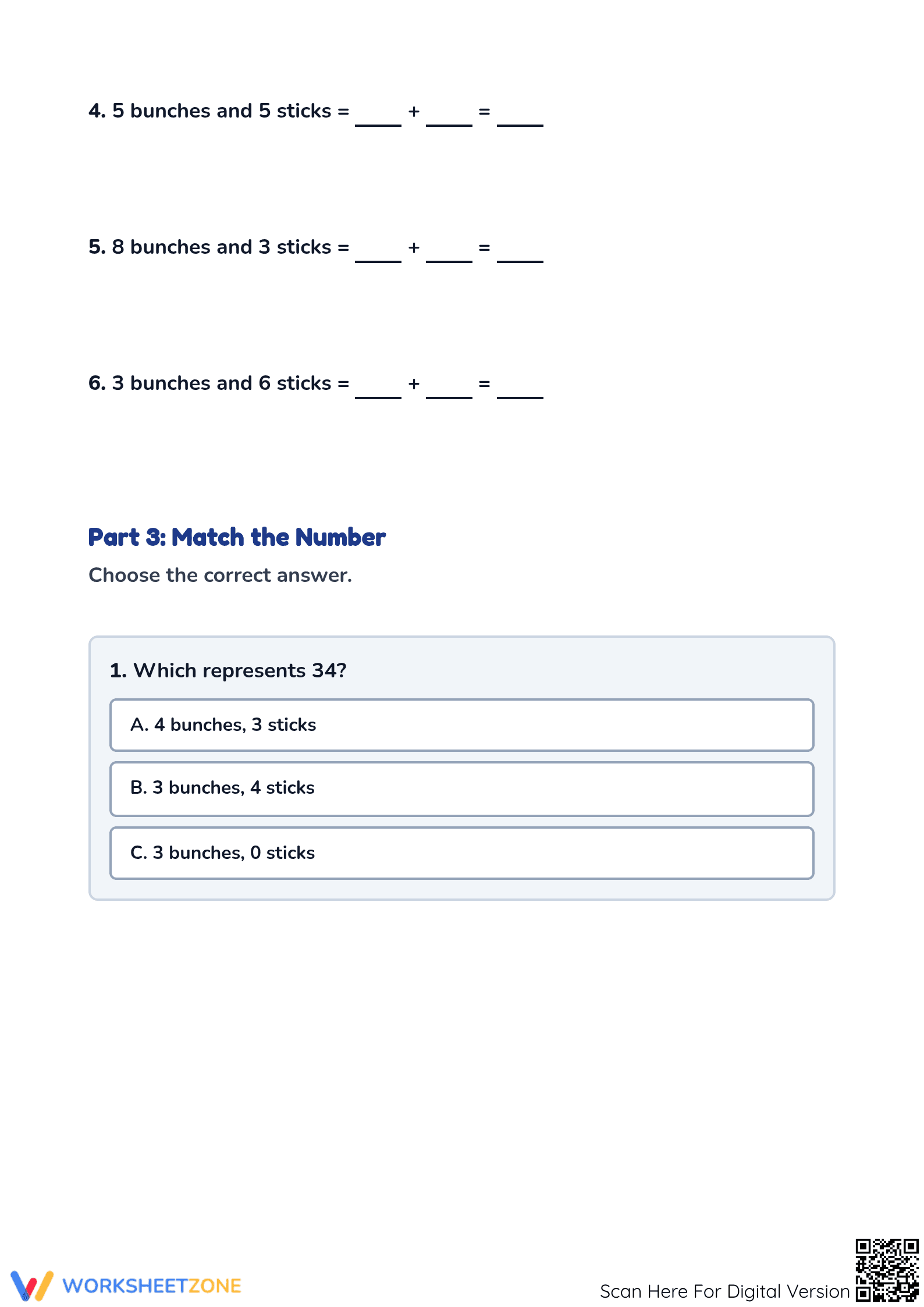
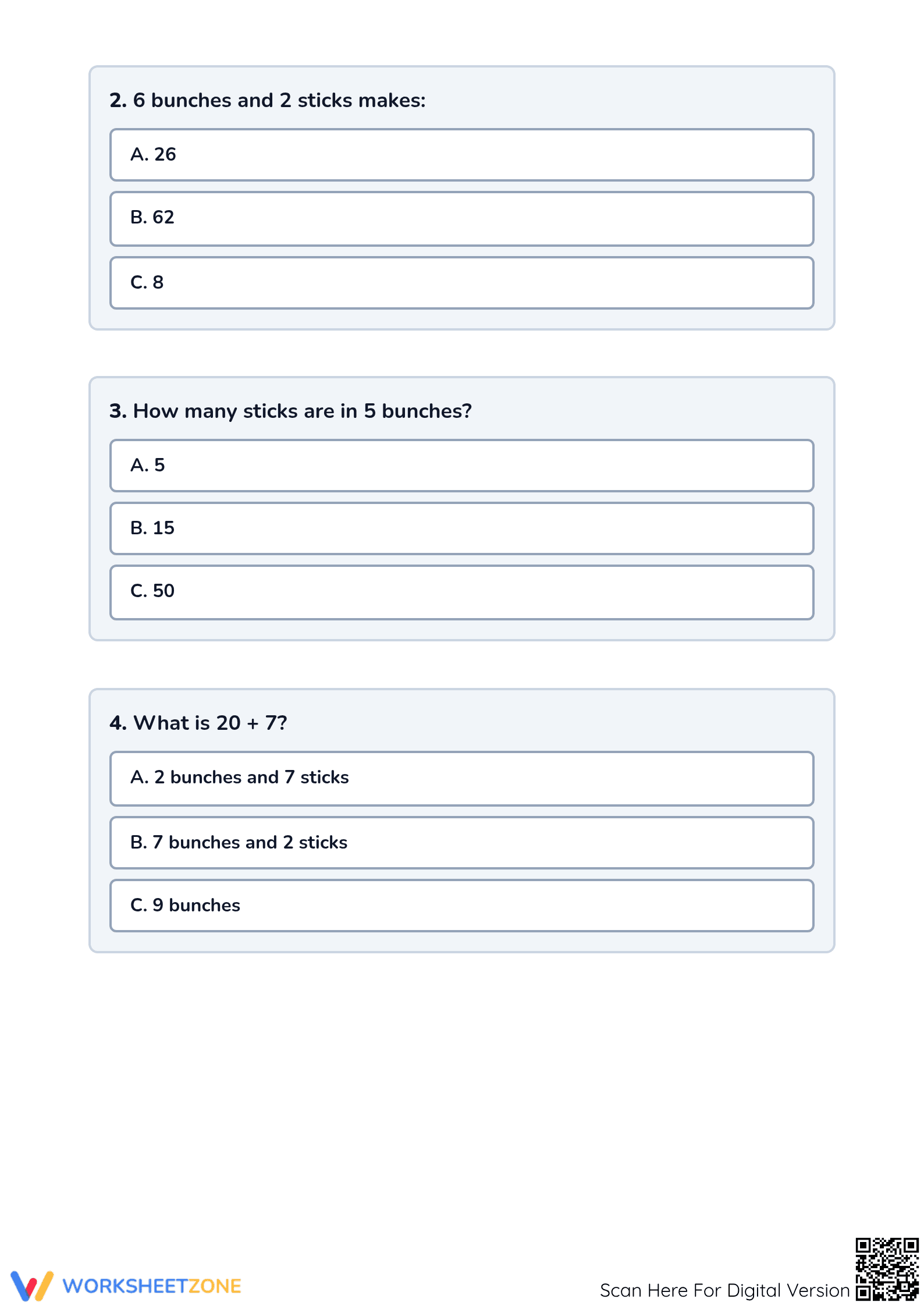
Inside this 5-page PDF, teachers will find activities designed to bridge the gap between concrete counting and abstract notation. The first sections utilize bunch-of-sticks models to represent tens. This is followed by equation-building exercises where students write 'X bunches and Y sticks = Z'. The final pages transition into multiple-choice assessment questions to verify conceptual mastery and numerical comparison. A full answer key is included for rapid grading.
Skill Progression
- Guided practice: Visual counting tasks establish the tens-and-ones pattern through simple fill-in-the-box exercises.
- Supported practice: Equation writing converts verbal descriptions of bunches and sticks into standard addition sentences.
- Independent practice: Multiple-choice mastery checks require students to evaluate representations, compare values, and solve place-value riddles.
This sequence follows a gradual-release model, moving from visual scaffolds to linguistic translation and finally to abstract mental math applications.
Standards Alignment
The core alignment for this resource is `CCSS.MATH.CONTENT.1.NBT.B.2`, which requires students to understand that the two digits of a two-digit number represent amounts of tens and ones. Additionally, it supports `CCSS.MATH.CONTENT.2.NBT.A.1` by reinforcing the foundational 'ten-ones make one-ten' concept. Both standard codes can be copied directly into lesson plans, IEP goals, or district curriculum mapping tools.
How to Use It
Use this worksheet as a mid-unit check during place value instruction. It works well for math rotations or independent desk work. For a formative-assessment observation, watch if students count individual sticks or immediately recognize the bunch as a ten; this shift marks a critical milestone in mathematical fluency. Completion typically takes 20 to 30 minutes.
Who It's For
This resource is ideal for first and second graders establishing base-ten foundations, or third graders needing intervention for place value gaps. It pairs perfectly with physical base-ten blocks or popsicle stick manipulatives, allowing students to build bunches physically before recording findings on the printable pages.
Place value understanding is the single most important predictor of later mathematical success in elementary school. According to the RAND AIRS 2024 report on foundational numeracy, students who master the decomposition of two-digit numbers into tens and ones show significantly higher proficiency in multi-digit addition and subtraction. This worksheet addresses the `CCSS.MATH.CONTENT.1.NBT.B.2` standard by requiring students to interact with 'bunches' as composite units, a key step in developing unitizing skills. By moving from concrete visual models to abstract equations and multiple-choice evaluations, the resource mirrors the Concrete-Representational-Abstract (CRA) instructional sequence recommended by researchers like Fisher & Frey (2014). This structured approach ensures that the plain-English skill of identifying tens and ones becomes a permanent part of the student's mathematical toolkit. The inclusion of assessment-style questions further prepares learners for standardized formats while reinforcing core conceptual clusters in base-ten operations.


