


























Views
Downloads
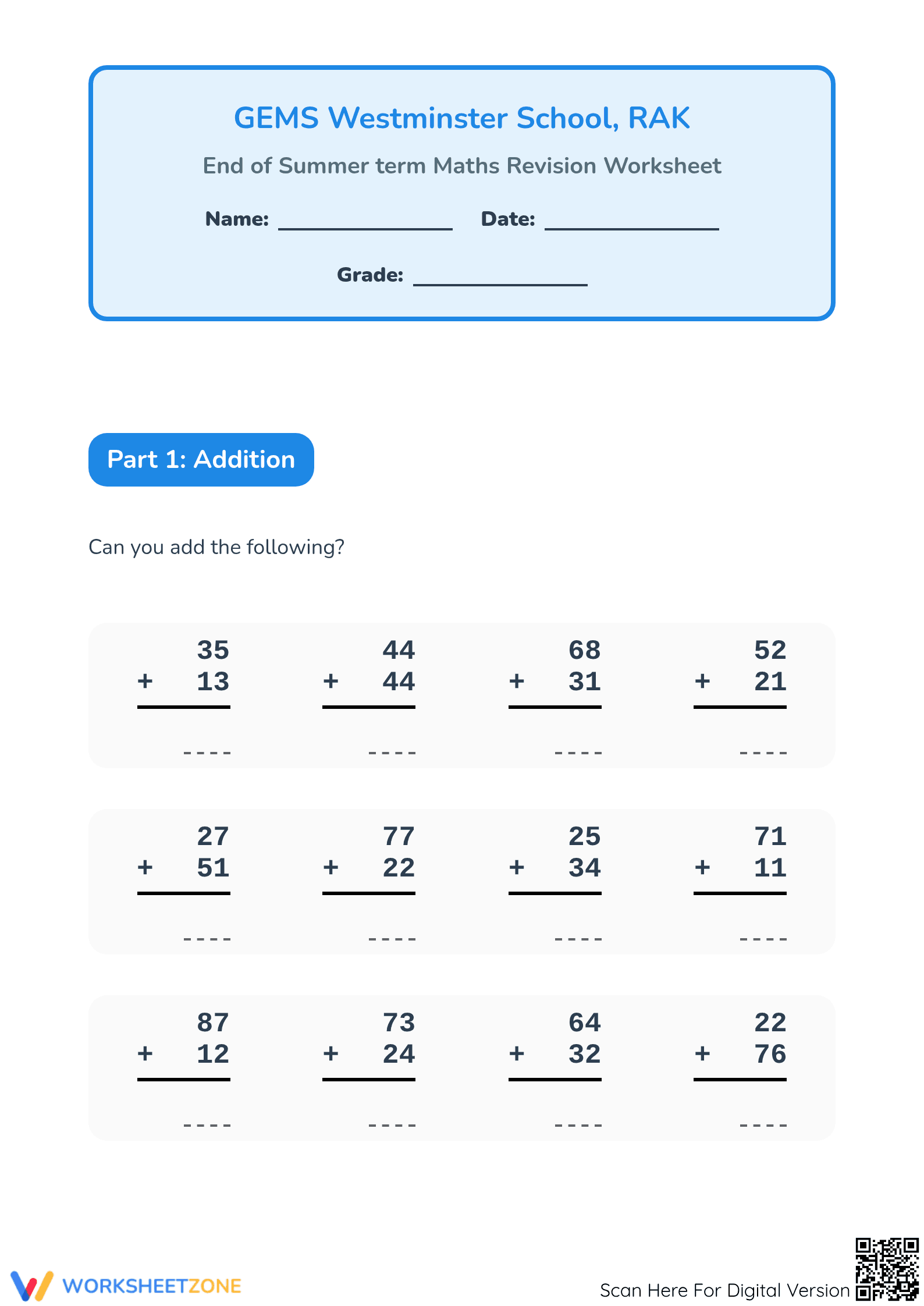


Grade 1-2 Math Revision: Essential Printable Worksheet
Paste this activity's link or code into your existing LMS (Google Classroom, Canvas, Teams, Schoology, Moodle, etc.).
Students can open and work on the activity right away, with no student login required.
You'll still be able to track student progress and results from your teacher account.
Comprehensive Math Foundations
This Grade 1 and Grade 2 math revision worksheet provides a structured approach to mastering fundamental numeracy. Students practice multi-digit addition, place value decomposition, and skip counting patterns to build a solid mathematical foundation. By integrating diverse task types into one printable packet, this resource ensures learners transition smoothly between core concepts.
At a Glance
- Grade: 1-2 · Subject: Math
- Standard:
CCSS.MATH.CONTENT.2.NBT.B.5— Fluently add within 100 using strategies based on place value- Skill Focus: Addition, Place Value, Patterns
- Format: 4 pages · 38 problems · Answer key included · PDF
- Best For: End-of-term review and summer bridge
- Time: 30–45 minutes
What's Inside
This four-page PDF includes 38 distinct tasks organized into logical blocks. Part one features 16 vertical addition problems ranging from simple sums to double-digit equations. Part two focuses on place value, requiring students to decompose numbers into tens and ones and write number names. Part three introduces patterns with a skip-counting grid, while part four provides a gentle introduction to multiplication using visual prompts. A complete answer key is provided.
Zero-Prep Workflow
- Print: Generate copies of the 4-page packet in 30 seconds using black-and-white printer settings.
- Distribute: Hand out the stapled packets or individual sheets to students with zero additional manipulative setup required.
- Review: Use the provided answer key to grade the entire class set in 10 minutes, identifying common misconceptions in addition or place value.
Standards Alignment
This resource is meticulously aligned to CCSS.MATH.CONTENT.2.NBT.B.5: "Fluently add and subtract within 100 using strategies based on place value, properties of operations, and/or the relationship between addition and subtraction." This worksheet specifically targets the place value component of the standard by forcing students to visualize numbers as tens and ones before performing operations. Both standard codes can be copied directly into lesson plans, IEP goals, or district curriculum mapping tools.
How to Use It
Deploy this worksheet as a summative assessment at the end of a unit on base-ten operations to gauge student mastery. Alternatively, use it during morning work rotations as a quiet, independent activity that reinforces previous instruction. Teachers should observe students during the place value section to see if they are physically counting or using mental decomposition strategies, providing a quick formative assessment of their internal number sense.
Who It's For
This resource is designed for first-grade students ready for extension or second-grade students needing a comprehensive refresher on foundational arithmetic. It serves as an excellent pairing with base-ten blocks or a hundreds chart for students requiring extra visual support during the multi-digit addition section.
Research from NAEP indicates that early mastery of place value decomposition is a significant predictor of long-term success in complex algebraic thinking and multi-step word problems. This Grade 1-2 math revision worksheet directly addresses this developmental need by integrating CCSS.MATH.CONTENT.2.NBT.B.5 through structured addition and number naming tasks. By practicing these skills in a varied format—ranging from vertical equations to pattern-based grids—students develop the cognitive flexibility required to apply mathematical principles in diverse contexts. According to Fisher & Frey (2014), the gradual release of responsibility is most effective when students are provided with clear, self-contained review materials that allow them to demonstrate independent proficiency. This printable resource offers exactly that, providing a robust tool for educators to verify student readiness for more advanced operations while ensuring that no gaps remain in their understanding of the base-ten system.


