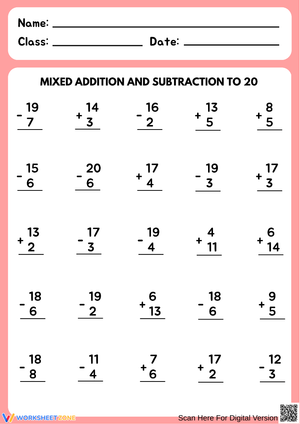
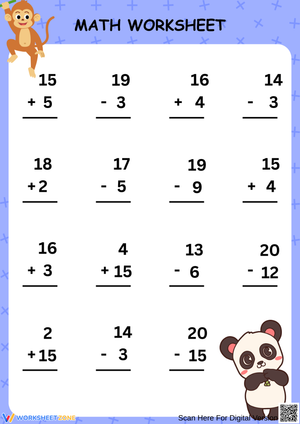
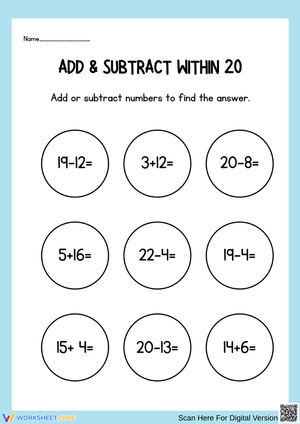
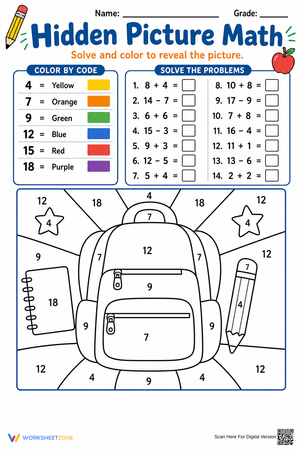
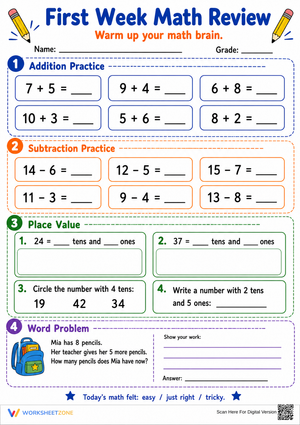
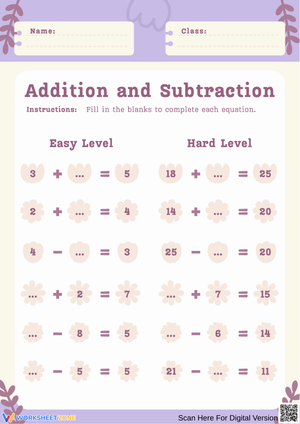
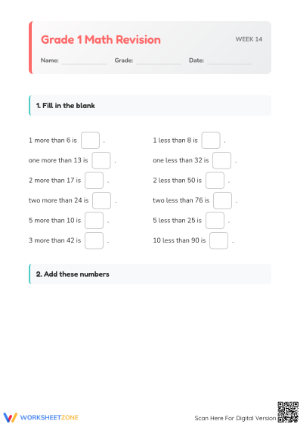
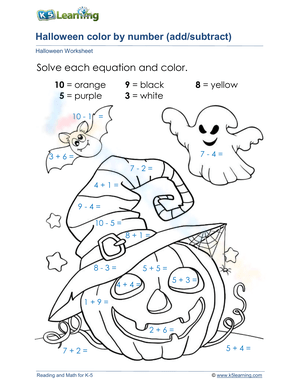
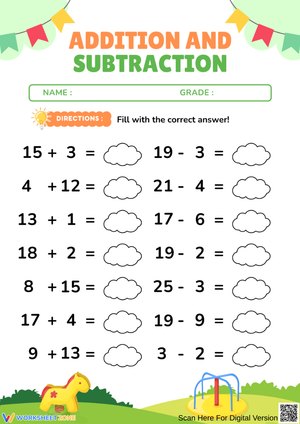
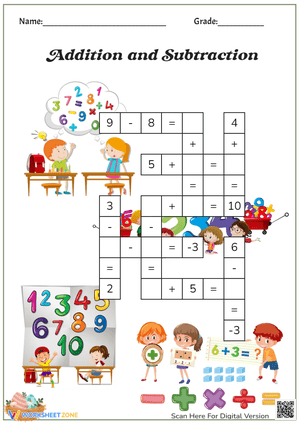
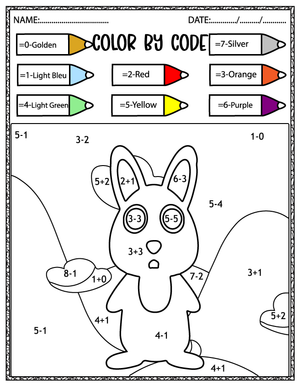
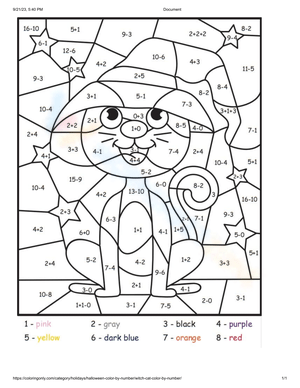
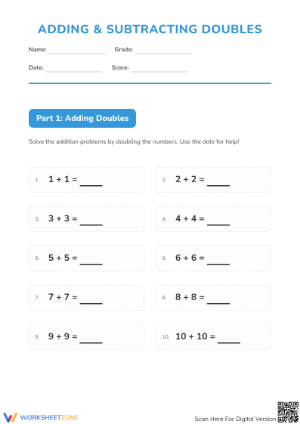
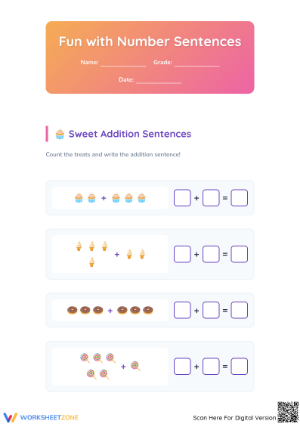
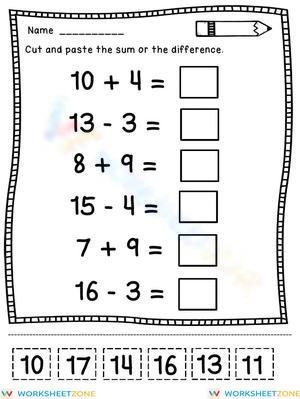
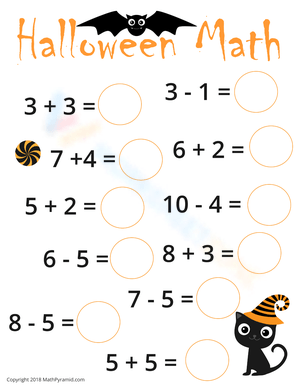
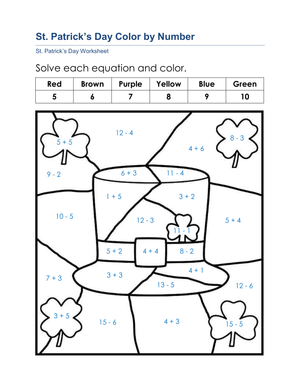
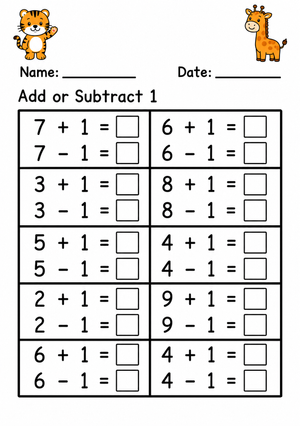
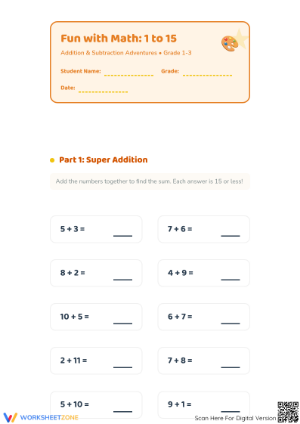
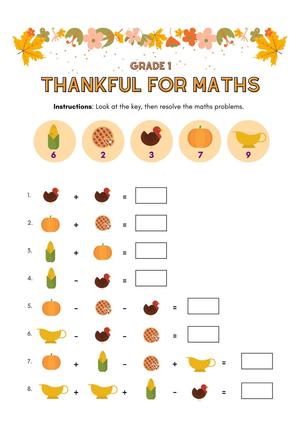
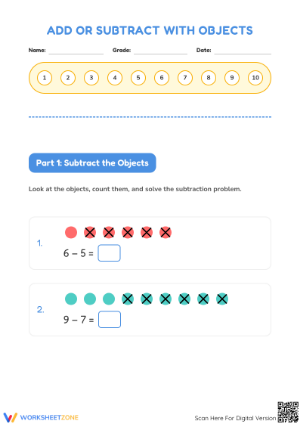
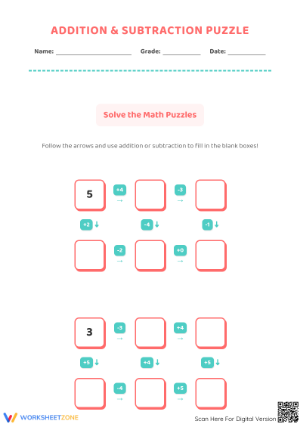
These 1st grade addition and subtraction within 20 printable worksheets give teachers a ready progression of practice — from counting-on problems with small gaps to word problems that require students to identify the operation and explain their reasoning. The set covers making ten, fact families, missing addends, and true-false equations, with each worksheet targeting a specific stage in the move toward arithmetic fluency.
Skills These Worksheets Build
The core work falls into several related areas, each corresponding to a distinct stage in early arithmetic development. Students practice counting on from the larger addend — an essential shift away from always starting from one. They decompose one addend to build a ten with the other: to solve 8 + 6, a student splits the 6 into 2 and 4, adds 2 to 8 to make ten, then adds 4 to reach 14. That chain of steps develops the number sense that underlies multi-digit arithmetic later on.
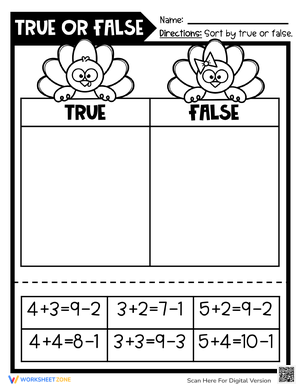
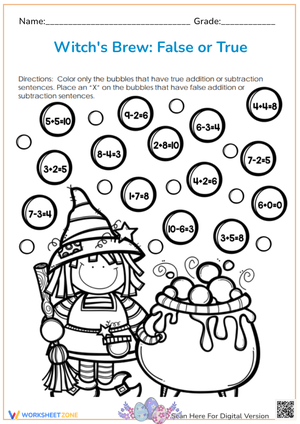
Fact family exercises ask students to write all four equations from a single number trio — 6, 9, and 15 generate 6 + 9 = 15, 9 + 6 = 15, 15 − 9 = 6, and 15 − 6 = 9. Students who work through these quickly reveal whether they truly understand the inverse relationship between operations or are rotating symbols without comprehension. Missing addend problems take that connection further: the equation 8 + ___ = 13 asks students to think subtractively while reading an addition sentence. True-false tasks, such as determining whether 7 + 5 = 14 − 2, require computing on both sides and comparing — a type of reasoning most first graders haven't encountered before their first attempt.
Arithmetic Errors That Show Up Predictably at This Stage
The most consistent mistake in missing addend problems is treating both visible numbers as addends. A student looking at 9 + ___ = 15 writes 24, having added 9 and 15 together. The blank reads as "add these two numbers" because that is what most equations in their experience have asked for. This is a conceptual gap in how students understand the equals sign — they read it as "here comes the answer" rather than as a symbol of balance. A quick individual check: ask the student to point to the total in that equation. If they can't identify 15 as the total, the gap is clear and specific.
The make-a-ten strategy generates its own reliable error. When students work on 7 + 5, some decompose the larger number rather than the smaller one — splitting the 7 into 5 and 2 instead of splitting the 5 into 3 and 2. The calculation reaches the same answer either way, but with more cognitive friction, and that friction compounds with larger numbers. Watching which number students choose to decompose — visible in their written work when they show the split — tells you whether the strategy is becoming automatic or still effortful.
Subtraction by counting all is the third pattern worth catching. A student solving 16 − 7 sometimes counts from 1 to 16 and then removes seven. The answer may be right, which is exactly why this persists: it works, slowly. The inefficiency doesn't surface until the numbers grow or the problems require two steps. With enough subtraction practice across the set, pace of completion at the station becomes your clue — students still using this approach take noticeably longer than peers using count-back or inverse addition facts.
Where These Worksheets Fit Best in the Weekly Math Block
In the math rotation, 1st grade addition and subtraction within 20 printable worksheets work best as one of three stations — paired with a ten-frame manipulative station and a teacher-led small group rather than assigned as a whole-class independent block. Students who are still on the counting-on stage benefit from handling actual counters before they see the printed equation; coming to the worksheet station second means they've already built a mental image of the problem before committing it to paper. Ten to twelve minutes is enough time to complete one worksheet and spend a few minutes self-checking against a posted answer strip, a low-stakes habit worth establishing early in the year.
Monday mornings are a natural time to reintroduce fact family worksheets, which tend to fade over the weekend. A short fact family warm-up before new instruction reactivates the inverse relationship concept without using much of the class period. At the end of the week, avoid assigning a full worksheet as a Friday exit ticket during the last ten minutes before dismissal — pull a single problem type instead. One missing addend problem or one word problem gives you the formative information you need without the distraction of a full worksheet competing with pack-up noise.
Standard Alignment
These worksheets address CCSS.MATH.CONTENT.1.OA.C.6, which requires first graders to add and subtract within 20 and demonstrate fluency for sums and differences within 10. That distinction in the standard matters: within-20 work requires accurate strategy use, while within-10 work requires genuine automaticity. In classroom terms, 1.OA.C.6 is the checkpoint teachers use to decide whether a student is ready to move into two-digit addition — a student still counting all on every problem within 20 is not ready for regrouping, regardless of other readiness indicators. Fact family worksheets directly address the inverse relationship component of the standard; missing addend worksheets address the algebraic thinking strand's emphasis on understanding the equals sign as a balance rather than a prompt for a single answer.
Pacing the Set Across a Mixed-Readiness Classroom
The 1st grade addition and subtraction within 20 printable worksheets include several problem formats that lend themselves to readiness-based assignment without making that sorting obvious to students. Students still consolidating sums within 10 do well starting with worksheets that have a number line printed along the top margin — they use it as a reference tool, and the goal is to watch whether they rely on it less over time. Hold off on missing addend worksheets for this group until their basic addition and subtraction is consistent; adding the algebraic framing before the underlying arithmetic is stable creates confusion rather than productive challenge.
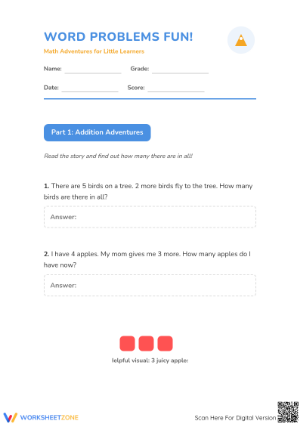
Students who are already fluent within 10 are ready for the full within-20 range and for word problem worksheets that require choosing the operation. A quick extension requiring no extra materials: after completing the four fact family equations, ask them to circle which equation in the set would be hardest to reconstruct if they forgot it — and explain why. That question separates students who have memorized the format from those who understand how the three numbers actually relate to each other.
Frequently Asked Questions
How do these worksheets work alongside hands-on manipulatives?
These worksheets function as the written recording layer after students have explored a concept with ten-frames, linking cubes, or counters — not as replacements for that hands-on work. In practice, that means using manipulatives during the first week of a new strategy and shifting to worksheets in week two, once students have a mental image to draw on. Asking students to sketch a quick ten-frame drawing in the margin before writing the equation keeps the visual connection active even at the worksheet station.
Can these be used for formative assessment rather than graded work?
Yes, and the most useful formative information comes from error patterns rather than answer tallies. A student who misses three missing addend problems the same way — writing the sum of the two visible numbers — tells you something specific about their understanding of the equals sign. A student who misses three unrelated problems across different types tells you something different about stamina or attention. The 1st grade addition and subtraction within 20 printable worksheets include enough problem variety within each worksheet that a single sitting can reveal a specific gap without requiring a formal assessment.
What should I do when a student finishes well ahead of others at the station?
Build a short extension task into the station directions rather than sending the student back to an earlier worksheet. The most effective option for this content area: ask the student to write a word problem that matches the last equation they solved, then trade it with a partner at the end of the rotation for checking. This keeps the mathematical content the same while adding language production and peer accountability — and it requires no additional materials to set up.













 Interactive Worksheet Maker
 Quiz Maker
 Word Search Maker
 Crossword Puzzle Maker
 Word Scramble Generator
 Sentence Scramble Generator
 Handwriting Worksheet Generator
 Name Tracing Generator
 Fill In The Blank Generator