




























Views
Downloads

Thanksgiving Math True or False Worksheet | Grade 1 Ready

Paste this activity's link or code into your existing LMS (Google Classroom, Canvas, Teams, Schoology, Moodle, etc.).
Students can open and work on the activity right away, with no student login required.
You'll still be able to track student progress and results from your teacher account.
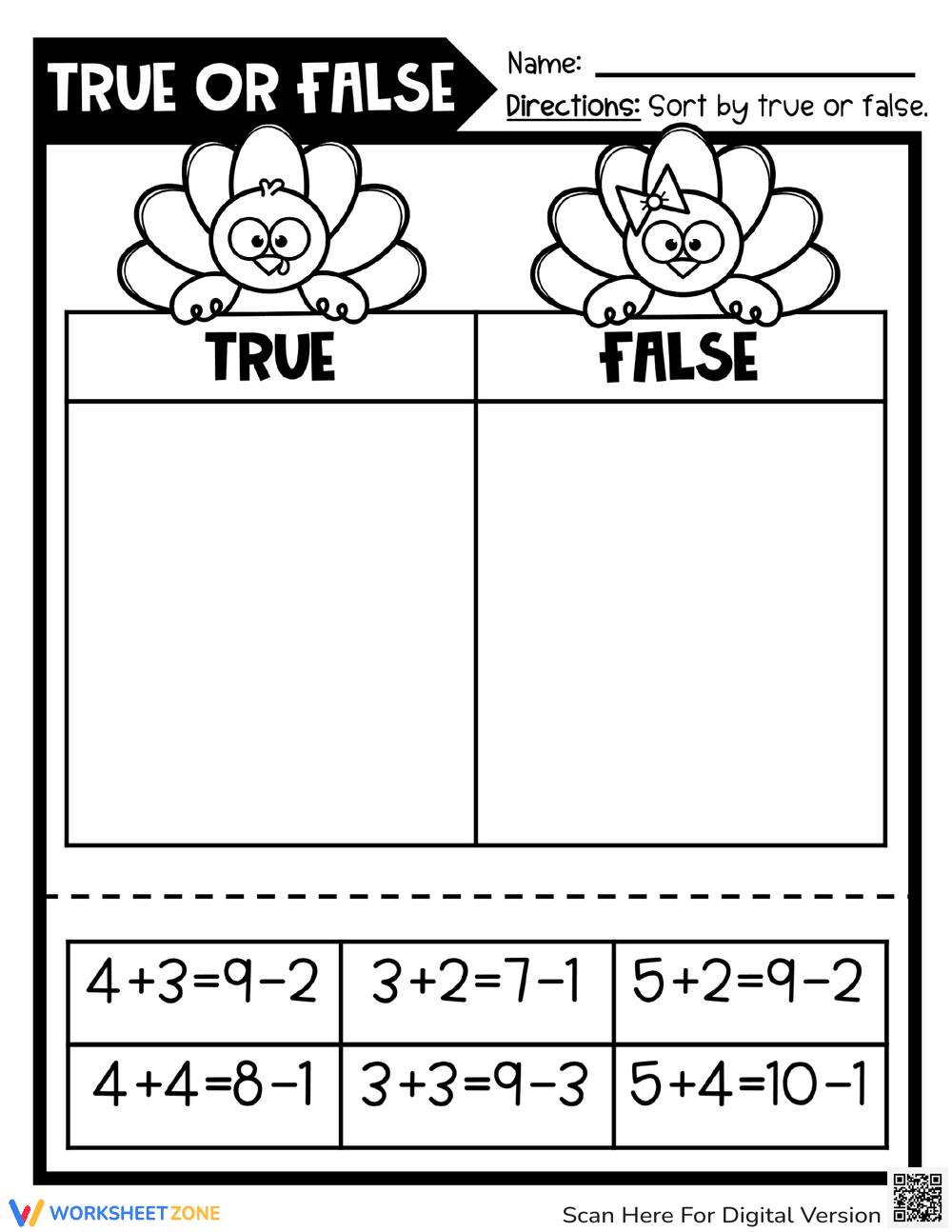
This Grade 1 Thanksgiving math worksheet helps students master the meaning of the equal sign through a hands-on sorting activity. By evaluating addition and subtraction expressions on both sides of an equation, learners develop a deep conceptual understanding of mathematical balance. Students will determine the truth value of six different equations to build foundational algebraic thinking.
At a Glance
- Grade: 1 · Subject: Math
- Standard:
CCSS.MATH.CONTENT.1.OA.D.7— Understand the equal sign and determine if addition/subtraction equations are true or false- Skill Focus: Equation Balance & Sorting
- Format: 1 page · 6 problems · Answer key included · PDF
- Best For: Holiday-themed math centers or morning work
- Time: 15–20 minutes
This single-page PDF features a festive Thanksgiving theme with two sorting columns labeled "True" and "False." At the bottom of the page, students will find six distinct equations involving mixed addition and subtraction, such as 4+3=9-2. The worksheet is designed as a cut-and-paste activity, providing a tactile experience that reinforces learning. A full answer key is provided for quick grading.
The zero-prep design allows for immediate classroom implementation. First, print the required number of copies for your group (1 minute). Next, distribute the sheets along with scissors and glue; students can begin working independently as the directions are self-explanatory (1 minute). Finally, review the sorted equations as a whole group or using the included answer key to provide instant feedback (5 minutes).
This resource is directly aligned with CCSS.MATH.CONTENT.1.OA.D.7, which requires students to "understand the meaning of the equal sign, and determine if equations involving addition and subtraction are true or false." It also supports Grade 2 fluency standards by requiring mental computation of sums and differences within 20. Both standard codes can be copied directly into lesson plans, IEP goals, or district curriculum mapping tools.
Use this worksheet during your "You Do" phase of a gradual release lesson on mathematical equality. It serves as an excellent formative assessment tool; observe students as they calculate both sides of the equation to see if they recognize that the equal sign denotes balance rather than just an answer. Expect most students to complete the sorting task within 15 to 20 minutes.
This activity is ideal for first and second-grade students who benefit from kinesthetic learning and fine motor practice. It is particularly effective for students who struggle with the "answer-only" misconception of the equal sign. Pair this worksheet with a balance scale demonstration or a set of linking cubes to provide a concrete representation of the abstract equations.
Research by Fisher & Frey (2014) emphasizes the importance of the gradual release of responsibility, where structured tasks like this sorting activity allow students to apply conceptual knowledge independently. This worksheet specifically targets the common misconception that the equal sign is an operator meaning "find the total," rather than a relational symbol indicating equivalence. By requiring students to evaluate expressions on both sides of the symbol, such as 5+4=10-1, the task aligns with NAEP frameworks for early algebraic reasoning. According to recent EdReports 2024 evaluations of high-quality instructional materials, hands-on sorting tasks significantly improve retention of mathematical properties in early elementary learners. This resource provides the necessary scaffolding to move students from basic computation to the higher-order thinking required by CCSS.MATH.CONTENT.1.OA.D.7, ensuring they are prepared for more complex algebraic concepts in later grades.


