




























Views
Downloads


Adding & Subtracting Doubles | Essential Grade 1 Math

Paste this activity's link or code into your existing LMS (Google Classroom, Canvas, Teams, Schoology, Moodle, etc.).
Students can open and work on the activity right away, with no student login required.
You'll still be able to track student progress and results from your teacher account.
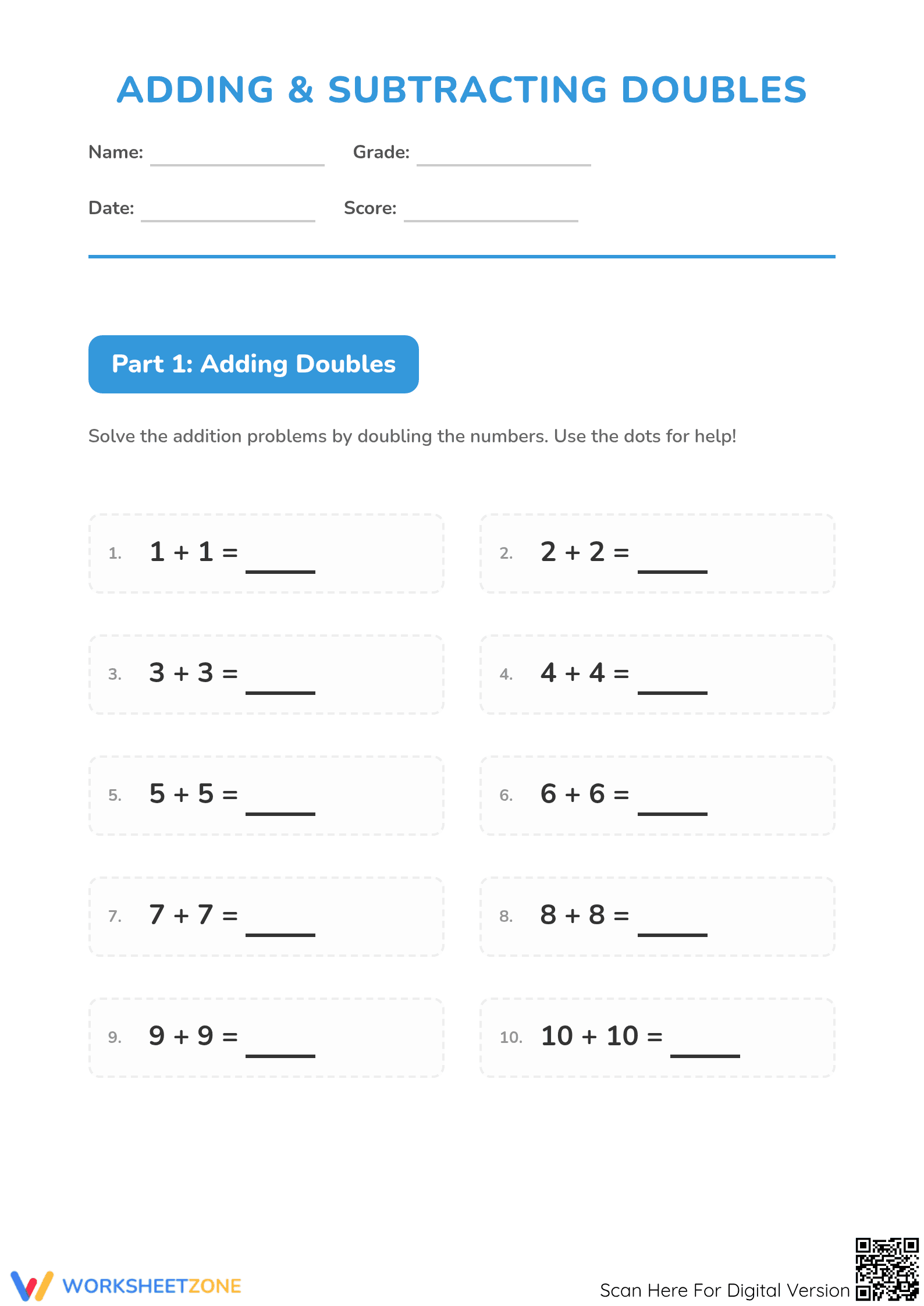
Build foundational math fluency with this focused worksheet on adding and subtracting doubles facts. By mastering the relationship between equal addends, students develop the mental math strategies necessary for rapid calculation and algebraic readiness. This resource provides a clear, structured path for learners to transition from counting dots to automaticity with numbers up to twenty.
At a Glance
- Grade: 1 · Subject: Math
- Standard:
CCSS.MATH.CONTENT.1.OA.C.6— Fluently add and subtract within 20 using strategies such as doubles facts- Skill Focus: Doubles Strategy Fluency
- Format: 3 pages · 22 problems · Answer key included · PDF
- Best For: Mental math fluency and morning work
- Time: 10–15 minutes
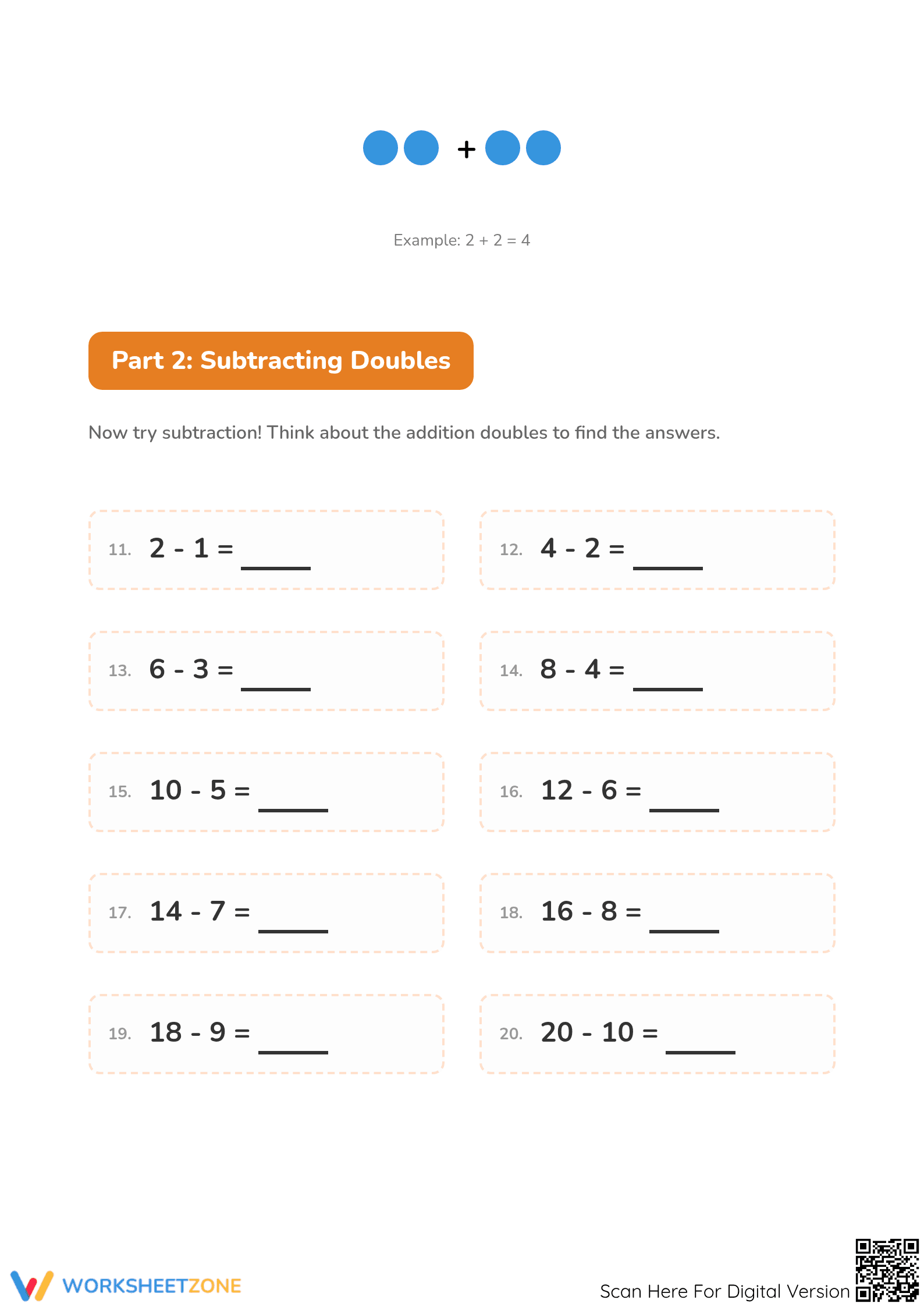
This three-page PDF offers a comprehensive look at the doubles strategy. Part one focuses on the additive property, while part two challenges students to use their knowledge of addition to solve subtraction problems. The worksheet includes clear visual dot supports for the initial problems and concludes with a bonus challenge section featuring larger numbers to encourage mathematical extensions and higher-order thinking.
Skill Progression
- Guided Practice: The first ten problems use visual dot arrays to help students visualize the doubling process (10 tasks).
- Supported Practice: Students transition to subtraction by thinking about the inverse relationship of the addition doubles they just mastered (10 tasks).
- Independent Application: Bonus challenges require students to apply the doubles concept to larger sums like 15 + 15 and 50 - 25 (2 tasks).
This sequence follows a gradual-release model, ensuring students feel confident before moving to abstract subtraction.
Standards Alignment
This resource is specifically aligned to CCSS.MATH.CONTENT.1.OA.C.6. It focuses on demonstrating fluency for addition and subtraction within 10 and 20 by using known equivalent sums. Both standard codes can be copied directly into lesson plans, IEP goals, or district curriculum mapping tools to track student mastery of foundational mental math strategies.
How to Use It
This worksheet is ideal for use during a warm-up or morning work session to reinforce daily fluency. After direct instruction on the "doubles" strategy, assign this as independent practice. For a formative assessment, observe students to see if they are still counting individual dots or if they are beginning to recognize the patterns and recall the sums instantly.
Who It's For
Designed primarily for Grade 1 and Grade 2 students, this worksheet is also an excellent tool for RTI groups or students requiring extra support with mental math strategies. It pairs perfectly with physical manipulatives like ten-frames or double-sided counters to provide a multisensory learning experience during small-group math rotations or individualized tutoring sessions.
This Grade 1 mathematics resource focuses on the foundational skill of adding and subtracting doubles, a critical component of algebraic thinking and mental math fluency. According to research from NAEP, students who master mental strategies such as doubles facts demonstrate significantly higher accuracy and speed in more complex arithmetic operations. This worksheet aligns with CCSS.MATH.CONTENT.1.OA.C.6 by providing structured practice that bridges the gap between concrete counting and abstract problem-solving. By utilizing visual aids like dot patterns and reinforcing the relationship between addition and subtraction through the doubles strategy, learners develop a robust understanding of number relationships within 20. The inclusion of bonus challenge problems further supports the development of higher-order thinking skills, ensuring that students can apply known doubles facts to unfamiliar contexts. Educators can utilize these findings to target specific instructional interventions, fostering a deeper level of mathematical proficiency and confidence in early learners during core curriculum sessions.


