




























Views
Downloads
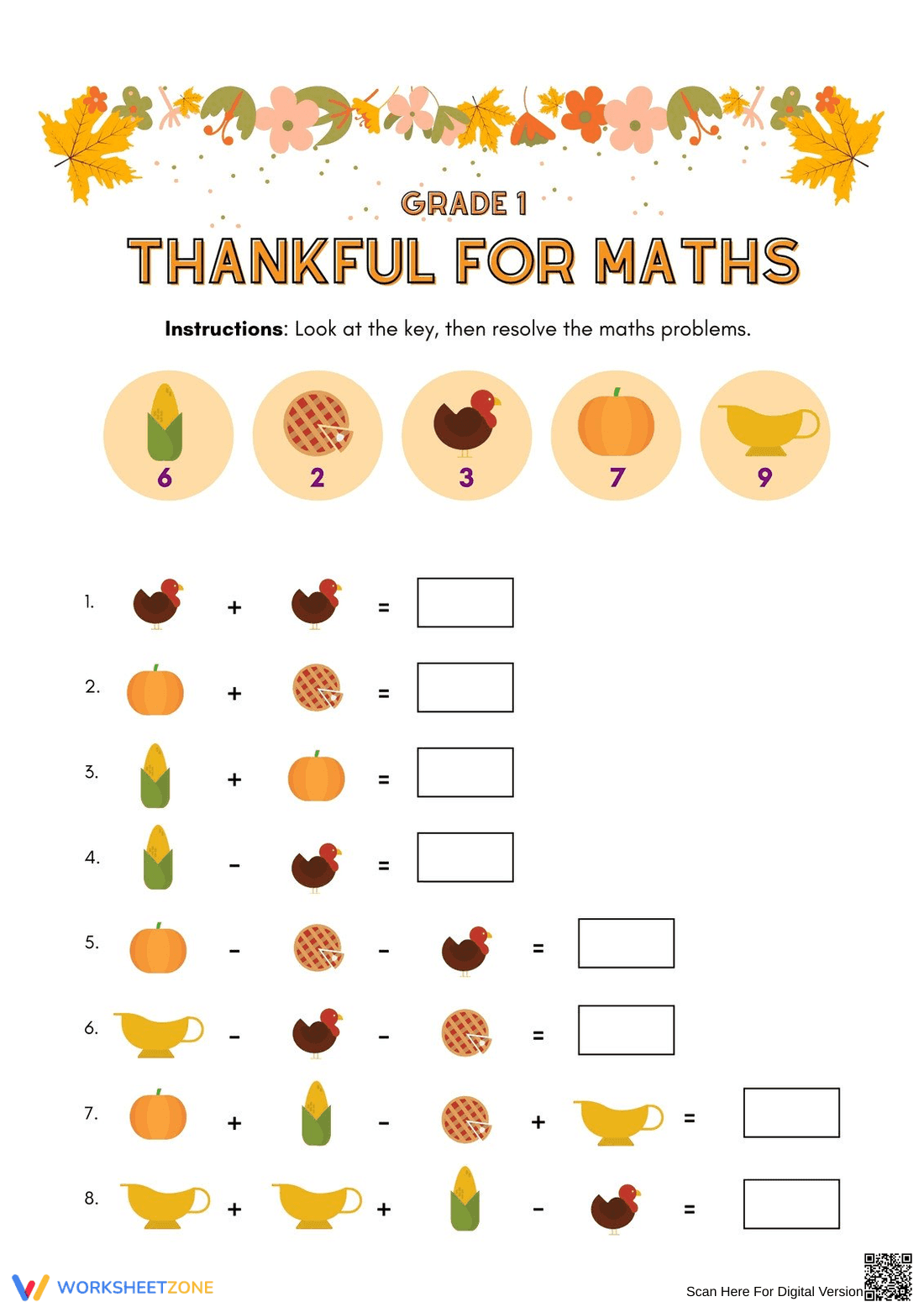

Grade 1 Thanksgiving Math Worksheet — Printable Essential

Paste this activity's link or code into your existing LMS (Google Classroom, Canvas, Teams, Schoology, Moodle, etc.).
Students can open and work on the activity right away, with no student login required.
You'll still be able to track student progress and results from your teacher account.
This Grade 1 Thanksgiving math worksheet strengthens addition and subtraction skills through an engaging symbol-substitution activity. Students decode festive icons to solve 8 unique equations, fostering algebraic thinking and computational fluency. By translating visual keys into numerical values, learners develop the foundational logic required for multi-step problem solving in early elementary mathematics.
At a Glance
- Grade: 1 · Subject: Math
- Standard:
CCSS.MATH.CONTENT.1.OA.A.1— Use addition and subtraction within 20 to solve word problems and equations- Skill Focus: Symbol substitution and operations
- Format: 1 page · 8 problems · Answer key included · PDF
- Best For: Holiday-themed morning work or math centers
- Time: 15–20 minutes
This single-page PDF features a clear visual legend at the top, assigning numerical values to five Thanksgiving-themed icons: corn, pie, turkey, pumpkin, and gravy. Below the key, students encounter 8 horizontal equations that mix addition and subtraction. The layout includes dedicated answer boxes for each problem, ensuring a clean workspace for young learners. A comprehensive answer key is provided for rapid grading.
The workflow for this resource is designed for maximum efficiency. Print the single-page PDF (30 seconds). Distribute the sheets to students as a festive warm-up or independent practice task (1 minute). Use the included answer key to review student work or facilitate self-correction (30 seconds). Total teacher preparation time is under 2 minutes, making it an ideal sub-plan or last-minute holiday activity.
The primary focus is CCSS.MATH.CONTENT.1.OA.A.1: "Use addition and subtraction within 20 to solve word problems involving situations of adding to, taking from, putting together, taking apart, and comparing, with unknowns in all positions." This worksheet specifically targets the "putting together" and "taking apart" aspects through symbolic representation. Both standard codes can be copied directly into lesson plans, IEP goals, or district curriculum mapping tools.
Use this worksheet during Thanksgiving week as a formative assessment to check student mastery of basic operations. It works best after direct instruction on addition and subtraction within 20. Observe students as they decode symbols; if a student struggles, provide a sticky note with numbers next to icons for support. Completion typically takes 15 to 20 minutes.
This resource is tailored for first-grade students but serves as an excellent review for second graders. It is particularly effective for visual learners who benefit from icon-based math. Pair this worksheet with a Thanksgiving-themed counting book or a physical manipulative set to provide a concrete bridge to the abstract symbolic math presented here.
This Grade 1 math resource aligns with the CCSS.MATH.CONTENT.1.OA.A.1 standard, focusing on the essential skill of solving addition and subtraction equations within 20. By utilizing symbol substitution, the worksheet encourages students to engage in algebraic reasoning, a precursor to formal variable manipulation. Research from Fisher & Frey (2014) emphasizes the importance of scaffolded practice where visual cues help bridge the gap between concrete objects and abstract numerical symbols. This specific task design allows students to practice computational fluency while maintaining high engagement through a seasonal theme. The inclusion of multi-step problems aligns with NAEP recommendations for increasing cognitive depth in early elementary mathematics. Educators can utilize this tool to gather evidence of student decoding abilities and operational accuracy. The structured format ensures that learners remain focused on the mathematical logic rather than complex text-based instructions, supporting diverse classroom needs.


