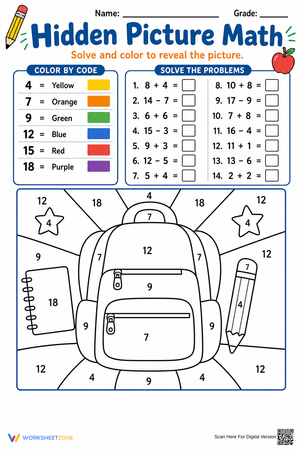
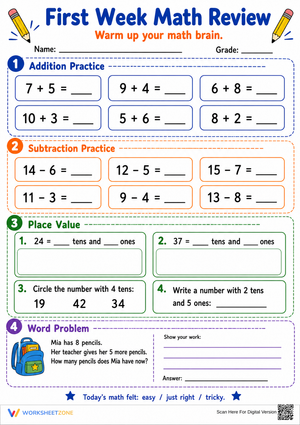
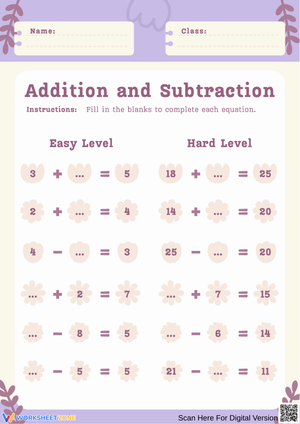
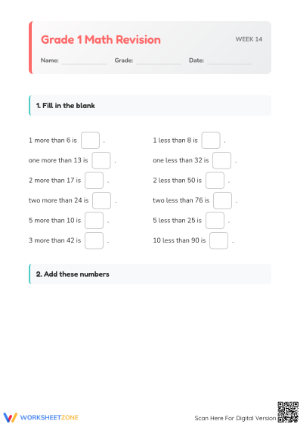
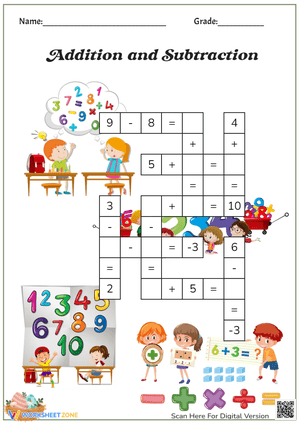
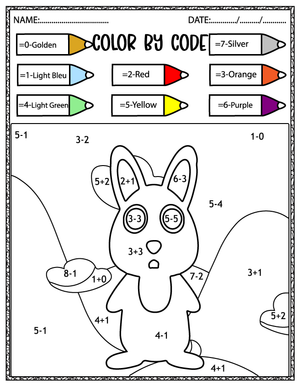
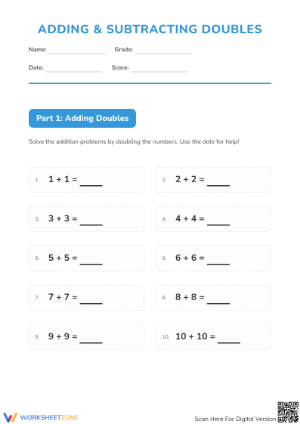
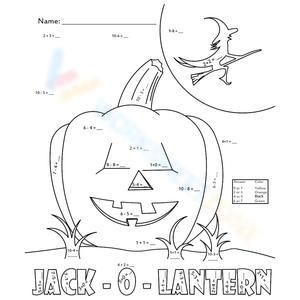
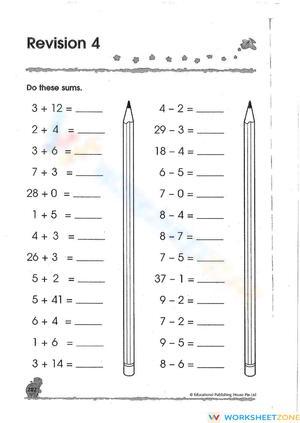
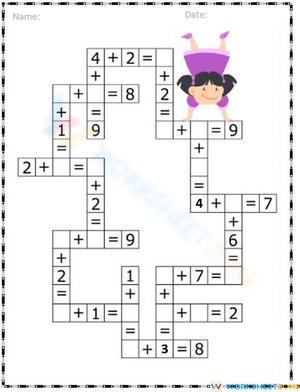
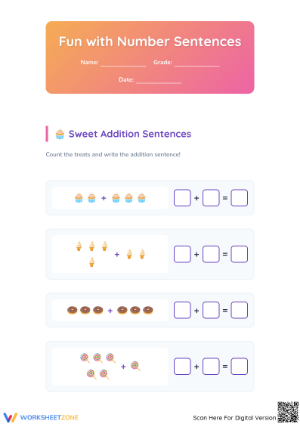
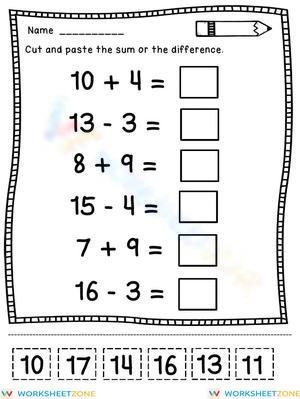
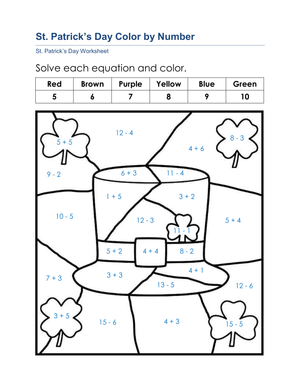
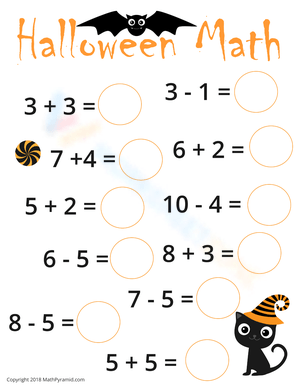
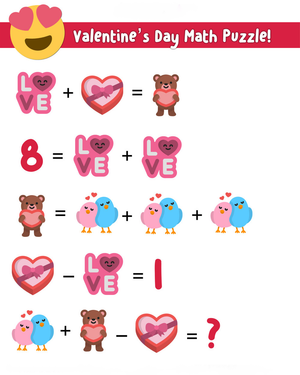
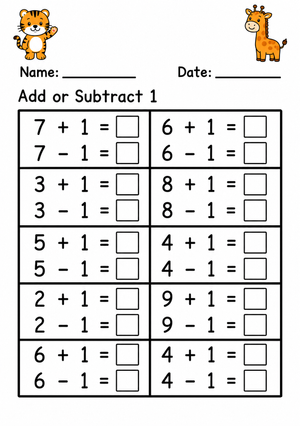
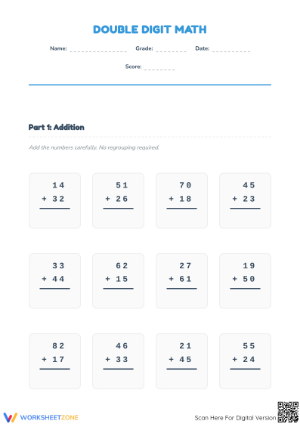
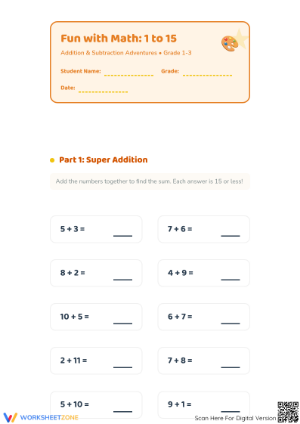
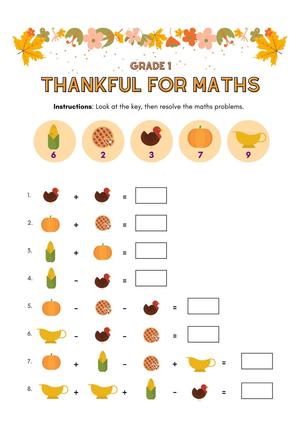
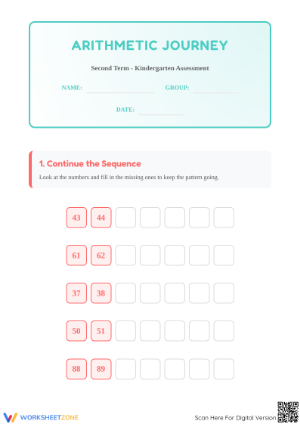
These addition subtraction printable worksheets for 1st grade give teachers a ready-to-use set of practice materials for one of the most important transitions in early elementary math — the point at which students stop treating addition and subtraction as two unrelated skills and begin recognizing them as inverse operations. Each worksheet targets a distinct skill: equations within 20, fact families, number-line problems, and word problems that require students to identify what a situation is asking before writing a single digit.
Why Mixed Operations Matter This Early
Most curricula introduce addition and subtraction in separate, multi-week units. That sequencing makes sense for initial instruction, but it creates a specific problem over time: students stop reading the operation sign. After three weeks of addition-only drill, a child sees any equation and adds. Mixed operation practice interrupts that pattern before it solidifies. It forces students to pause, check the sign, and make a deliberate choice — a small act of decision-making that becomes more consequential as equations grow more complex in later grades.
The deeper benefit is conceptual. When a student completes a fact family worksheet and writes 6 + 3 = 9, 3 + 6 = 9, 9 − 3 = 6, and 9 − 6 = 3 in one sitting, they are not memorizing four isolated facts — they are observing that three numbers hold four relationships, and that addition and subtraction undo each other. That observation, concrete and visible at this age, is the foundation of algebraic thinking. Students who internalize it in first grade arrive at second-grade multi-digit work without the confusion about inverse operations that slows down many of their peers.
The Specific Skills Targeted
The set spans four distinct formats, each addressing a different dimension of early arithmetic fluency.
- Fact family triangles — Given three numbers, students write all four related equations. The format makes the inverse relationship structurally visible; students are not told that addition and subtraction are related — they see it by completing the task.
- Number-line worksheets — Students mark a starting point and hop right for addition, left for subtraction. Connecting the operation to a spatial direction gives students a reliable strategy to fall back on when mental computation fails.
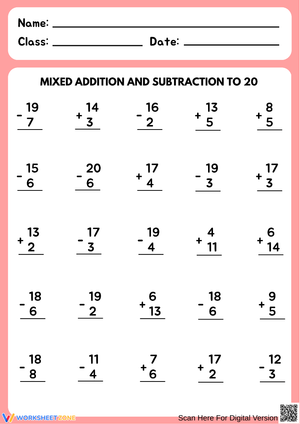
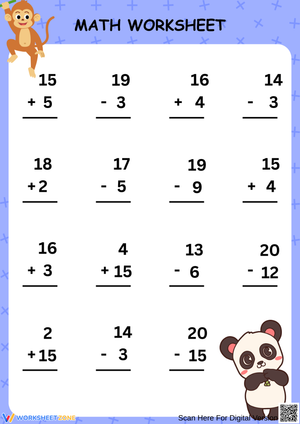
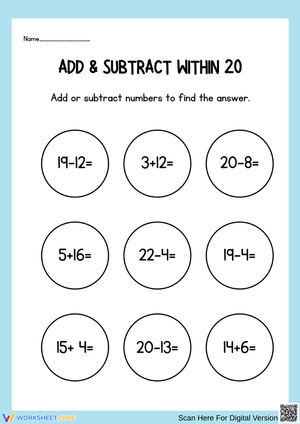
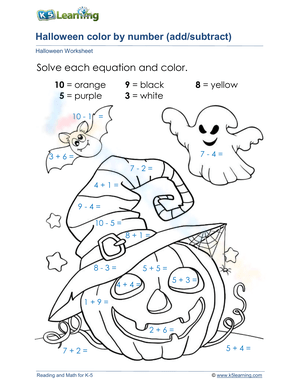
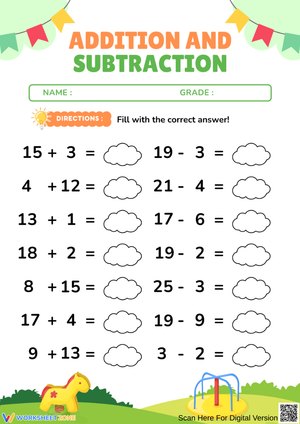
- Mixed equation drills — Addition and subtraction problems appear in random order, requiring students to check the sign on every problem rather than working on autopilot. These function well as timed fluency checks or untimed warm-up work.
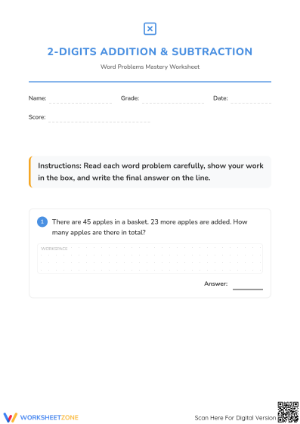
- Word problems with operation-selection prompts — Short, readable scenarios ask students to underline the action verb, write the equation, and solve. The emphasis is on reading for meaning, not executing a calculation the student has already decided to make.
Mistakes Students Make That These Worksheets Help You Catch
The most consistent error pattern is sign blindness, and it tends to appear specifically in students who have recently become confident on single-operation drills. A child who scores 20 out of 20 on an addition assessment will often add every problem on a mixed worksheet, including those clearly marked with a minus sign. The problem is not confusion about subtraction — it is a habit-override issue. Catching it on a worksheet tells the teacher exactly what to address: not reteaching the operation, but slowing the student down and making deliberate sign-checking a required step before any computing begins.
A second pattern shows up on word problems. Students spot two numbers, add them, and move on without reading what the situation actually asks. This produces answers like "Marcus has 8 stickers and gives away 5, so now he has 13" — written with full confidence. Telling students to "read more carefully" does not reliably fix this. Teaching them to find and underline the action verb before touching the numbers does. Once a student marks gives away, the subtraction signal becomes hard to miss.
Standard Alignment
The primary standard addressed is 1.OA.C.6, which requires students to add and subtract within 20 and demonstrate fluency for both operations within 10. That fluency benchmark matters beyond the standard itself — automaticity within 10 is the prerequisite for multi-digit computation in second grade. Students who still count on fingers for 7 + 5 carry that counting load into two-digit addition, where they do not have enough working memory left to manage the regrouping procedure as well. The addition subtraction printable worksheets for 1st grade address 1.OA.C.6 directly by presenting both operations in every session, with number ranges that teachers can adjust by student tier.
Word-problem worksheets address 1.OA.A.1, which covers using addition and subtraction within 20 across all major situation types: adding to, taking from, putting together, taking apart, and comparing. The compare structure — where no physical joining or removing action is described — is the hardest for first graders and the most commonly undertaught. Including it in the word-problem set ensures students encounter it in a supported practice context before they meet it on an assessment.
How to Build These Worksheets Into Your Lesson Plans
The addition subtraction printable worksheets for 1st grade work across several points in a typical math block, and their placement determines how much students get out of them.
Mixed equation drills are well-suited to the first six to eight minutes of math time — quiet, independent work that transitions students into a math mindset before whole-group instruction begins. Fact family worksheets land best immediately after a lesson on inverse operations, giving students a structured format to apply the concept they just encountered the same day. Word-problem worksheets belong in a small-group or station setting rather than full-class independent completion; the reading load is significant for six- and seven-year-olds, and having a teacher or aide nearby to ask students to read each problem aloud before writing anything produces noticeably stronger work than silent independent practice.
For fluency drills specifically: laminating the equation worksheets or sliding them into dry-erase pockets lets you run the same worksheet across multiple days without reprinting. Students write with a dry-erase marker, erase, and repeat. Beyond the paper savings, the practical benefit is visibility — you can scan the room during the warm-up and immediately see which students are still on problem three when most of the class has reached problem twelve.
Adjusting the Worksheets for a Range of Learners
For students who are still building counting-on reliability, restrict the number range to within 10 and keep two-color counters on the desk during worksheet time. The task structure stays identical — same format, same sign-checking requirement — but the numbers stay in a range where the student can self-correct by modeling with counters when mental computation produces an answer that doesn't feel right. Keeping the format consistent across levels also simplifies classroom management during independent work time.
Students who demonstrate consistent fluency within 10 move to worksheets with sums and differences within 20. A further adjustment for this group is introducing missing-addend equations (__ + 6 = 11) alongside standard problems, which requires inverse reasoning rather than direct computation. The addition subtraction printable worksheets for 1st grade also support a peer-conferring structure at this level: a student who finishes early checks answers against a posted key, marks any errors, and discusses the discrepancies with a partner before seeking teacher input — adding a layer of self-monitoring without requiring additional facilitation.
Frequently Asked Questions
Do students need to be fully fluent in addition before working on mixed operation practice?
Not fully fluent — functional. Students should be able to count on reliably and produce most single-digit addition sums before a mixed worksheet is introduced. If a child cannot yet arrive at any answer for 4 + 5, the additional demand of deciding which operation to use is too much at once. The right entry point is when a student handles single-operation work with reasonable accuracy and needs the next challenge: reading the sign and making a deliberate decision about what to do with the numbers.
How many problems per session is reasonable for first graders?
For equation drills, eight to twenty problems depending on whether the goal is fluency-building or warm-up volume. For word problems, four to five per session is the practical ceiling. Reading load accumulates quickly for students this age, and reasoning quality drops sharply after the fourth or fifth problem if students are also working to decode unfamiliar vocabulary in the scenarios.
What is the best approach when students have not yet had direct instruction on fact families?
Introduce the concept with physical objects before handing out the worksheet. Place four red tiles and three blue tiles on a table, write both addition equations together as a class, then ask what subtraction facts the same tiles can show. Once students have seen the relationship with objects they can touch and rearrange, the fact family worksheet format makes structural sense rather than appearing as a new memorization exercise. Running two or three fact families as a whole-class activity before releasing students to independent work gives them enough of a mental model to proceed without confusion.













 Interactive Worksheet Maker
 Quiz Maker
 Word Search Maker
 Crossword Puzzle Maker
 Word Scramble Generator
 Sentence Scramble Generator
 Handwriting Worksheet Generator
 Name Tracing Generator
 Fill In The Blank Generator