




























Views
Downloads

St. Patrick's Day Color by Number | Essential Math

Paste this activity's link or code into your existing LMS (Google Classroom, Canvas, Teams, Schoology, Moodle, etc.).
Students can open and work on the activity right away, with no student login required.
You'll still be able to track student progress and results from your teacher account.
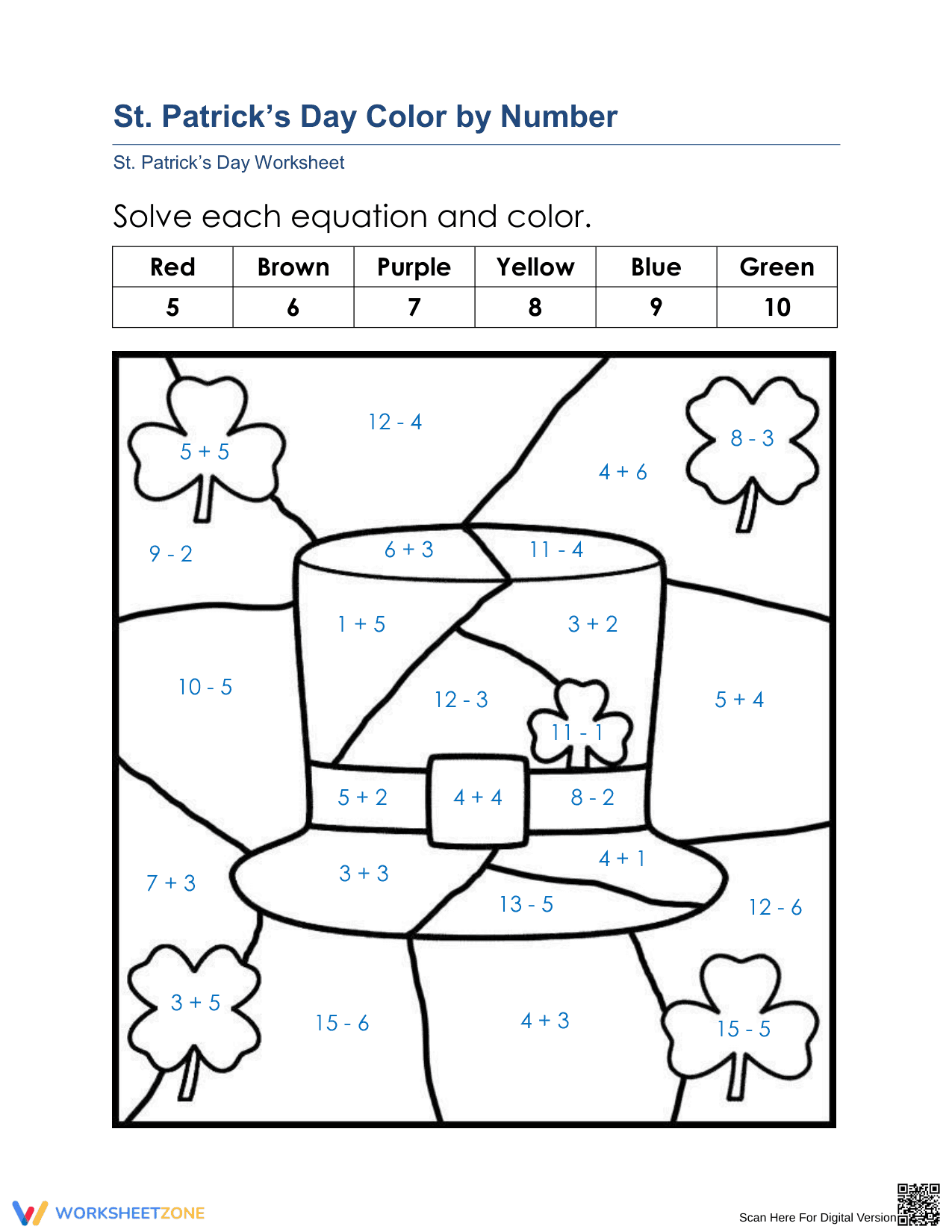
This Grade 1-3 St. Patrick's Day math worksheet helps students master addition and subtraction fluency through an engaging color-by-number activity. By solving 24 distinct equations, learners reinforce their mental math strategies while creating a festive leprechaun hat illustration. It provides a high-interest way to practice operational skills during the holiday season.
At a Glance
- Grade: 1-3 · Subject: Math
- Standard:
CCSS.MATH.CONTENT.1.OA.C.6— Add and subtract within 20, demonstrating fluency for addition and subtraction.- Skill Focus: Mixed Operations (Sums/Differences 5-10)
- Format: 2 pages · 24 problems · Answer key included · PDF
- Best For: Seasonal morning work or early finishers
- Time: 15–25 minutes
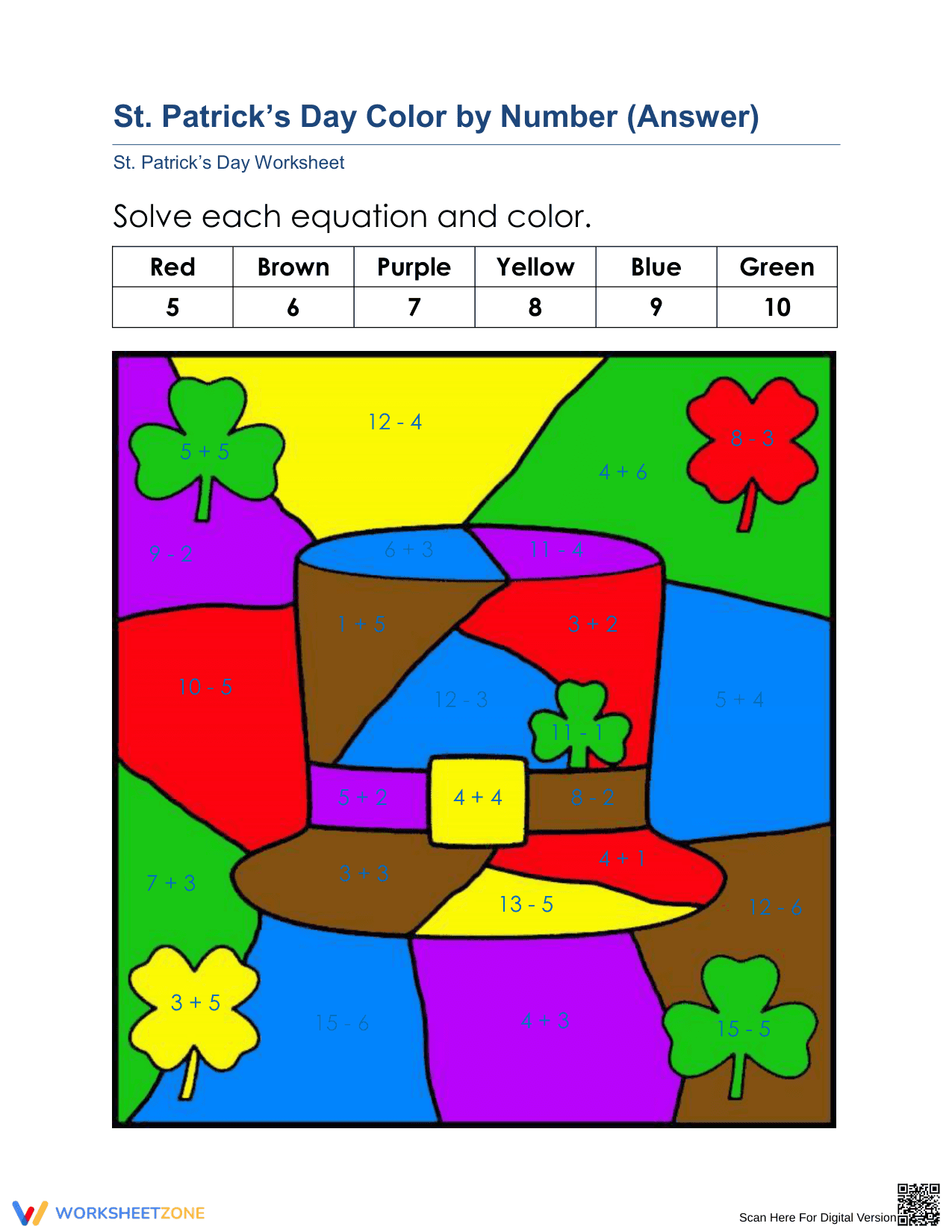
This resource features a single-page student activity and a full-color answer key for rapid grading. The worksheet contains 24 mixed addition and subtraction equations strategically designed to result in totals between 5 and 10. Each number corresponds to a specific color—Red, Brown, Purple, Yellow, Blue, and Green—allowing students to self-check their work as the holiday image emerges. The layout is clean and professional, ensuring that the mathematical tasks remain the central focus of the activity.
The zero-prep workflow is designed for busy educators. First, print the single-page PDF (30 seconds). Next, distribute the sheets along with standard crayons or colored pencils (1 minute). Finally, use the included visual answer key to review student accuracy or allow for peer-grading (1 minute). Total teacher preparation time is under two minutes, making it an ideal sub plan or transition activity during the busy month of March.
The primary focus is CCSS.MATH.CONTENT.1.OA.C.6, which requires students to add and subtract within 20, demonstrating fluency for addition and subtraction within 10. The worksheet also supports second-grade fluency goals under CCSS.MATH.CONTENT.2.OA.B.2. Both standard codes can be copied directly into lesson plans, IEP goals, or district curriculum mapping tools.
Use this worksheet as a festive morning work assignment on March 17th to settle the class during arrival. It also serves as an effective formative assessment tool; observe students as they solve the equations to identify those still relying on finger counting versus those using mental strategies like "counting on" or "making ten." The expected completion time ranges from 15 to 25 minutes depending on student fluency levels.
This activity is tailored for first through third-grade students who need varied practice to achieve operational automaticity. It is particularly helpful for kinesthetic learners who benefit from the tactile experience of coloring. Pair this with a St. Patrick's Day read-aloud or a lesson on Irish folklore for a cross-curricular holiday experience that maintains high academic standards.
Research by Fisher & Frey (2014) emphasizes that purposeful practice is most effective when it is engaging and provides immediate feedback. This St. Patrick's Day worksheet applies these principles by integrating 24 math problems into a color-by-number format, where the emerging visual pattern acts as a self-correction mechanism. By focusing on CCSS.MATH.CONTENT.1.OA.C.6, the resource targets the critical transition from basic counting to operational fluency. Studies in the RAND AIRS 2024 report suggest that seasonal, high-interest materials can increase student time-on-task by up to 15% compared to traditional drill-and-kill worksheets. This resource ensures that holiday celebrations in the classroom remain academically rigorous while supporting the development of mental math strategies. The inclusion of both addition and subtraction within a single task forces students to attend closely to operational signs, a key component of mathematical precision.


