


























Views
Downloads

K.OA.A.1 Worksheet: Math Evaluation — Printable Grade K
Paste this activity's link or code into your existing LMS (Google Classroom, Canvas, Teams, Schoology, Moodle, etc.).
Students can open and work on the activity right away, with no student login required.
You'll still be able to track student progress and results from your teacher account.
This comprehensive second-term evaluation for Kindergarten and early Grade 1 provides a holistic assessment of foundational math skills. Students demonstrate mastery in operations, algebraic thinking, and number sense through structured tasks. It serves as a vital tool for identifying learning gaps and tracking progress toward end-of-year standards.
At a Glance
- Grade: K-2 · Subject: Math
- Standard:
CCSS.MATH.CONTENT.K.OA.A.1— Represent addition and subtraction with objects, fingers, mental images, or equations- Skill Focus: Foundational operations and number sense
- Format: 3 pages · 50 problems · Answer key included · PDF
- Best For: Term-end assessment and progress monitoring
- Time: 25–40 minutes
What's Inside
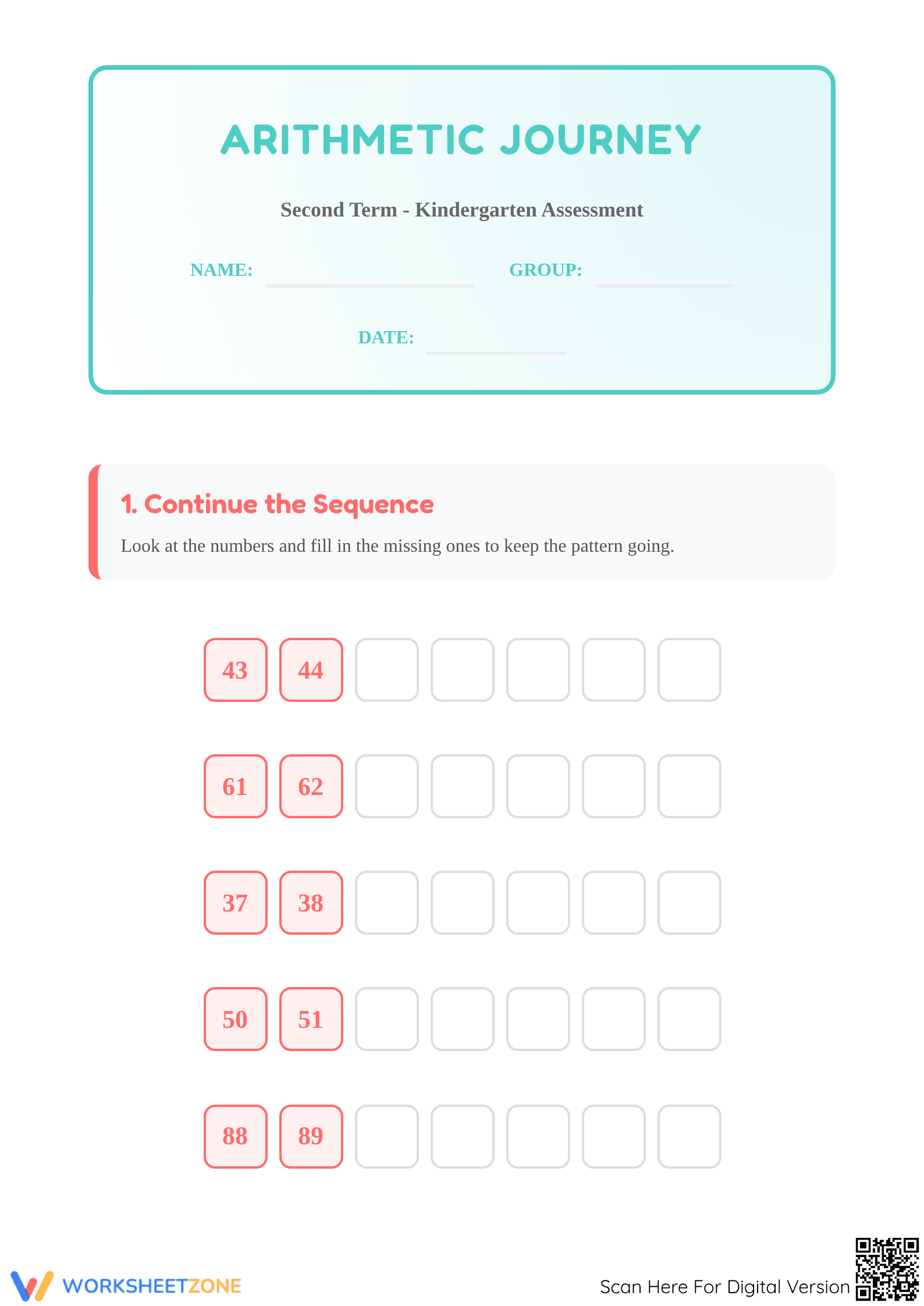
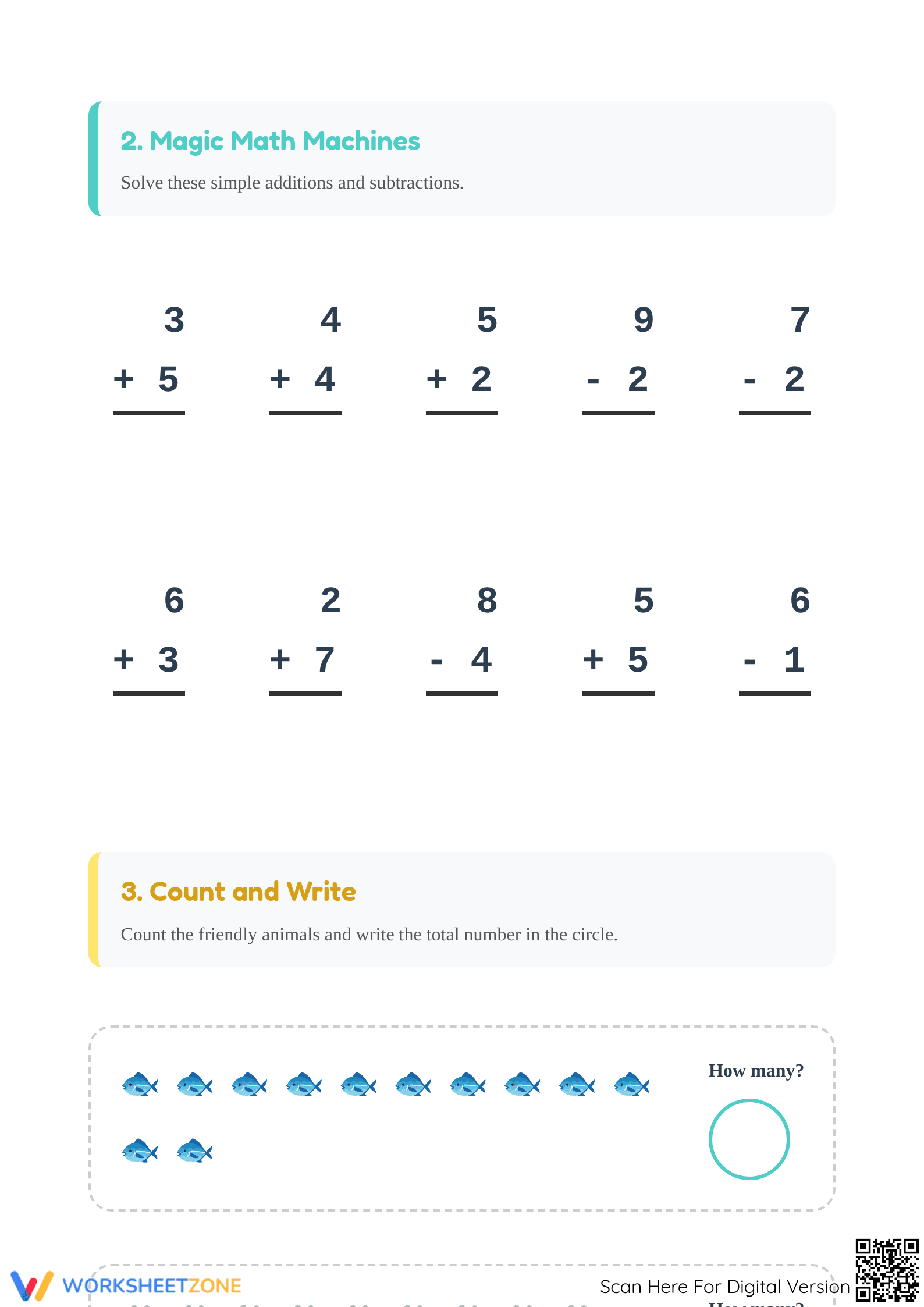
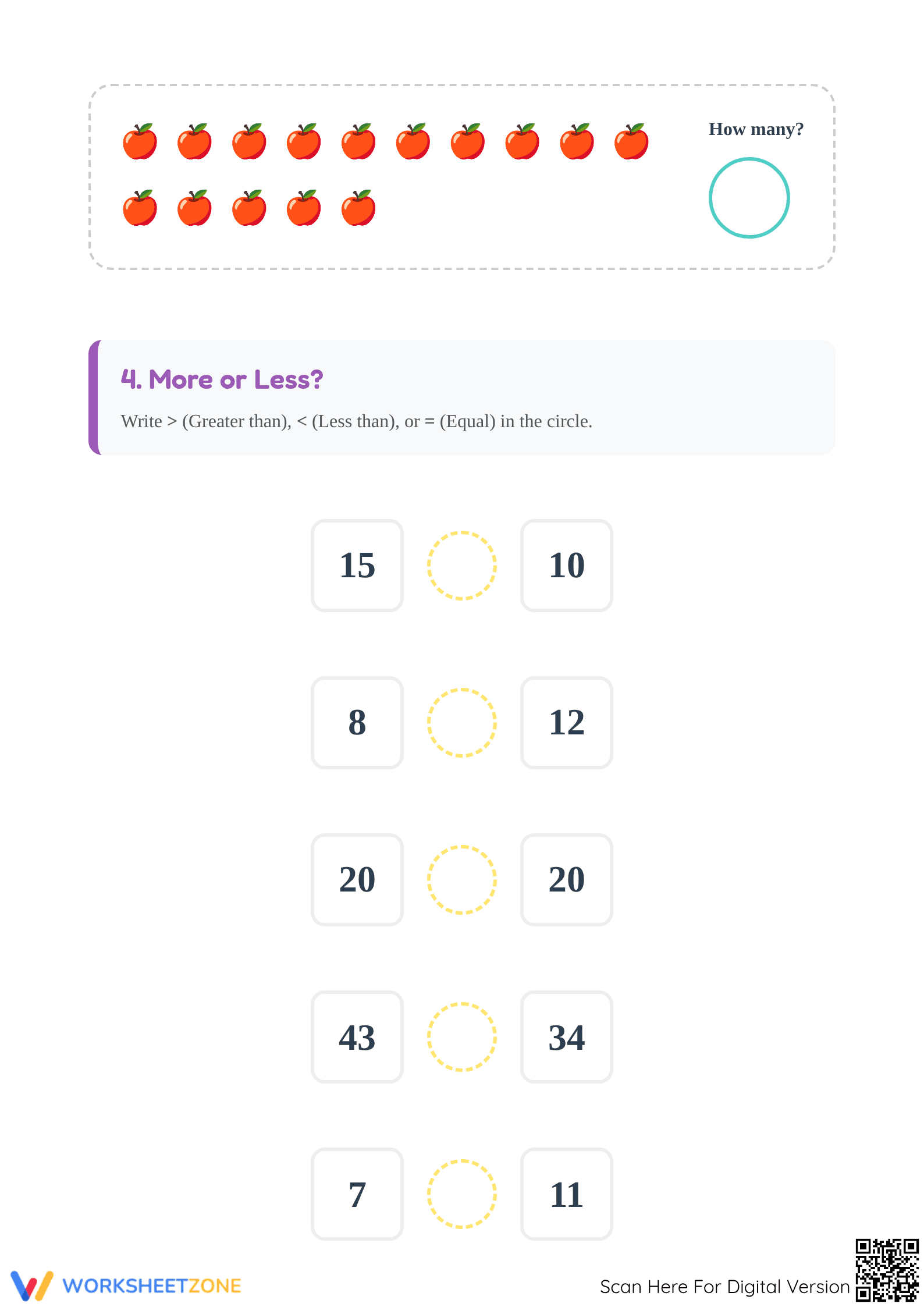
This three-page assessment is meticulously organized into thematic modules. The first page focuses on number recognition, counting, and geometric shapes. The second page features 20 targeted addition and subtraction equations within 10. The final page challenges students with numerical comparisons (greater than/less than) and missing number sequences. A complete answer key is provided for rapid grading.
Mastery Evidence
Each section of this evaluation is mapped to specific Kindergarten and First Grade standards, allowing teachers to pinpoint exactly where students fall on the mastery spectrum. The tasks transition from concrete representation (counting objects) to abstract operations (equations). Scores can be disaggregated by strand to inform small-group instruction or update IEP progress reports.
Standards Alignment
Aligned to CCSS.MATH.CONTENT.K.OA.A.1, students represent addition and subtraction with mental images, drawings, and equations. It also supports CCSS.MATH.CONTENT.K.CC.A.3 by requiring students to write numbers from 0 to 20. Both standard codes can be copied directly into lesson plans, IEP goals, or district curriculum mapping tools.
How to Use It
Administer this evaluation at the end of the second term to measure cumulative growth. For students struggling with the abstract equations on page two, provide manipulatives like counters or number lines to observe their strategy use. Use the results to form flexible groups for the upcoming unit on double-digit addition or place value.
Who It's For
Designed for Kindergarten students ready for mid-year benchmarks and Grade 1 students needing a review of foundational concepts. It pairs naturally with number line anchor charts or a set of ten-frame manipulatives during direct instruction or guided practice sessions.
According to the RAND AIRS 2024 report on early childhood numeracy, consistent formative and summative assessment in the Kindergarten years is predictive of long-term algebraic success. This worksheet aligns with these findings by providing a balanced mix of computational fluency and conceptual understanding. By targeting standard CCSS.MATH.CONTENT.K.OA.A.1, it ensures students develop the necessary mental models for operations. Fisher & Frey (2014) emphasize that such structured evaluations allow for the gradual release of responsibility, moving students from teacher-led counting to independent problem-solving. Educators can rely on this tool to provide high-quality evidence of student learning that meets the rigorous demands of state and national frameworks. This 3-page resource bridges the gap between simple counting and formal arithmetic, making it an essential component of a robust Kindergarten math curriculum that prioritizes evidence-based instructional practices and data-driven decision-making in the classroom.


