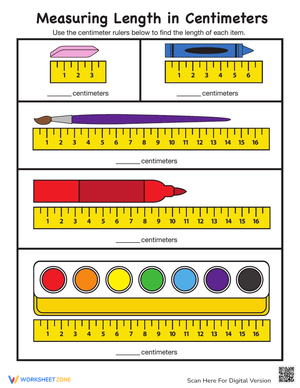
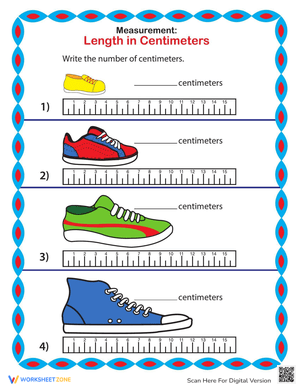
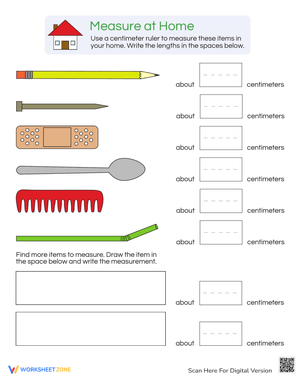
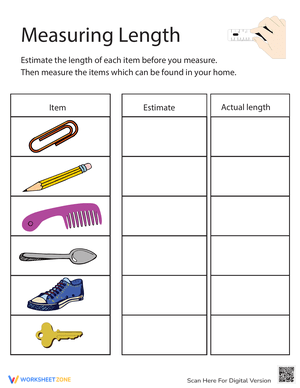
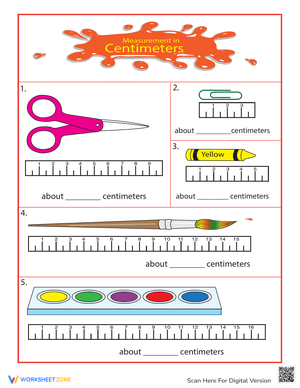
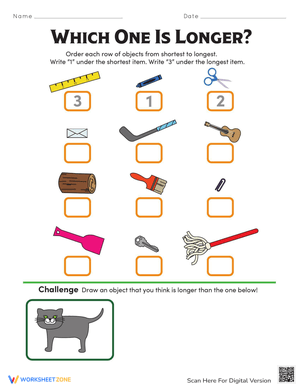
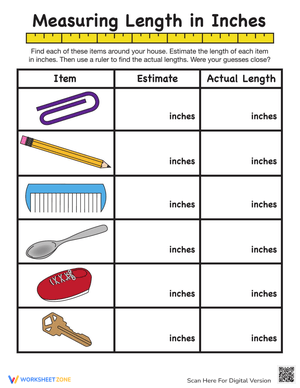
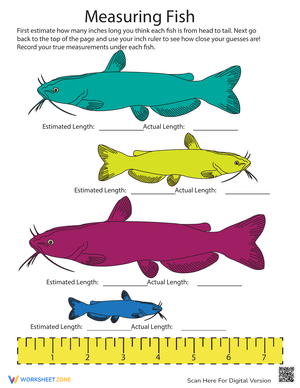
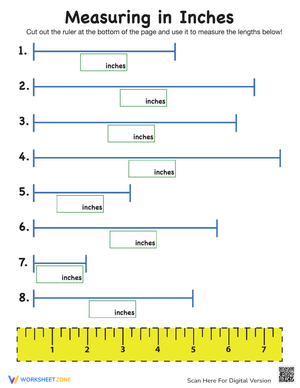
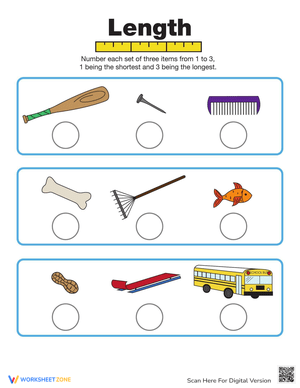
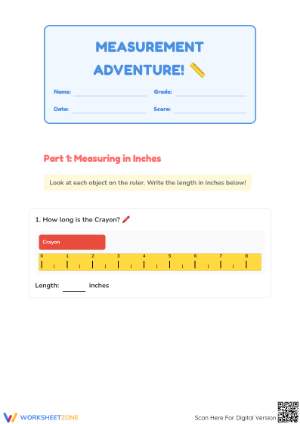
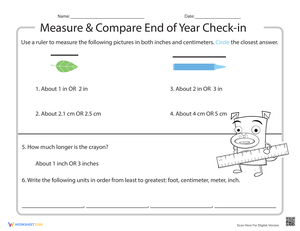
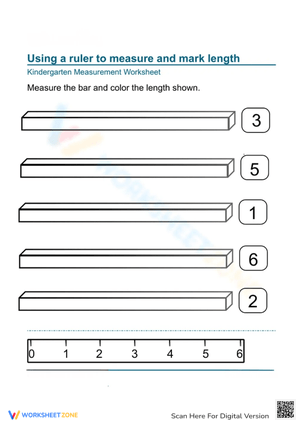
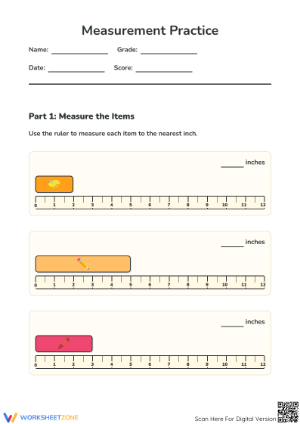
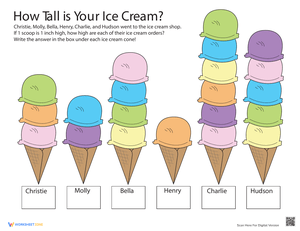
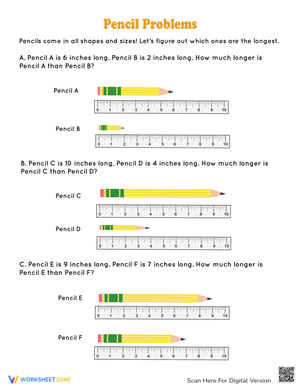
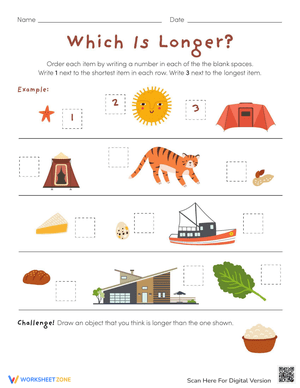
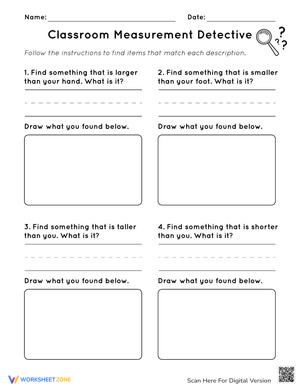
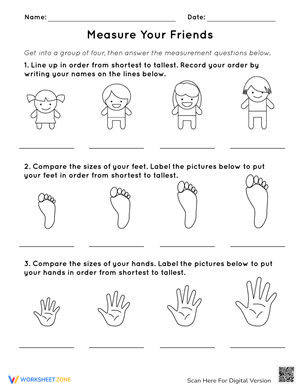
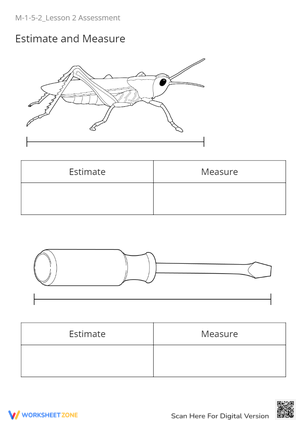
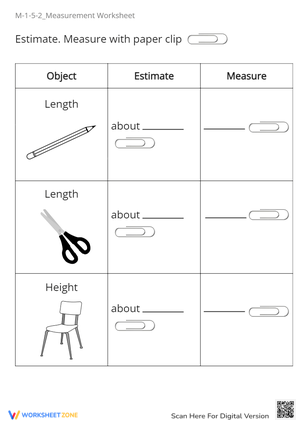
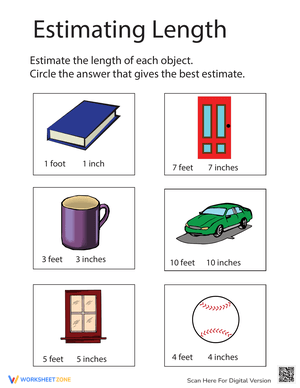
1st grade measuring length pdf worksheets give teachers a direct route into one of the most instructive corners of early math — the moment when students stop eyeballing objects and start counting units. The set targets two foundational skills from Grade 1 Measurement & Data: ordering objects by relative length and expressing length as a whole number of repeated units. Both skills require structured practice that goes beyond physical manipulation of cubes, and these worksheets supply exactly that in printable form.
The Specific Skills Targeted
1st grade measuring length pdf worksheets in this set each target one discrete measurement task, which lets teachers assign based on a student's current need rather than where the class median sits. Across the collection, students:
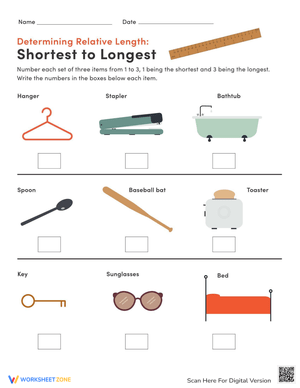
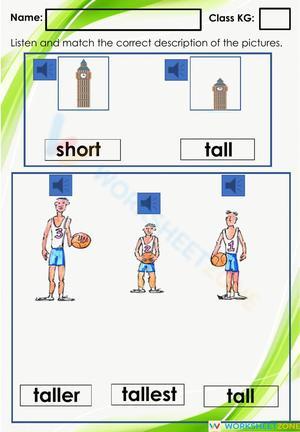
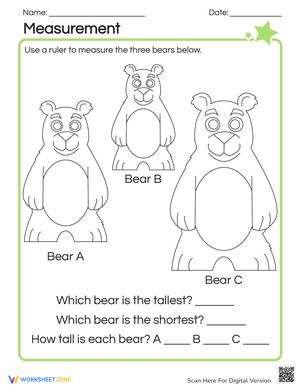
- Order three drawn objects from shortest to longest — and from longest to shortest — without counting units
- Count pre-drawn non-standard units (linking cubes, paperclips, square tiles) aligned beside an object and record the total as a whole number
- Compare two objects indirectly by using a third object as a reference
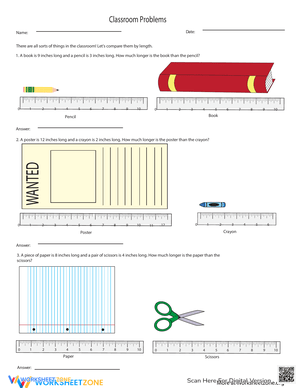
- Identify which of two measured objects is longer when both are expressed as unit counts
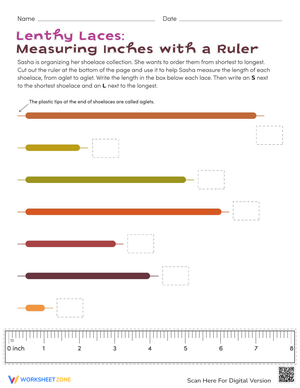
- Apply a consistent starting line and count only the units that fall within the object's span
Iteration tasks appear at higher frequency in the set than ordering tasks because expressing length as a unit count is harder to internalize than visual comparison. Students need more repetitions of it, and the worksheets reflect that imbalance deliberately.
Mistakes Students Make That These Worksheets Help You Catch
Three errors show up consistently in first-grade measurement work. The first is the gap problem: a student mentally places unit images end-to-end but treats the white space between them as an additional unit. On a completed worksheet, this produces a count that is two or three higher than the correct answer — and the student cannot see why they are wrong because the error is perceptual, not computational. Pre-drawn, fully abutted units remove this variable from the visual field and train students to expect contact between units before they count.
The second error is starting-point misalignment. A student begins counting at the second unit rather than the first, or counts the left-edge anchor line itself as a unit. The result is a measurement that is off by exactly one — consistently off by one, which is the tell that distinguishes this error from simple miscounting. The worksheets address this with a bold left-edge baseline and a first unit positioned flush against it, giving students a visual habit to replicate rather than an abstract verbal rule to remember.
The third error is the most conceptually revealing: students who measure horizontal objects correctly often struggle when the same task is presented vertically. Height feels different from length to a six-year-old, and the change in counting direction disrupts the eye. Including both orientations across the set catches this gap before it goes unnoticed through an entire unit.
Standard Alignment
These worksheets address CCSS 1.MD.A.1, which asks students to order three objects by length and compare two objects indirectly using a third, and CCSS 1.MD.A.2, which asks them to express the length of an object as a whole number of length units by placing shorter objects end-to-end without gaps or overlaps. In instructional terms, 1.MD.A.1 precedes 1.MD.A.2 because ordering by eye requires judgment, not counting — students who cannot reliably compare objects visually are not yet ready to attach numbers to length. The worksheet sequencing mirrors this progression. Teachers in Texas will find alignment to TEKS 1.7C and 1.7D, which address the same foundational concepts under the state's measurement expectations.
How to Work These Worksheets Into Your Week
The most efficient placement for 1st grade measuring length pdf worksheets is as a five-minute daily warm-up during the two-week window when measurement is the primary unit. One worksheet per morning — completed independently while the teacher handles arrival and attendance — creates a consistent retrieval structure that reinforces the previous day's lesson without cutting into new instruction time. After the unit wraps, one worksheet per week as a maintenance task prevents the skill from eroding before the spring benchmark.
For small-group rotations, print and laminate selected worksheets and pair them with physical linking cubes sized to match the printed units. Students place actual cubes over the drawn cubes before counting — a step that bridges the 2D representation and the physical act of measuring more concretely than a verbal reminder does. This setup works especially well as a correction tool: a student who completed the worksheet incorrectly during morning work can redo it at the small-group table, placing cubes to check their count against the image and seeing the error in real time.
Adjusting the Worksheets Across Ability Levels
For students still solidifying one-to-one correspondence, assign counting worksheets where objects span three to four units rather than seven or eight. The cognitive load of tracking the unit count, the object's boundary, and the left-edge alignment simultaneously is real at this age. Reducing the unit count lets the student practice the procedure without losing track partway through. Once a student reliably counts four units, extend to six and then eight — each extension is small enough not to feel like a new task.
Students who grasp iteration quickly benefit from a modification that requires them to draw their own units inside a bounded span before counting. Remove the pre-drawn cubes, leave only a start line and an end line, and ask the student to fill in the space with equal-size marks before recording the total. This reversal makes the equal-unit-size rule visible in a way that pre-drawn worksheets do not. A student who draws units of inconsistent size has revealed a conceptual gap — not a counting error — and that distinction changes how a teacher responds.
Frequently Asked Questions
Why do these worksheets use non-standard units instead of rulers?
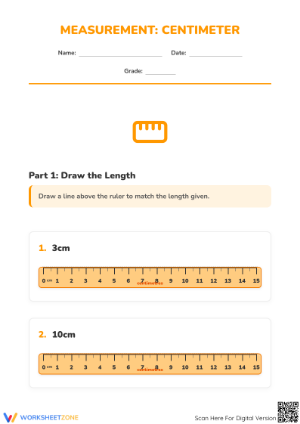
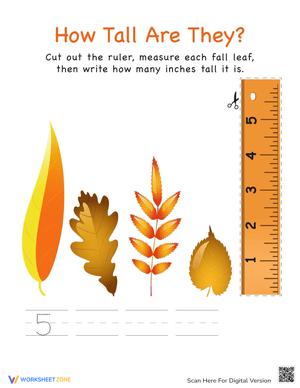
Rulers ask students to read a scale, interpret hash marks, and locate a printed number — all at the same time. Non-standard units strip that complexity away and let students focus entirely on the iteration concept: length is the count of same-size units placed end-to-end without gaps. Standard rulers become meaningful once that concept is solid. Introducing a ruler before the concept is in place produces students who can read "4 inches" off a scale but cannot explain what that number represents or why it would change if the units were smaller.
Do these worksheets include vertical measurement tasks as well as horizontal ones?
Yes. Several worksheets present objects oriented vertically because height measurement trips up students who have only counted units running left to right. The underlying skill is identical — count the units, no gaps, start at the baseline — but first graders need to encounter the task in both orientations to understand that the direction of the units does not change the procedure.
How do these worksheets pair with hands-on measurement activities?
They work best as a complement to physical measurement, not a replacement for it. A productive sequence: measure a real object with real cubes first, then complete the corresponding worksheet. That order gives students a physical referent before they encounter the printed representation. The 1st grade measuring length pdf worksheets in this set depict objects students handle daily — crayons, scissors, glue sticks — so the connection between the paper task and the desk object is immediate and obvious.
Can parents support this work at home without extra materials?
Yes. Because the unit images are printed directly on each worksheet, parents do not need to supply linking cubes or read lengthy setup instructions. The task is visible on the page. A completed worksheet with an incorrect answer is also useful information the next morning: the type of error — wrong count, wrong starting point, inflated total — tells the teacher what to address before moving on.













 Interactive Worksheet Maker
 Quiz Maker
 Word Search Maker
 Crossword Puzzle Maker
 Word Scramble Generator
 Sentence Scramble Generator
 Handwriting Worksheet Generator
 Name Tracing Generator
 Fill In The Blank Generator