




























Views
Downloads

Grade K Height Ordering — Printable No-Prep Worksheet

Paste this activity's link or code into your existing LMS (Google Classroom, Canvas, Teams, Schoology, Moodle, etc.).
Students can open and work on the activity right away, with no student login required.
You'll still be able to track student progress and results from your teacher account.
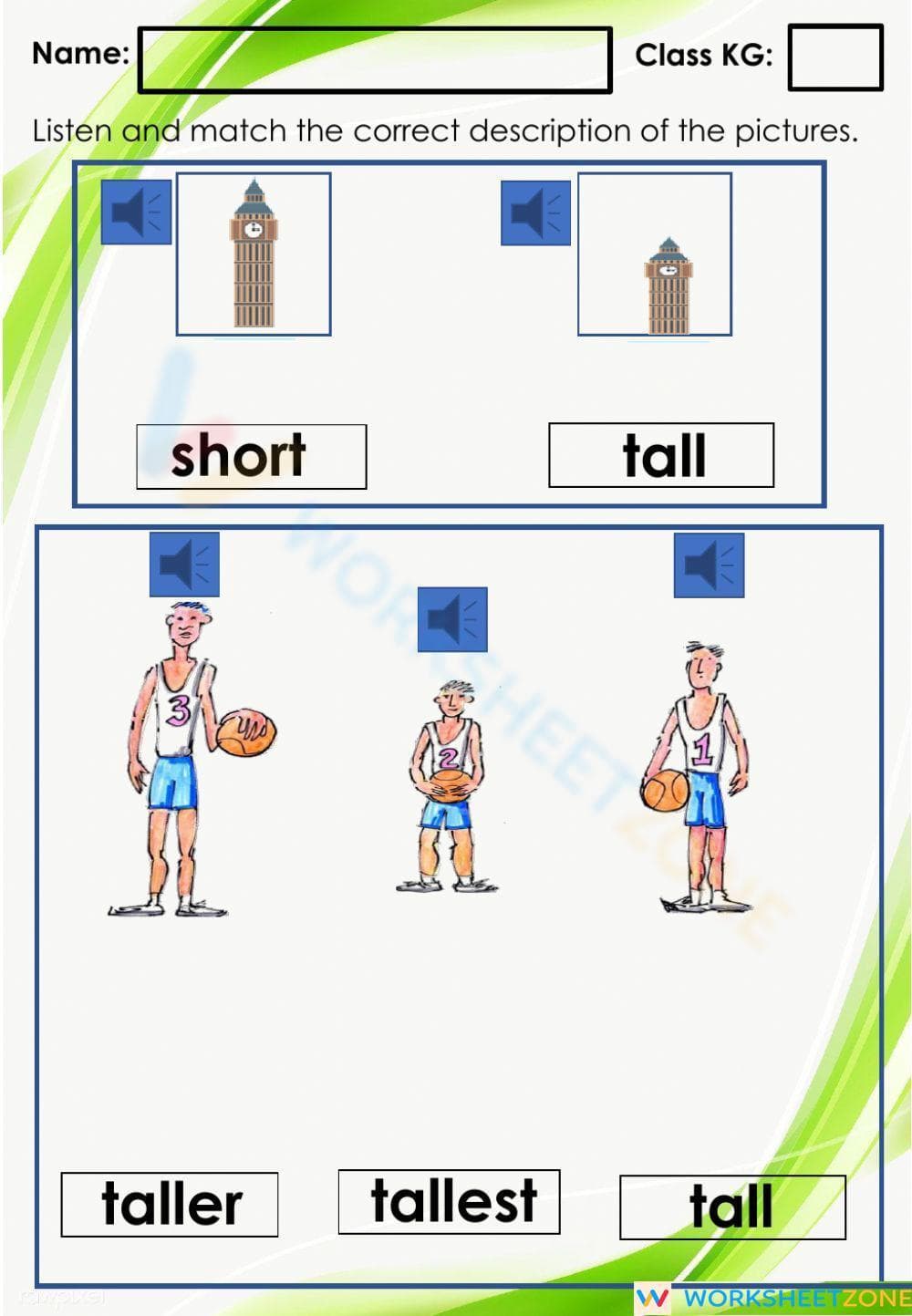
This Kindergarten measurement worksheet provides immediate practice with ordering by height, helping young learners accurately identify and compare objects using vocabulary like short, tall, taller, and tallest. Students build foundational spatial reasoning and descriptive language skills by matching visual representations to their correct comparative terms.
At a Glance
- Grade: K · Subject: Math
- Standard:
CCSS.MATH.CONTENT.K.MD.A.2— Compare heights of objects and describe differences- Skill Focus: Ordering by height
- Format: 1 page · 5 problems · Answer key included · PDF
- Best For: Independent practice or centers
- Time: 10–15 minutes
Inside this single-page resource, educators will find five distinct matching tasks focused on height comparison. The first section asks students to differentiate between "short" and "tall" using images of clock towers. The second section increases the vocabulary demand, requiring students to label three basketball players as "tall," "taller," or "tallest." The worksheet features clear illustrations and includes a complete answer key. The visual layout is highly accessible for early readers.
This resource is designed for a zero-prep classroom workflow:
- Print (1 minute): Download the PDF and print a class set. No special materials required.
- Distribute (1 minute): Hand out during math centers. Instructions are self-explanatory.
- Review (2 minutes): Use the included answer key to quickly check understanding.
With total teacher prep time under two minutes, this worksheet is ideal for substitute plans.
This activity is directly aligned to CCSS.MATH.CONTENT.K.MD.A.2: Directly compare two objects with a measurable attribute in common, to see which object has "more of"/"less of" the attribute, and describe the difference. It also supports early language acquisition by reinforcing comparative adjectives. Both standard codes can be copied directly into lesson plans, IEP goals, or district curriculum mapping tools.
Teachers can deploy this worksheet during independent math centers after a whole-group lesson on measurement. It serves as an excellent follow-up activity once students have practiced comparing physical objects. Alternatively, use it as a quick formative assessment. While students work, observe whether they correctly sequence the three basketball players; struggling students may need hands-on practice with linking cubes. Expected completion time ranges from 10 to 15 minutes.
This worksheet is primarily designed for Kindergarten students mastering basic measurement and comparison concepts. It is also highly effective for Preschool students ready for an academic challenge, or first-grade students needing a quick review of comparative vocabulary. The clear visuals make it accessible for English Language Learners developing math-specific vocabulary. Pair this resource with a hands-on anchor chart showing different heights or a direct instruction lesson using physical manipulatives.
Mastering early measurement concepts, such as those outlined in CCSS.MATH.CONTENT.K.MD.A.2, requires students to compare heights of objects and describe differences using precise vocabulary. According to a recent EdReports 2024 analysis of early childhood mathematics curricula, explicit instruction in comparative language significantly improves students' spatial reasoning and foundational geometry skills. When young learners practice identifying objects as short, tall, taller, or tallest, they are not merely memorizing words; they are developing the cognitive framework necessary for understanding standardized units of measurement in later grades. Worksheets that combine visual representations with targeted vocabulary practice provide the structured repetition needed to solidify these concepts. By integrating visual matching tasks with specific descriptive terms, educators can effectively bridge the gap between concrete physical comparisons and abstract mathematical reasoning, ensuring long-term retention and academic success in elementary mathematics.


