


























Views
Downloads
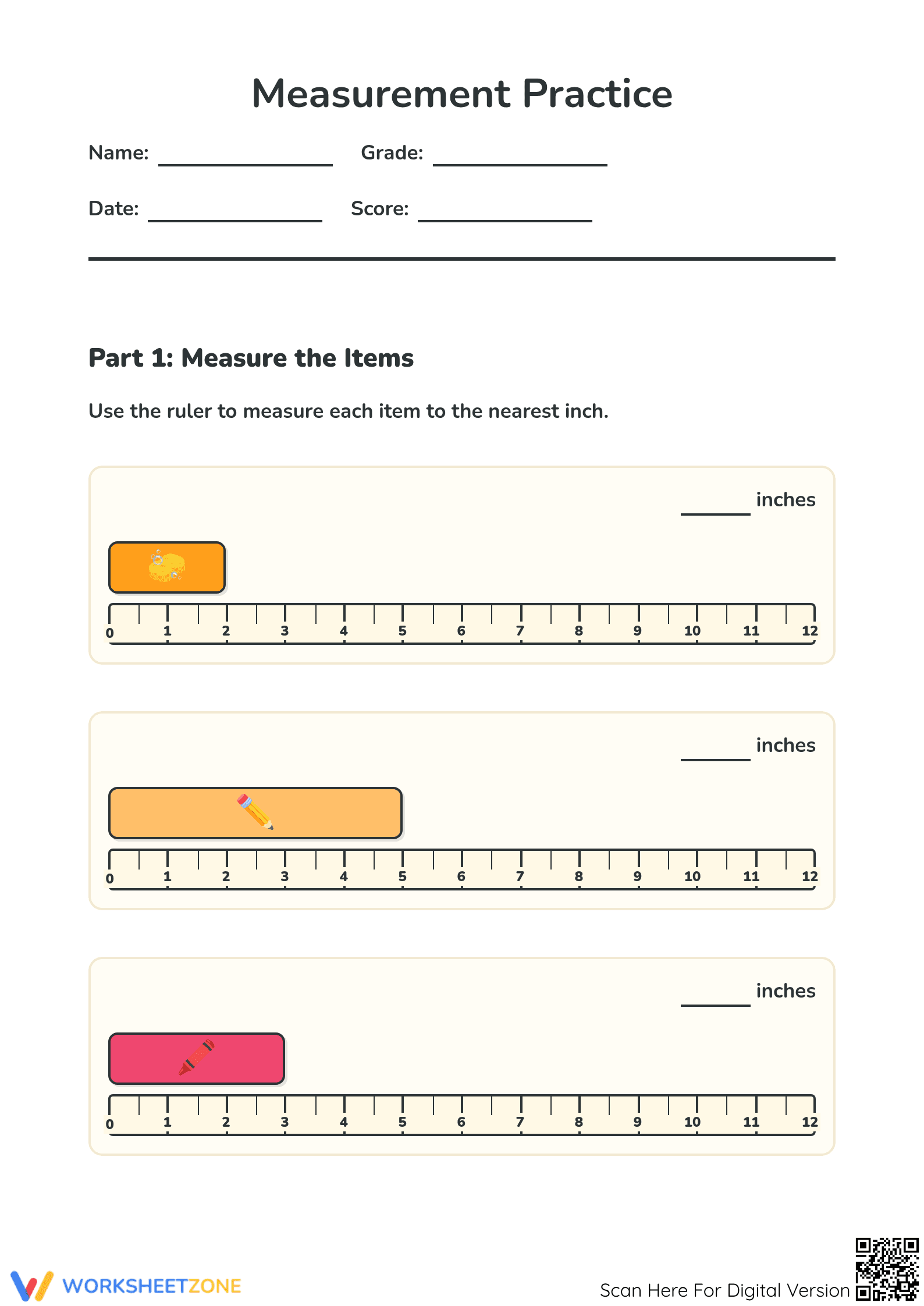


Printable Measurement Practice Worksheet | Grade 2 Math
Paste this activity's link or code into your existing LMS (Google Classroom, Canvas, Teams, Schoology, Moodle, etc.).
Students can open and work on the activity right away, with no student login required.
You'll still be able to track student progress and results from your teacher account.
Mastering measurement requires hands-on application of spatial reasoning and tool usage. This comprehensive worksheet provides Grade 2 students with structured practice in determining length to the nearest inch. By using depicted rulers to gauge everyday objects, learners build the foundational precision needed for more complex geometry and data analysis tasks in later grades.
At a Glance
- Grade: 2 · Subject: Math
- Standard:
CCSS.MATH.CONTENT.2.MD.A.1— Measure the length of an object using appropriate tools like rulers- Skill Focus: Measuring to the nearest inch
- Format: 4 pages · 15 problems · Answer key included · PDF
- Best For: Independent practice or formative assessment
- Time: 20–30 minutes
What's Inside
This four-page PDF includes ten distinct measurement tasks and five critical thinking comparison questions. Each problem features a clear, high-contrast illustration of a common object—such as a pencil, crayon, or pair of scissors—aligned perfectly with a standard 12-inch ruler graphic. A full answer key is provided to facilitate rapid grading and student self-correction.
Skill Progression
- Guided Practice: The first three items (sponge, pencil, crayon) include prominent ruler alignment to establish the foundational whole-number measurement skill.
- Supported Practice: Seven subsequent items (glue, scissors, paintbrush, etc.) challenge students to maintain accuracy across varied lengths and object orientations.
- Independent Application: Part 2 features five comparison questions where students must apply their collected data to identify the longest/shortest items and calculate additive length differences.
This sequence follows a gradual-release model, transitioning students from simple observation to higher-order comparative analysis.
Standards Alignment
This resource is explicitly aligned to `CCSS.MATH.CONTENT.2.MD.A.1`, which requires students to measure the length of an object by selecting and using appropriate tools such as rulers, yardsticks, meter sticks, and measuring tapes. It also supports `CCSS.MATH.CONTENT.1.MD.A.2` for foundational length concepts. Both standard codes can be copied directly into lesson plans, IEP goals, or district curriculum mapping tools.
How to Use It
Use this worksheet during the "You Do" phase of a measurement lesson to assess individual student accuracy. It serves as an excellent formative assessment tool after a teacher-led demonstration with physical rulers. Alternatively, assign it as a homework reinforcement task; the included ruler graphics ensure students can complete the work successfully even if they do not have a physical ruler at home.
Who It's For
Designed primarily for Grade 2 students, this worksheet is also highly effective for Grade 1 advanced learners or as a remedial review for Grade 3 students. It pairs naturally with a hands-on "Scavenger Hunt" activity where students measure actual classroom items, serving as the written verification of their measuring skills.
According to a 2024 ScienceDirect TpT Analysis of high-performing educational resources, the integration of static visual tools, such as the embedded rulers in this worksheet, significantly reduces cognitive load for early elementary learners. By removing the physical dexterity requirement of aligning a loose ruler, students can focus entirely on the conceptual task of reading an incremental scale to the nearest inch. This "Essential" Grade 2 measurement worksheet targets `CCSS.MATH.CONTENT.2.MD.A.1` by simulating real-world tool application across 15 distinct tasks. Research from Fisher & Frey (2014) emphasizes that such structured practice is vital for transitioning from non-standard units to standard American English units. The clear layout and varied item lengths provide the repetitive yet engaging exposure necessary for students to internalize spatial intervals. This printable resource ensures that every student, regardless of physical supply availability, can master the core skill of linear measurement with professional-grade accuracy.


