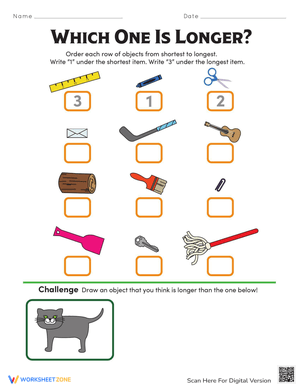
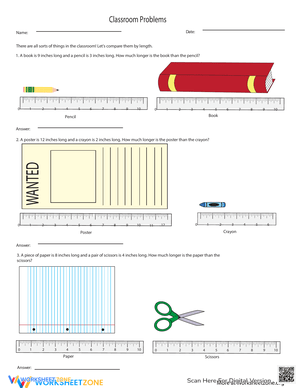
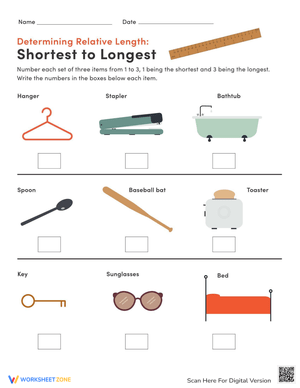
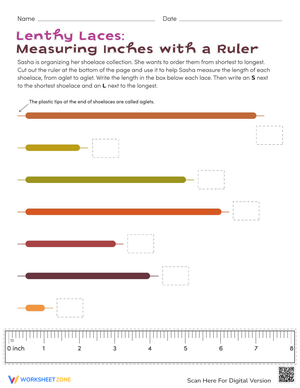
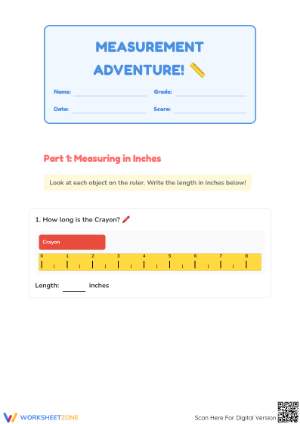
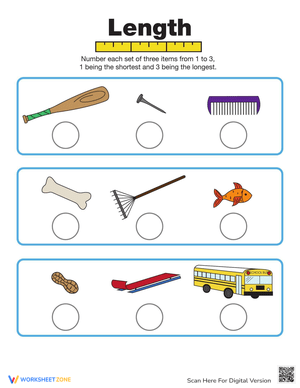
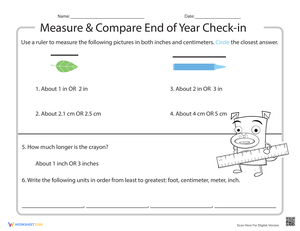
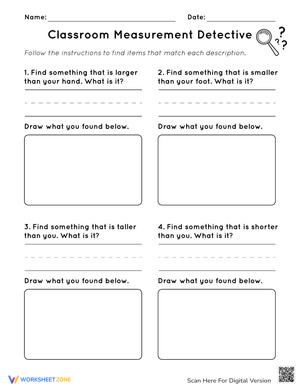
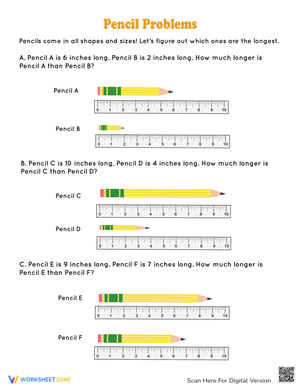
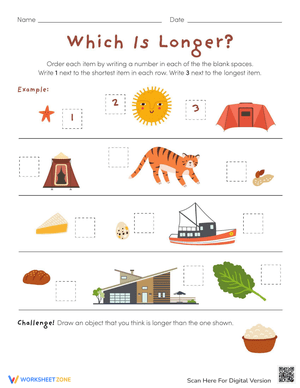
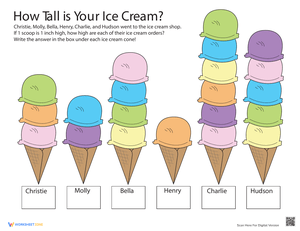
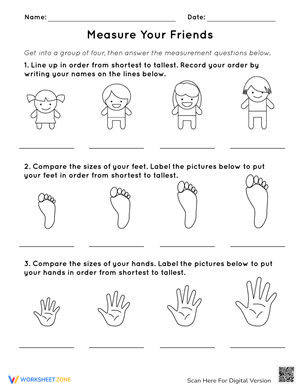
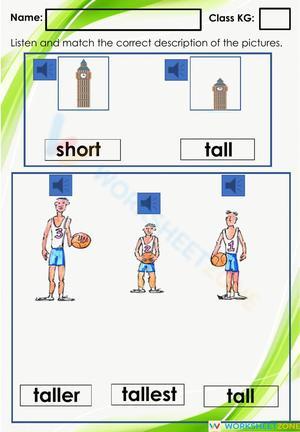
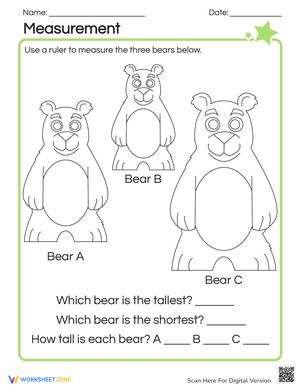
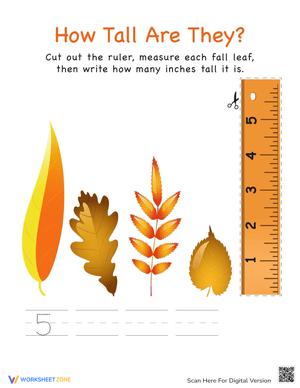
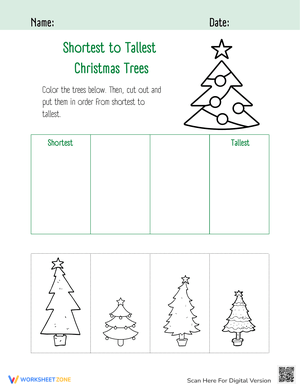
These comparing and ordering length printable worksheets for 1st grade give teachers a ready set of visual, action-based tasks for the direct comparison stage of early measurement — the stage that must come before students ever pick up a ruler. Each worksheet presents picture-based scenarios where students circle, color, mark, or cut and paste to show which object is longer, which is shorter, and how three objects rank from one end of the length spectrum to the other. The formats stay lean: clear images, math vocabulary students already hear in whole-group lessons, and response options that hold up in a center, a homework folder, or the last few minutes of a math block.
Why This Concept Comes Before the Ruler
Before a number can be assigned to a length, a student must understand what length actually is — and more specifically, where it starts and ends. Grade 1 is the year the math standards expect this perceptual work to happen formally. At the concrete level, students compare pencils and paper strips on a desk. At the representational level — which is where printable worksheets live — they apply that same reasoning to pictures, which requires noticing endpoints and ignoring irrelevant features like color, thickness, or overall visual size.
The move from holding two pencils side by side to interpreting a picture of two pencils is not trivial for a six-year-old. A two-dimensional image is fixed on the page, so students must mentally identify what "starting at the same place" means in a drawing rather than discovering it through physical handling. That cognitive step is where many early errors originate, and it is the step these worksheets address directly.
The Specific Skills These Worksheets Target
Students work through three tightly connected skill areas across the set:
- Comparing two objects by length and labeling the result using longer, shorter, and taller
- Ordering three objects from shortest to longest and from longest to shortest
- Identifying shared starting points and recognizing when objects are deliberately offset to make the comparison less obvious
The third item gets explicit attention on several worksheets, with objects drawn at staggered positions so students cannot rely on the rightmost edge as a proxy for "longer." That design reflects what actually shows up in student work: a child who handles aligned-object tasks correctly will still mark the wrong answer the moment one object shifts right on the page.
Mistakes Students Make That These Worksheets Help Teachers Catch
The most reliable error pattern at this level is comparing overall visual size rather than length along a single axis. A wide, squat crayon consistently gets circled as "longer" than a thinner, longer one because it occupies more visual space on the page. This happens even in students who answer correctly when objects appear as simple lines — introduce a realistic-looking object and size perception starts overriding length reasoning.
A second pattern surfaces in ordering tasks: students find the extremes first — longest and shortest — and then drop the remaining object into the middle slot without actually comparing it to its neighbors. The result is a correct first and third position with a reversed middle pair. Two out of three objects are right, so a quick scan can miss it entirely. Asking students to point to both endpoints of each object and trace with a finger before placing it in sequence slows down that guessing behavior considerably.
A third error is directional reversal. A student who physically sorts three objects correctly will still write them in the wrong order on paper because "shortest to longest" asks for a left-to-right arrangement in one task format and a top-to-bottom arrangement in another. That spatial translation is genuinely confusing at age six, and it needs direct practice rather than a single verbal reminder.
Fitting These Worksheets Into Your Instructional Week
Before distributing any worksheet, spend three to five minutes with real objects. Put two markers on the board ledge, align both on the left end, and ask which is longer. Then nudge one right so the left endpoints no longer match and ask the same question again. Students who give a different answer in the second scenario have just shown you exactly what the worksheet is about to test — and that quick contrast sharpens attention before the paper arrives.
The comparing and ordering length printable worksheets for 1st grade that include cut-and-paste ordering tasks fit naturally into math centers, where students can arrange pieces before committing to a final sequence. Comparison worksheets — circle the longer object, color the shortest — work as Monday morning warm-ups or as the last five minutes of a lesson when you want a fast formative snapshot. Short exit-ticket worksheets with three objects to order produce clear data quickly: if more than a third of the class places the middle object in the wrong position, that is a signal for small-group follow-up the next day.
Rotating formats across the week prevents the practice from going mechanical. Monday: circle the shorter object in each pair. Tuesday: cut and paste three objects in order. Wednesday: mark the left endpoints, then circle the longer object. Thursday: complete an ordering sequence with the middle object missing. The length comparison skill stays constant; the task structure shifts enough to require genuine thinking each time.
Differentiating the Set for a Mixed-Ability Classroom
For students who need more support, start with worksheets showing only two objects at a time, drawn large with obvious length differences, and with the response reduced to a single action — circle or color. Cut-and-paste formats reduce the number of decisions students must hold in working memory at once, because they can arrange pieces, check the result visually, and only then commit. Pre-printing sentence frames on the page ("___ is longer than ___") removes the language production demand so attention stays on the length judgment itself.
For students ready for more challenge, the same worksheets carry an added layer without any new materials. After completing the ordering task, they write a sentence comparing the first and third objects by reference to the middle one — an informal version of indirect comparison. Or they draw a fourth object that would fall between positions two and three in the sequence. Neither extension requires a different worksheet; both push students to engage with length relationships more precisely than circling alone demands.
Standard Alignment
Comparing and ordering length printable worksheets for 1st grade address CCSS.MATH.CONTENT.1.MD.A.1: "Order three objects by length; compare the lengths of two objects indirectly by using a third object." This is the entry-point standard for the Grade 1 measurement strand — placed before nonstandard units, before rulers, before any numeric value gets attached to a length.
In most scope-and-sequence plans, 1.MD.A.1 instruction lands between September and November of first grade. The worksheets that present three-object ordering do the most direct alignment work with the standard's first clause. The tasks that show deliberately offset objects — where students must identify the truly longer item despite misleading placement — push toward the indirect comparison language in the standard's second clause.
Frequently Asked Questions
Do students need to be reading independently to use these worksheets?
No. Each worksheet relies on pictures to carry the task. Direction words like "circle the shorter object" appear, but a teacher can read them aloud once during the introduction and students work independently from there. The image-forward format is deliberate for exactly this reason — it keeps the cognitive demand on length comparison, not decoding.
How many practice sessions does this skill typically need before it sticks?
Concentrating all the comparing and ordering length printable worksheets for 1st grade into a single week is less effective than spreading them across two to three weeks with other measurement activities in between. Most first graders need five to seven encounters across different formats before the alignment habit and comparison vocabulary transfer reliably to unfamiliar objects and pictures. Spaced practice across the unit produces more durable results than a concentrated block.
How do I know when students are ready to move to measurement with units?
Students are ready when they can order three objects correctly, use comparison language accurately, and catch their own alignment errors when prompted. A short oral check — ask the student to explain why they placed the objects in that sequence — gives clearer readiness information than a written task alone. If the student can explain and self-correct, they have the conceptual foundation the next stage requires.













 Interactive Worksheet Maker
 Quiz Maker
 Word Search Maker
 Crossword Puzzle Maker
 Word Scramble Generator
 Sentence Scramble Generator
 Handwriting Worksheet Generator
 Name Tracing Generator
 Fill In The Blank Generator